
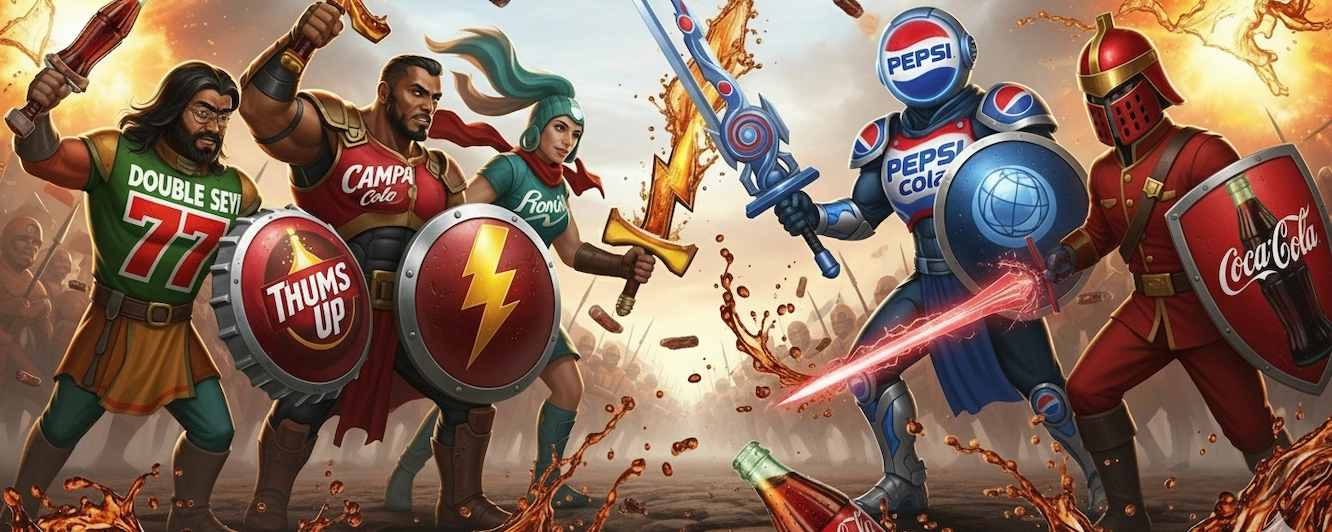
Today, if you order a cold drink in a restaurant, the first name that comes to mind is Coca-Cola or Pepsi. But did you know, there was a time in India when Coca-Cola was shown the door? A time when Desi cola brands ruled the Indian market.
It was not just a business competition, but the story of India’s self-reliance, Swadeshi struggle and new business thinking. This journey had politics, business tricks and a Desi taste that won the hearts of millions of Indians.
This is the story of Campa Cola, Thums Up and Double Seven (77). Born in a special political and economic environment, they made their unique identity in the Indian market.
Let’s open the bottle of this ‘Indian Cola’ and taste the spicy and bubbly taste of its history!
1977: Coke’s departure
Coca-Cola had tremendous market dominance in India in the 1970s. From shops in small towns to big restaurants, its bottles were sold in abundance. When the Janata Party government came to power in 1977, things suddenly changed.
The new Industry Minister George Fernandes instructed Coca-Cola that if they wanted to stay in India, they would have to follow the ‘FERA law’ (Foreign Exchange Regulation Act). According to this law, foreign companies had to hand over a large part of their business in India to Indian partners and reveal their trade secrets to the government.

This was an impossible condition for an American company. For them, their ‘secret formula’ was their biggest strength, and they could not share it under any circumstances. They refused to accept the government’s conditions and closed their business in India.
With this, a big void came in the soft drink market in India. But this void did not last long. Indian entrepreneurs and the government saw it as an opportunity and started preparing to launch local brands.
Double Seven (77): Indian Government’s Cola
Soon after Coca-Cola left India, the government decided that the Indian market would not be left without cola drinks. Modern Food Industries Limited (MFIL) was given the responsibility to prepare a new drink, which would be completely Indian.
Now the biggest problem was what to name this new drink.
Someone suggested, “Aazadi!”
Someone said, “Swadeshi Cola!”
But all these are very heavy names. Then a smart person suggested,
“Coke went out in the year 1977, so why not name it ‘Double Seven (77)’!”
Thus, the new drink was named Double Seven (77). It was seen as a symbol of self-reliance and the historic victory of the Janata Party government in 1977.
Double Seven (77) was produced in government factories in Delhi and Ghaziabad.
Market Adoption of Double Seven (77)
Now since it was a government project, it would not be wrong to think that there were many government twists in it.
First Twist: Desi Taste
Double Seven (77) did not have the punch of Coca-Cola. Its flavour profile was tailored to have a better compatibility with Indian food. Due to this, it was made a little sweeter and it went very well with spicy Indian food.
Second Twist: Sarkari (Government) Touch in Marketing
The government presented Double Seven (77) as the ‘nationalist cola’. People drank it proudly as if it were patriotic juice!
Double Seven (77) bottles started appearing in government offices instead of tea. Double Seven (77) also started selling in large numbers at railway stations and bus stands.

However, being a government product, it lacked commercial thinking and aggressive marketing. People started seeing it as ‘Government Cola’ and slowly its appeal started fading.
Campa: Pure Drinks Enters the Fray
While Double Seven (77) was a government initiative, Campa was an ambitious project of an Indian company. It was launched in 1977 by Pure Drinks Group, which had been the official bottling partner of Coca-Cola in India since 1949.
When Coke pulled out of India, the owners of Pure Drinks Group felt they could fill the void with their brand. They launched Campa Cola in the Indian market using their old bottling factories.
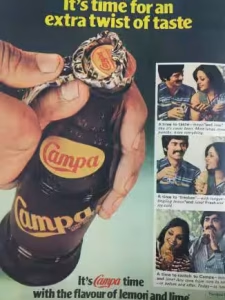
Campa used nationalistic slogans like ‘The Great Indian Taste’ in its promotion, which made it extremely popular. It tasted similar to the Coke and was especially liked in North India. It soon became an iconic brand.
Thums Up’s Masculine Entry
Founded in 1949 by the Chauhan family, Parle was a big company in the biscuit and soft drinks sector. They already had popular soft drinks like Gold Spot and Limca. In 1977, Parle launched its cola brand Thums Up.
The biggest attraction of Thums Up was its ‘more fizz and stronger taste’. It was specially made keeping in mind those Indian consumers who liked a sharp and strong taste after spicy food.

It was produced in bottling plants in Mumbai, Nagpur, Hyderabad and Bangalore. Thums Up’s ‘Taste the Thunder’ tagline and strong advertisements made it immensely popular among the youth.
This cold drink became a ‘masculine’ brand, which even Coke and Pepsi had to face a tough time competing with.
Niche Market of Non-Cola Drinks
While cola drinks dominated the market, Parle and other companies also created a niche in drink with different flavours.
Gold Spot was a fun and bubbly, orange-flavoured drink that was a hit among the youth. Limca was a lemon-spiced flavoured drink that was extremely popular, especially in the summers.
In the 1980s, another lemon-infused carbonated drink called Citra came into the market, which was exceedingly popular in the 90s.
Apart from this, mango-based drinks like Maaza and Frooti were also highly successful, which gave a new dimension to the Indian cold drink market.
Pepsi’s Indirect Entry
In 1988, Pepsi thought of entering India. According to the then rules, any foreign company could invest only if it benefited Indian agriculture and industry. To deal with this challenge, Pepsi formed a joint venture with the Punjab government and Indian companies (Punjab Agro Industries and Volcan Industries) called ‘Pepsi Foods Ltd’.
Under this partnership, Pepsi promised to invest in tomato processing and potato farming. However, the government did not allow them to use the ‘Pepsi’ brand, so in 1990 Pepsi launched its cola called ‘Lehar Pepsi’. This was the first blow to the Indian brands.

‘Lehar Pepsi’ attracted the Indian youth as soon as it came. After economic liberalization in 1993, Pepsi bought the stake of its Indian partners and completely transformed ‘Lehar Pepsi’ into ‘Pepsi’.
With this, Pepsi started competing directly with Thums Up and other domestic brands. This event started a new era in the Indian softdrink market.
Coca-Cola’s Return: Big Bet, Bigger Competition
Coca-Cola made a strong comeback in India in 1993. But this time they were not just back in the market, but to completely rule it. To strengthen its strategy, it acquired Parle’s popular brands, Thums Up, Limca and Gold Spot.
This was a masterstroke as it not only gave them a strong distribution network but also an already established trusted brand among Indian consumers.
The re-entry was a huge blow from which the Indian brands never recovered. Soon a fierce two-way battle between Pepsi and Coca-Cola ensued in the Indian market.
And there was no place for Indian brands in this battle!
End and Rebirth of Indian Brands
In the 90s, sales of Double Seven (77) started declining and in 1994 Modern Food Industries discontinued its production.
Coca-Cola tried to gradually weaken Thums Up, but the strong image of ‘Taste the Thunder’ kept Thums Up connected with Indian consumers. Eventually, they decided to retain it as a strong rival brand.
Campa Cola’s production was discontinued around 2000-2001. Recently, it has been re-launched by Reliance.
Some people believe that Double Seven (77) should also be re-launched.
Do you think Indian cola brands can make a comeback in the market?
Let us know your thoughts in the comments!
I am positive that you found this story interesting and informative!
Please subscribe to my blog by filling in your details below:
My blog has countless such articles and stories to guide you and quench your thirst for knowledge.
You can also follow me on X and Facebook to read more such stories and posts.
PS: Copilot and ChatGPT have been used to create parts of this post.
Leave a Reply