

THE 50-WORD SUMMARY: Filter out the noise to protect organisational momentum. Most companies fail not from a lack of opportunity, but from “priority dilution.” By building a strategic “No Muscle” and applying a three-layer Decision Filter, leaders can shield their Makers from low-value distractions and institutionalise high-impact execution.
Most successful companies do not fail due to a lack of opportunities; they gradually suffocate under the weight of too many.
We are conditioned to believe that growth is additive: more clients, more features, more initiatives. For a strategic leader, however, the equation is inverted. Sustainable momentum is not built by addition, but by filtering. It is the outcome of a well-developed “No Muscle” that safeguards your organisation’s most finite resource: collective focus.
Every time a low-value, high-distraction initiative slips through, it taxes the velocity of your most critical strategic priorities. You introduce operational noise that drowns out the signal of your core mission.
If your teams are sprinting without advancing, working harder yet moving the needle less, the issue is not productivity. It is the absence of a robust filter.
To reclaim your 20-Mile March and protect your margins, you need more than incremental prioritisation. You need a Strategic Filtering Framework that acts as an institutional guardrail against mediocrity.
The High Cost of the ‘Yes’ Culture
During phases of organisational scaling, growth becomes the dominant driver. Leaders, in pursuit of expansion, often default to saying yes to every incoming opportunity.
In doing so, they onboard clients and initiatives that are misaligned with their vision and mission. Once embedded, these decisions are difficult to reverse without immediate impact on the bottom line.
The cumulative effect is priority dilution. The organisation gradually drifts from its intended trajectory, leading to missed opportunities, constrained growth, and financial leakage.
Think of it as loading a high-performance engine with low-grade fuel. The system still runs, but efficiency drops, wear increases, and long-term performance is compromised.
Building the “No Muscle”
To counter this, organisations must deliberately build their No Muscle.
Every decision-maker should have absolute clarity on what the organisation will pursue and, more importantly, what it will decline.
Developing a strong No Muscle is not about resistance; it is about strategic discipline. It institutionalises the protection of your most valuable assets: time, focus, and execution bandwidth. This is achieved by consistently applying a filter to separate noise from the signal.
Before we operationalise this framework, it is critical to clearly define what constitutes noise and signal within an organisation.
Understanding ‘The Noise’ and ‘The Signal’
The Noise
Anything that does not align with the organisation’s current 20-Mile March is noise. It appears in multiple forms, often disguised as opportunity, urgency, or goodwill, making it harder to filter effectively. Typical examples include:
- Vanity Projects: These include favours, feel-good initiatives, obligations, and IOUs. While they may serve short-term optics or relationships, they deliver negligible business value, yet declining them often feels politically expensive.
- Emergency Requests: Constant firefighting situations that consume leadership bandwidth, leaving little room for strategic thinking or structured decision-making.
- Good Ideas That Don’t Align: Seemingly attractive or even profitable ideas that are either premature or misaligned with the organisation’s current strategic priorities.
If left unchecked, this noise compounds into execution drag, steadily eroding focus, speed, and strategic clarity.
The Signal
Signal represents activities that directly enhance margins, deliver measurable outcomes, and strengthen long-term strategic positioning. These are the initiatives that must pass through your filter with priority. Key examples include:
- Strategic Projects: Initiatives that directly contribute to the organisation’s long-term strategic roadmap and defined growth trajectory.
- Competence Building: Investments that strengthen organisational capabilities, deepen expertise, and build a resilient talent pipeline.
- Competitive Advantage: Projects that create differentiation and strengthen the organisation’s position within the market landscape.
Signal compounds into sustained momentum or the flow, reinforcing clarity, capability, and competitive strength.
Today’s Noise could be Tomorrow’s Signal
It is critical to recognise that what appears as noise today may evolve into a signal tomorrow. Building the “No Muscle” is not about rejecting ideas outright; it is about applying the right filter to prioritise what matters now without losing sight of future potential.
Consider a manufacturing firm that deferred investing in EV components 10 years ago, as it did not align with its immediate revenue priorities. A few years later, the same space became a high-growth strategic opportunity with stronger demand and internal readiness. What was once noise had clearly become a signal.
The lesson is simple: strong leaders do not discard ideas; they sequence them through the right filter based on timing and strategic fit.
Developing the Decision Filter: Strengthen Your No Muscles
The No Muscle, like any other, requires consistent conditioning. Without deliberate effort, it weakens under pressure, leading to poor decision quality.
Leaders build this muscle through a structured decision filter framework. Every opportunity, request, or initiative must pass through this filter to determine whether it is noise or signal.
An effective decision filter operates across three critical layers:
1. Strategic Alignment
Before committing, pressure-test the decision against your strategic priorities:
- Does this move the needle on our Q1/Q2 objectives?
- Will this create a tangible competitive advantage?
- Is this aligned with our long-term strategic vision?
If the answer is consistently no, the initiative is likely noise and should be filtered out. Misaligned decisions dilute focus and fragment execution.
2. Resource Capacity
The next layer filters whether you have the “Maker’s Schedule” space to execute the decision without compromising high-value work.
Assess your available capacity, including latent bandwidth and underutilised or “ghost assets.” Will this initiative optimise resources or strain them?
Once resource utilisation crosses 80%, systems begin to experience diminishing returns. Throughput slows, quality dips, and teams enter reactive mode.
If the decision stretches your capacity, it must be filtered or deferred until you can strategically invest in capability expansion.
3. ‘Little’s Law’ Check
As per Little’s Law, Work in Progress (WIP), Throughput, and Lead Time are intrinsically linked.
Adding more work to an already saturated pipeline does not increase output. It increases lead time, resulting in delays, reduced throughput, and compromised customer experience.
Such decisions should be filtered and treated as capacity-building interventions, not routine operational additions.
To explore Little’s Law further, refer to my blog – The Flow Audit: How to Spot and Clear Your Team Bottlenecks.
Pro Tip: Even with a robust filter, some noise will demand a “yes” due to urgency or obligation. The advantage of a strong decision filter is awareness. You engage selectively, allocate resources deliberately, and define clear exit points to protect your strategic momentum.
Understanding the ‘Maker vs Manager’ Execution Conflict
Every organisation operates with two distinct execution archetypes: Makers and Managers. Each functions differently and therefore consumes bandwidth in fundamentally different ways.
Makers are the creators, engineers, designers, operators, and auditors. Their output depends on long, uninterrupted stretches of work. High performance for them is driven by deep focus, cognitive immersion, and minimal fragmentation.
Managers, on the other hand, are leaders, executives, and coordinators. Their roles revolve around meetings, decisions, reviews, and communication. Their schedules are inherently fragmented into time blocks, making context switching unavoidable.
How Noise Impacts Each Differently
When Makers are exposed to noise in the form of low-value or misaligned work, the impact is immediate and visible. Efficiency drops, WIP increases, and rework multiplies. This quickly translates into delayed deliveries, rising customer complaints, and lost revenue.
Research suggests that for a Maker, a single ‘quick’ 15-minute interruption can cost up to 45 minutes of recovery time before they regain ‘Flow’ state. In a noise-heavy environment, your Makers are never actually making; they are constantly recovering.
For Managers, the impact is more subtle but far more strategic. Noise consumes bandwidth meant for high-value thinking. Over time, this leads to erosion of strategic clarity, weakened competitive positioning, and the accumulation of decision debt.
Standardising the Filtering Process
When designing your decision filter or “Vetting Process,” it is critical to balance the needs of both Makers and Managers. Protecting one while ignoring the other can disrupt overall execution flow.
For example, as a leader, you may introduce frequent review meetings to stay aligned (manager-centric signal). However, if these are not filtered, they fragment Maker schedules, reducing deep work and slowing execution.
Conversely, if you eliminate reviews entirely, it may protect Makers but create strategic blind spots for Managers.
Pro Tip: Apply a balanced filter that protects deep work while preserving strategic oversight, ensuring both execution speed and decision quality.
Filtering Framework: Establishing Your ‘Gatekeeper’ Protocols
I propose a three-step filtering framework that not only clears your existing noise backlog but also prevents its future accumulation
Step 1: Clearing the Deck
Start each month by resetting your execution slate. List all ongoing projects within your current backlog and conduct an Impact–Effort audit.
Here, impact reflects the short- and long-term value to the organisation, while effort captures the resources, time, and execution bandwidth required.
Plot each initiative on a 2×2 matrix and apply your filter:
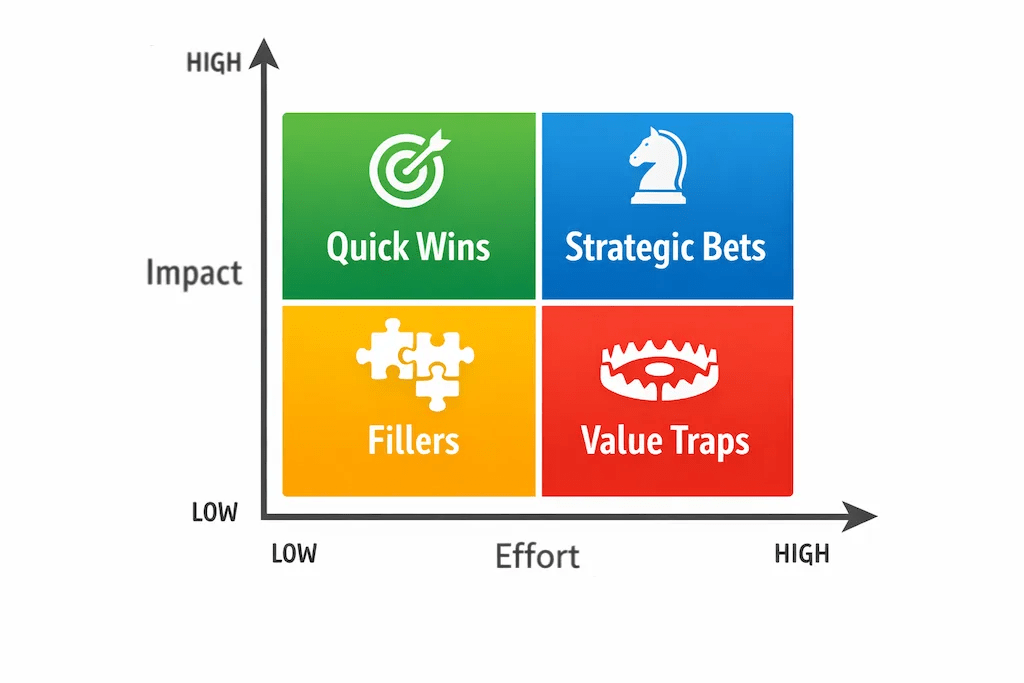
- Quick Wins (High Impact / Low Effort): Green Light
- Strategic Bets (High Impact / High Effort): Planned Investment
- Fillers (Low Impact / Low Effort): The Stealth Drain
- Value Traps (Low Impact / High Effort): The ‘No’ Zone
This step establishes clarity, eliminates clutter, and sharpens execution focus.
Step 2: Mid-month Pause
Even with a strong filter, some noise, particularly fillers, will slip through.
Build a deliberate mid-month checkpoint to identify these low-value initiatives. Reassess earlier assumptions, prune non-essential work, and refine your filtering criteria.
For example, your team might have initiated a minor reporting enhancement, assuming quick gains. Midway, it begins consuming disproportionate effort with limited business impact. A timely pause allows leadership to de-scope or halt, preventing further resource drain.
This step ensures continuous calibration and protects execution bandwidth.
Step 3: Strategic Backcasting
At month-end, shift focus to forward planning using strategic backcasting.
Start with your December 2026 goal and work backwards. Evaluate whether each proposed initiative aligns with this trajectory before allowing it to pass through your filter.
A new partnership opportunity appears attractive in isolation. However, when backcasted against the long-term strategy, it lacks alignment with core capabilities. The filter flags it as noise, and it is deferred.
We have discussed Strategic Backcasting in detail in the blog Strategic Backcasting: Secure 2027 Vision with 2026 Actions, which offers deeper insights.
Pro Tip: Institutionalise your filter as a non-negotiable discipline. When consistently applied, it enables leaders to eliminate noise, prioritise signal, and protect long-term strategic momentum.
Stories of Recovery from the Silent Margin Killers
Apple’s Product Line Simplification

In the late 1990s, Apple Inc. was on the brink of collapse, weighed down by a fragmented product portfolio filled with overlapping and low-performing offerings. When Steve Jobs returned, he applied a ruthless filter. Nearly 70% of ongoing products and projects were eliminated, including several “promising” but non-core initiatives.
Jobs reduced the portfolio to a simple 2×2 grid, focusing only on high-impact products aligned with Apple’s core strategy. This sharp removal of distraction projects improved operational efficiency, reduced costs, and allowed deeper focus on innovation.
The result was a dramatic turnaround, with improved margins, faster execution cycles, and the eventual launch of category-defining products like the iMac.
My Take: Margin expansion often begins not with adding more, but by applying a disciplined filter to eliminate what does not truly matter.
Ford’s ‘One Ford’ Strategy

In the mid-2000s, Ford Motor Company was struggling with declining profitability and a bloated portfolio of regional models and redundant initiatives. Under CEO Alan Mulally, the company introduced the “One Ford” strategy.
A strong filter was applied to eliminate fragmented product lines and region-specific distractions. Ford reduced complexity by focusing on fewer global platforms, cutting down engineering duplication and operational inefficiencies.
This strategic pruning led to significant cost savings, improved scale efficiencies, and a steady rise in operating margins without chasing aggressive expansion.
My Take: When leaders align execution with a clear filter, removing internal noise can unlock far greater value than chasing new opportunities.
Conclusion: Leadership Discipline is a Competitive Advantage
Ultimately, the buck stops at the leader’s table. You are the one signing on the dotted line, and your decisions define the organisation’s trajectory.
A leader’s true legacy is shaped not just by what they pursue, but by what they choose to decline. The ability to apply a disciplined filter and say “no” to noise is what separates effective leadership from reactive management.
By building a rigorous and bespoke filtering framework, you can channel your energy towards quick wins and strategic bets, while systematically eliminating value traps and fillers.
In the end, success is not a function of effort alone, but of impact creation. Your No Muscle is the ultimate safeguard of your team’s focus, momentum, and execution excellence.
Tomorrow morning, look at your calendar. Identify one ‘Filler’ project and apply your No Muscle. Delete it, delegate it, or defer it. Experience the immediate return of your momentum.
If you found this perspective useful, consider subscribing to my blog by sharing your email below. You will receive regular insights on strategy, leadership, and building sustainable systems.
Stay Connected: For short-form thoughts and business storytelling, follow me on X and Facebook for regular updates.
Beyond the Blog: If stories of power, ambition, and passion interest you, explore my books on Amazon. They examine the fine line between success and surrender, and the choices that define both.


Leave a Reply