
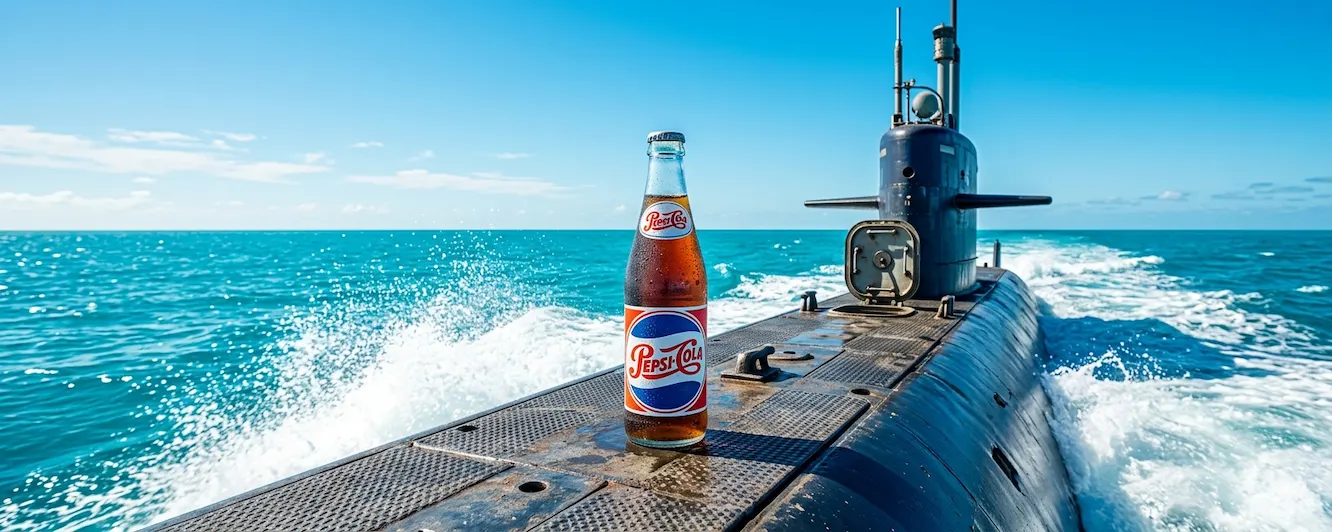
THE 50-WORD SUMMARY: Resilience isn’t just about survival; it’s about resourceful Asset-Velocity. By bartering 17 submarines for soda, the USSR avoided a Capital-Heavy crisis, turning Idle Assets into growth. This case study proves that even nations must look within, monetising “dead metal” to fund expansion without relying on external cash reserves.
A naval fleet is the ultimate symbol of a nation’s sovereign strength, until it becomes the currency for a soft drink.
An armada of submarines, aircraft carriers, frigates and destroyers can tilt the balance of power and rattle the confidence of any adversary. Beyond warfare, naval forces guard sea lanes, protect cargo movement, and keep pirates and unlawful actors at bay.
In many ways, a navy embodies a nation’s strategic resilience. It protects sovereignty, secures trade routes, and ensures that the lifeblood of global commerce keeps flowing. But here is a strange question:
“Can a navy help a country buy soda?”
It sounds absurd, almost outrageous. Yet one of the most remarkable episodes of modern business history proves that it can.
This is the story of an extraordinary resilience-driven barter deal, where a struggling superpower and an ambitious beverage company found common ground. A deal so unusual that, for a brief moment, Pepsi became one of the world’s largest naval powers.
The Sugar Craving Without the Cash
In 1989, the Cold War was slowly thawing. Political tensions between the United States and the Soviet Union were easing, but the Soviet economy remained stubbornly frozen in inefficiency.
Factories suffered from resource stagnation, supply chains faltered under bureaucratic weight, and consumer goods were often scarce on store shelves. Yet amid these shortages, one Western product had quietly become a sensation across the Soviet Union.
That product was Pepsi-Cola. In a country where consumer choice was limited, Pepsi felt refreshing not only in taste but also in symbolism. It represented a small sip of the outside world.
But popularity alone does not sustain a business.
Behind the growing demand lay a stubborn economic obstacle. The USSR craved Pepsi, and Pepsi wanted to expand in the USSR, but the Soviet system had a fundamental problem.
It had no hard currency. Their need for a cashless deal led to a barter that became a case study in resilience.
The Soviet Resilience Crisis of the 1980s
In the 1980s, the Soviet Union operated under a tightly controlled economic system. Its currency, the Soviet Ruble, was non-convertible, meaning it could not easily be exchanged for US dollars or other international currencies.
This structural limitation quietly weakened the country’s economic resilience. The world traded in hard currency, but the Soviet system remained trapped inside its own financial perimeter.
For Western businesses eyeing the Soviet market, the situation was puzzling. Demand existed, scale existed, yet the basic mechanism of payment did not.
A Market That Wanted Pepsi but Could Not Pay

Pepsi had already solved this puzzle years earlier when the company entered the Soviet market through a creative arrangement built on barter trade.
In an ingenious workaround, the Soviet government granted Pepsi the rights to distribute Stolichnaya vodka in the United States. Pepsi supplied its concentrate to Soviet bottlers, and in return earned revenue from vodka sales in the American market.
The arrangement worked smoothly till the late 1980s; however, the Soviet public’s appetite for Pepsi-Cola grew dramatically. Demand surged, bottling plants expanded, and the vodka arrangement alone could no longer sustain the expansion.
Once again, the Soviet Union faced the same uncomfortable truth. It had a sugar craving, but it still had no dollars.
Engineering a Resilience Pivot
For many companies, this would have been the moment to retreat. Expanding into a market that cannot pay in internationally accepted currency is hardly a wise strategy. But Pepsi’s leadership saw something different.
The USSR, with nearly 300 million consumers, represented one of the largest untapped markets on the planet. Walking away from such an opportunity would have been strategically short-sighted.
So instead of stepping back, Pepsi began searching for a solution of resilience. If the Soviet Union could not pay with money, perhaps it could pay with something else. That simple question prompted Soviet officials to look inward and examine the country’s vast state-owned resources.
What they discovered would transform a routine commercial discussion into one of the most unusual deals in corporate history.
An Economy Rich in Idle Assets
The Soviet Union possessed enormous industrial and military capacity. It had vast factories, sprawling shipyards, powerful defence installations, and one of the largest armed forces in the world.
But by the late 1980s, much of that military hardware had begun to show its age. Advances in technology and shifting defence priorities meant that many older vessels were no longer strategically valuable.
Maintaining them consumed resources. Decommissioning them required effort. From a bureaucratic standpoint, these ageing ships had quietly become idle assets sitting on the national balance sheet. Yet in the world of negotiation, idle assets can sometimes become currency.
And that realisation opened the door to an extraordinary proposal. If the Soviet Union could not pay Pepsi in dollars, it would pay with something it had in abundance: Warships.
The Birth of the Pepsi Navy: 17 Subs for a Sugar Rush
In 1989, PepsiCo finalised a barter agreement with the Soviet government that stunned the global business community. As part of the deal, the Soviet Union transferred an entire fleet of naval vessels to Pepsi.
The fleet included 17 Whiskey-class submarines, along with a cruiser, a frigate, and a destroyer.
For a brief and surreal moment, the soft drink company effectively owned one of the largest naval fleets in the world. The media quickly seized upon the story, giving it a memorable nickname: the Pepsi Navy.
The image was irresistible. A multinational beverage company controlling submarines that once patrolled Cold War waters. Of course, Pepsi had no intention of launching maritime operations.
The ships were never meant to be used as military assets. They were simply a creative form of payment. Yet the symbolism of the deal was too amusing to ignore.

During discussions with American officials, Pepsi CEO Donald Kendall famously joked to the US National Security Advisor:
“We’re disarming the Soviet Union faster than you are.”
A Deal Unlike Any Other
The negotiations themselves were unlike any typical corporate transaction. Instead of discussing interest rates or currency conversions, executives and officials were discussing submarine classes, naval tonnage, and ship transfer logistics.
The conversation sounded more like a defence briefing than a commercial meeting. Yet beneath the unusual details lay a very practical economic strategy. The vessels themselves were no longer valuable as military tools. But they were made from materials that had global demand.
Steel, copper, and industrial alloys still carried significant value. The ships were not weapons anymore. They were simply floating scrap metal. And scrap metal could easily be turned into money.
Turning Dead Metal into Real Value
Pepsi quickly arranged for the vessels to be sold for scrap through international partners. The ships were transferred to ship-breaking yards in Norway, where they were dismantled and recycled.
Steel plates were melted down for industrial use. Copper wiring and other valuable components were salvaged. The once-formidable war machines of the Cold War were gradually reduced to raw materials.
In business terms, Pepsi and the USSR had achieved something remarkable. They had converted obsolete military hardware into growth capital. What had once been instruments of geopolitical power were now helping finance the expansion of a soft drink brand.
Resilience Lesson: Even Nations Look Within for Growth
This remarkable episode offers a simple but powerful lesson in resilience.
When conventional solutions fail, even superpowers and corporate giants are forced to look inward for answers. The USSR–Pepsi deal is a vivid reminder that growth often hides in places we overlook.
This story demonstrates a few enduring truths:
- Even powerful nations like the USSR and global corporations like Pepsi sometimes need to look within their own systems to unlock growth.
- When adversity tightens the screws, what appears absurd at first glance may turn out to be the most practical solution.
- Instead of rushing to banks for loans, mid-sized companies can often create momentum by monetising idle assets and underutilised resources.
In other words, resilience is not always about raising new capital. Sometimes it is about discovering value in what already exists.
The Capital-Light Growth Blueprint
I explored this idea in greater depth in my blog, Resilience Strategy: The Capital-Light Growth Blueprint.
In that piece, I discussed how leaders must gradually shift away from CAPEX-heavy expansion models toward a capital-light growth strategy. Such an approach encourages organisations to look inward before knocking on the doors of banks or investors.
When executed well, this mindset creates an internal marketplace of resources. Teams begin pooling, sharing, and even bartering capabilities that would otherwise remain idle.
The result is a business that becomes nimble, resilient, and self-reliant, with far less dependence on external capital.
USSR’s Macro-Resilience
The USSR wanted Pepsi badly, but its earlier vodka barter workaround had run its course. With no hard currency available, Soviet planners were forced to look inward.
That search led them to a rusting naval inventory that was no longer serving a strategic purpose but continued to consume resources for upkeep and maintenance.
By monetising these idle naval assets in the Pepsi deal, the USSR extracted better value from dormant infrastructure while also avoiding future maintenance and disposal costs.
The Strategic Resilience of Unconventional Liquidity
Sometimes resilience emerges not from strength, but from the willingness to rethink value.
In 1989, the USSR’s thirst for Pepsi and its shortage of hard currency forced exactly that kind of strategic rethink.
The “Ego-Exit” Strategy
The USSR’s decision to trade warships for Pepsi syrup was a masterclass in humility over optics. On the surface, it sounded absurd. Yet beneath that headline lay a strategic act of economic resilience.
In the boardroom, the Pride Trap manifests as ‘The Legacy Project’. Assets that no longer serve the mission but are protected because of the political capital spent to acquire them. Resilience requires the humility to trade a ‘Cruiser’ for ‘Syrup’ when the syrup is what fuels the future.
The Soviet fleet involved in the deal was ageing and expensive to maintain. Its strategic relevance had already faded.
Instead of preserving appearances, Soviet planners chose pragmatism. They realised that sometimes a submarine is more valuable as currency than as a weapon, turning idle naval assets into economic leverage.
Velocity Over Value
Traditional strategy focuses on the value of assets on a balance sheet. Ships, factories, and machinery are recorded as static numbers that rarely move beyond financial statements.
But capital-light resilience operates on a different principle: velocity. An asset gathering rust creates no momentum. An asset in motion creates opportunity.
By bartering its ageing fleet, the USSR converted static steel into flowing commerce. Submarines that once rested in naval docks were suddenly enabling Pepsi’s expansion across the Soviet market. A disciplined, capital-light march, rather than a reckless gamble.
Idle metal became an active trade. This is the essence of resilience. It is not merely about surviving constraints, but about keeping resources moving and generating value.
The “Option B” Infrastructure
Pepsi’s Soviet strategy revealed another dimension of resilience. The company did not depend on a single financial channel. Instead, it built an alternative commercial ecosystem.
First came the vodka-for-soda arrangement, where Stolichnaya vodka bridged Soviet production and American consumers. Later came the naval barter deal. Together, these moves created a secondary supply chain based on barter, surplus assets, and creative logistics.
The insight is simple: redundancy through variety. If cash is the only payment method, the system has a single point of failure.
But when organisations can exchange surplus capacity or idle assets, they become truly adaptable.
Resilience, after all, is rarely about having more resources. It is about seeing value where others see surplus and turning dormant assets into momentum.
Conclusion: The Triumph of Creative Constraint
The story of the Pepsi Navy is a compelling lesson in resilience and strategic creativity. The USSR craved Pepsi, and Pepsi wanted to expand in the USSR, but the absence of hard currency forced both sides to rethink the rules of conventional trade.
Instead of abandoning the opportunity, they looked inward and discovered value in idle naval assets. Submarines and warships that once symbolised military power quietly became instruments of commerce, helping Pepsi expand across the Soviet market.
The real takeaway is simple. When resources appear scarce, resilience begins by reimagining the assets you already possess.
I will sign off with a simple three-step weekend checklist you can review and begin acting on from Monday:
- Step 1: Spot your “Non-Convertible Rubles” – resources you aren’t using.
- Step 2: Find a partner whose “Syrup” matches your surplus.
- Step 3: Think about how you can barter both to fund your growth.
If you found this perspective useful, consider subscribing to my blog by sharing your email below. You will receive regular insights on strategy, leadership, and building sustainable systems.
Stay Connected: For short-form thoughts and business storytelling, follow me on X and Facebook for regular updates.
Beyond the Blog: If stories of power, ambition, and passion interest you, explore my books on Amazon. They examine the fine line between success and surrender, and the choices that define both.
Disclaimer: This article is written for informational and educational purposes only, based on details available in the public domain. It is intended to analyse the event from a strategic and historical perspective. It does not intend to absolve, accuse, or defame any individual, entity, or corporation of wrongdoing, criminal intent, or dereliction of duty beyond what has been documented in historical records and legal proceedings.
Leave a Reply