
THE 50-WORD SUMMARY: In 1983, 61-year-old farmer Cliff Young defeated elite athletes in a 544-mile race using a “boring” shuffle. This narrative explores why Brutal Consistency outperforms Flashy Intensity. For professionals, success isn’t about high-speed bursts; it is about the relentless Operational Flow and the grit to outlast the Middle Miles.
It is the early morning of 27 September 1983 in Sydney. Winter has just stepped aside, but summer has not yet arrived. The air carries a mild coolness that gradually gives way to warmth as the sun climbs higher. Spring in Sydney is known for its clear skies, low humidity, and crisp winds drifting in from the Australian interior.
The Parramatta area was buzzing with nervous anticipation and the unmistakable scent of liniment oil, muscle balm, and a touch of elite ego. Runners had gathered from across Australia for the Westfield Sydney to Melbourne Ultramarathon, a 544-mile endurance race that pushes human stamina to its limits.
Just before the race began, a sixty-one-year-old participant quietly walked into the arena.
And a fascinating duel between brutal consistency and race craft honed through years of practice, data, and planning unravelled.
This is the story of Cliff Young, an old farmer from Victoria, who demonstrated that in a head-to-head contest, consistency can quietly defeat even the most carefully engineered performance.
The Starting Line
Numerous lean and sculpted runners gathered at the starting line. Their calves were tight coils of muscle. Their shoes were light and engineered for speed. Their gear carried the logos of sports brands promising aerodynamic fabrics and superior cushioning.
Some had trainers hovering around them, adjusting laces and discussing pacing strategies.
These professionals approached endurance running with a scientific mindset of the competitive sport. Conversations revolved around heart rates, lactate thresholds, recovery windows, and carefully calibrated energy cycles.
And then there was Cliff Young, who looked like someone who had wandered into the wrong event entirely.
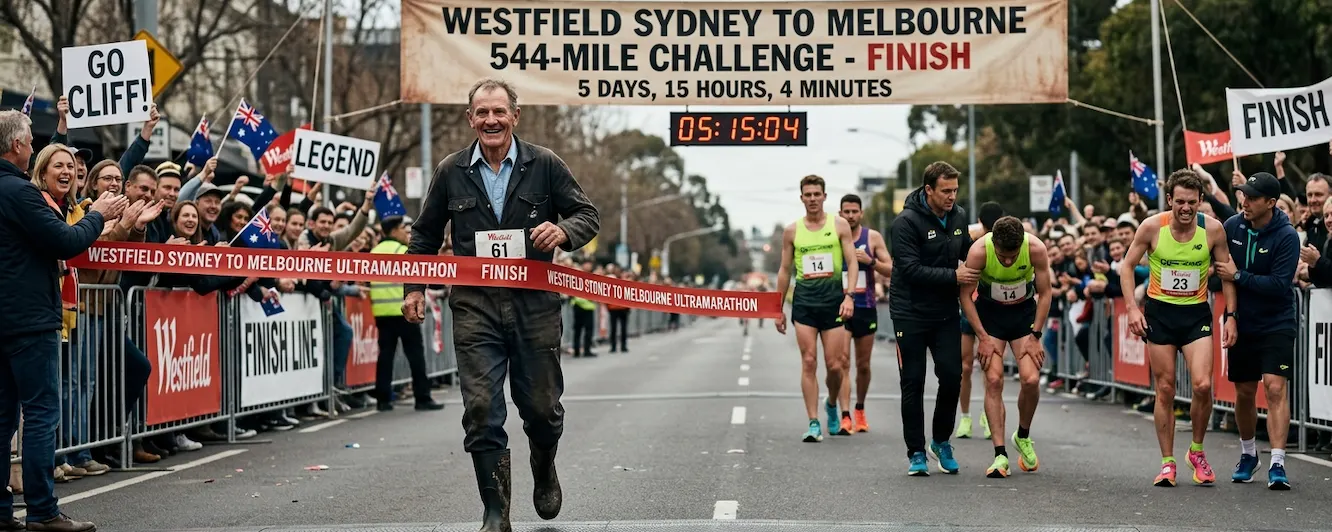
He stood among the runners wearing loose work overalls and gumboots, the kind farmers wear while fixing fences or repairing tractors. His posture was slightly hunched, his frame wiry rather than muscular.
The Contrast: Flashy Speed vs Relentless Consistency
The contrast at the starting line was striking.
The professional runners represented the flashy corporate “sprinters.” The kind who arrive with high-budget launches, dazzling presentations, and a vocabulary full of buzzwords. Operating in bursts, generating immediate momentum and commanding attention.
We see this in every ‘transformation project’ that burns out by Q3 because the strategy relied on heroism rather than habit.
Cliff, on the other hand, symbolised the quiet professional who shows up every day on time and keeps raising the bar one millimetre at a time.
No fanfare. No accolades. Just steady progress.
The professionals relied on speed, strategy, and controlled recovery cycles. Cliff relied on something far simpler: Consistency.
Strategy of the Lump Sprint
The strategy of the elite runners was to run hard for eighteen hours and then stop for six hours. Sleep, recover, reset, and repeat. It was a cycle of high-intensity effort followed by total stasis.
The logic was sound. The human body needs recovery. Muscles require time to repair, and sleep restores mental clarity. By every modern measure of sports science and endurance training, the professionals appeared perfectly prepared for the 544-mile ultramarathon.
Cliff Young, however, came from a very different school of life.
He had grown up on a sheep farm, a rugged land of rolling fields and unpredictable weather. When storms swept across the countryside, sheep scattered across miles of land. When that happened, someone had to gather them.

That someone was usually Cliff. Sometimes it took two days. Sometimes three. During lambing season, when storms arrived without warning, it could take even longer. Cliff would simply start moving and keep moving until every sheep was safe. Sleep was optional. He did what the work required.
To Cliff, the Sydney to Melbourne race did not look extraordinary. It simply looked like a very long job that needed to be finished. And he knew that when work stretches across days, consistency is more valuable than speed.
The Corporate Mirror
Interestingly, the strategy of the elite runners mirrors the “Big Push” culture of modern workplaces. Teams launch into intense bursts of activity filled with brainstorming sessions, frantic meetings, and ambitious go-to-market strategies. All engines run at full throttle.
Then the initial euphoria fades, burnout creeps in, and exhaustion takes over until the next surge begins. The fundamental flaw is that high-intensity bursts create forced breaks in momentum.
Every time the professionals stopped to sleep, they had to restart their engines from zero. A surprising amount of strength was spent in restarting and rebuilding the momentum.
Cliff’s consistency circumvented the stop-start cycle. He kept moving slowly, steadily and relentlessly.
Young Shuffle: An Arithmetic of Consistency
The starting gun fired.
The professionals surged forward instantly with their long and explosive strides. Their movements were rhythmic, controlled, and purposeful. They looked powerful and efficient, like finely tuned machines built for endurance racing.
Cliff Young started moving too. But he did not run the way runners normally run. He shuffled.
His feet barely lifted from the ground. His arms hung loosely by his sides. His stride was short and awkward, almost like someone trying not to wake a sleeping baby. The crowd chuckled. A few spectators even laughed openly.
The professionals soon disappeared down the road while Cliff trailed. His slow shuffle was steady but unimpressive. No one expected the old farmer to last even a day in the 544-mile ultramarathon.
As the race settled into its rhythm, the professionals executed their strategy exactly as planned. They ran hard for eighteen hours, covering enormous distances with impressive speed. Then they stopped.
Meanwhile, somewhere down the long dark highway, Cliff Young kept moving. He shuffled through the night. There was no sleep. No support team. No carefully designed recovery plan.
Just Cliff and the road.

When race officials eventually caught up with him and said, “Cliff, you should stop and sleep,” he looked genuinely surprised.
“We’re allowed to sleep?” he asked.
Cliff had assumed the race worked the same way farm work did. You start when the job begins, and you stop when the job is done. So while the elite runners slept, Cliff kept shuffling.
His pace was not fast. But it never stopped. And in the quiet arithmetic of endurance, consistency begins to defeat speed.
The Professional Metaphor
This is the part most professionals underestimate. The boring work.
The documentation that nobody celebrates. The follow-ups that quietly keep projects alive. The small incremental improvements, the Poka-Yoke safeguards, the steady tightening of systems and processes.
Cliff’s shuffle was his Poka-Yoke; by barely lifting his feet, he mistake-proofed his gait against the fatigue and injury that high-impact strides guaranteed.
None of it looks glamorous. There is no dramatic sprint to the finish line, only consistency and a quiet refusal to stop.
Middle Miles and the Breaking Point
The race began turning brutal by day three.
The professionals started experiencing the hidden consequences of their aggressive pacing. Shin splints appeared. Muscles tightened. Tendons inflamed. Some runners even developed stress fractures.
The speed that felt like a competitive edge on Day 1 became a tax on Day 3. A tax paid in swollen joints and depleted willpower. Every explosive stride multiplied the stress on joints and ligaments. The cost of intensity, once invisible, demanded payment.
Meanwhile, Cliff Young continued shuffling.
Slow. Steady. Almost invisible.
He ate simple food. Occasionally, he slept for a few minutes in chairs or by the roadside. But for the most part, he simply kept moving. And gradually, something astonishing began happening.
The gap began closing. By the fourth day, spectators along the route began whispering among themselves.
The old farmer was catching up. The shift did not look dramatic. There was no surge of blistering speed, no heroic sprint toward glory. It was simply the quiet mathematics of endurance: Consistency versus intensity.
Cliff’s slow pace began steadily devouring the professionals’ early lead, one mile at a time.
The man who had been treated like a joke now became the centre of attention. Cameras followed him along the road. Crowds gathered along the highways just to witness the strange Young Shuffle that was quietly defeating elite athletes.
And somewhere along those long Australian roads, a deeper truth about consistency was beginning to unfold.
The Mental Weight
Cliff faced multiple constraints.
His age, lack of sophisticated gear, and the public mockery. In many ways, these are similar to the constraints professionals face in their own workplaces: red tape, outdated systems, and office politics.
The instinctive reaction is often to bulldoze through these obstacles with speed and intensity.
But the real advantage lies in consistency. The quiet discipline of showing up every day. The patience to tolerate monotony. The resilience to tackle one obstacle at a time without losing rhythm.
Because in the long run, brutal consistency almost always outlasts flashy but sporadic performance.
The Finish Line: 5 Days, 15 Hours, 4 Minutes
Finally, after five days, fifteen hours, and four minutes, Cliff Young reached Melbourne.
He crossed the finish line first, and the crowd erupted.
The record for the Sydney to Melbourne ultramarathon had been beaten by nearly two full days. It instantly became one of the most improbable victories in endurance sports history.
Yet the real story was not about speed.
Cliff Young had not won because he was fast. He had won because his consistencywas more efficient than their speed.
The professionals had mastered intensity in spectacular bursts. Cliff mastered something far more powerful: Relentless consistency.
The Prize
When reporters surrounded Cliff at the finish line, one of them asked, “How does it feel to win the ten-thousand-dollar prize?”
Cliff looked puzzled. He had not known there was prize money.
When the organisers explained the award, he paused for a moment and then made a quiet decision. Cliff divided the prize money among the other runners. In his view, they had worked just as hard as he had.
Cliff Young had never entered the race for fame, money, or spectacle. To him, the event had simply been another long stretch of road, another job waiting to be completed.
Professional Insights on Consistency
The story of Cliff Young offers powerful lessons in how consistency quietly defeats intensity. In business, careers, and execution, the same rule often applies. The winners are rarely those who sprint the fastest. They are the ones who refuse to stop moving forward.
Process vs Progress Trap
In many organisations, people become trapped in “the way things are done.” The elite runners in the race followed a perfectly logical formula: run hard for eighteen hours and sleep for six. It was structured, scientific, and widely accepted.
Cliff’s quiet shuffle challenged orthodoxy. He devised a sustainable method that allowed him to keep moving. In professional life, we often confuse process compliance with real progress. Excellence sometimes requires ignoring the playbook and finding a rhythm that sustains momentum.
Compound Effect of the Shuffle
Cliff’s pace never looked impressive. There were no dramatic surges. No moments of spectacular acceleration. But his consistency created something far more powerful: compounding progress.
In professional development, the same principle quietly governs growth. A 1% improvement repeated daily produces far greater results than a sudden 50% surge followed by burnout. The slow accumulation of effort eventually overtakes sporadic brilliance.
Operational Excellence and the Power of Flow
Another lesson from Cliff’s victory lies in the principles of operational excellence.
Concepts such as Little’s Law or Poka-Yoke teach us that efficiency rarely comes from pushing people to move faster. Instead, it emerges when systems eliminate friction and minimise unnecessary stops.
The professional runners focused on speed. Cliff focused on flow. In operational terms, he reduced the interruptions in the system. Over time, that uninterrupted flow proved far more efficient than repeated cycles of acceleration and recovery.
The Thursday Epilogue: Your Friday Shuffle
The deeper insight from this remarkable story is simple. In the long run, brutal consistency almost always outperforms flashy but sporadic performance.
As you head into the weekend, here is a thought worth carrying with you.
In which area of your work are you trying to sprint through a 500-mile problem?
Once you identify that area, plan your next pivot. Not a dramatic leap, but a sustainable shift in rhythm.
Remember, the overalls and gumboots are optional.
But consistency is not.
If you found this perspective useful, consider subscribing to my blog by sharing your email below. You will receive regular insights on strategy, leadership, and building sustainable systems.
Stay Connected: For short-form thoughts and business storytelling, follow me on X and Facebook for regular updates.
Beyond the Blog: If stories of power, ambition, and passion interest you, explore my books on Amazon. They examine the fine line between success and surrender, and the choices that define both.
Leave a Reply