
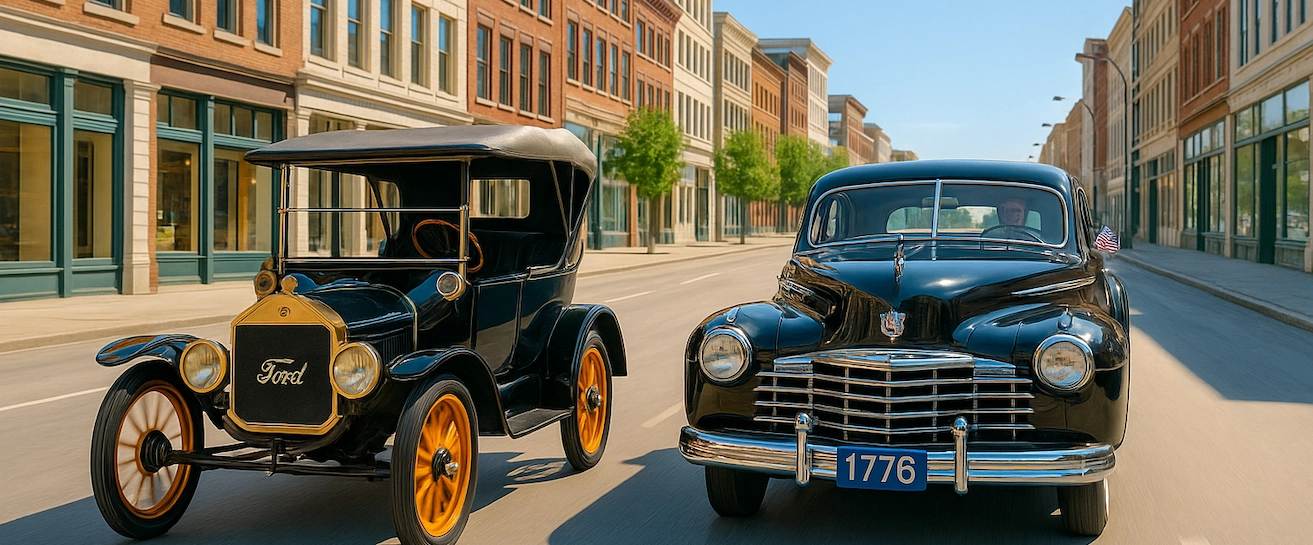
If there’s one automotive rivalry that has defined the very soul of American car culture, it’s the legendary clash between Ford and General Motors. These two automotive giants have been locked in competition for over a century, constantly pushing each other to innovate, sharpen their strategies and win the hearts of consumers.
But this rivalry isn’t just about sales figures or market share. It’s a high-octane saga of innovation, ambition, pride, and legacy. It’s Henry Ford versus Alfred Sloan, the Model T against the Cadillac, Mustang versus Camaro. This isn’t just business, it’s deeply personal. And if cars had emotions, the streets would be their battleground.
This enduring rivalry has shaped not only the vehicles we drive but also how cars are designed, manufactured, and marketed. From Ford’s efficiency-first mindset to GM’s diversified, brand-driven empire, both companies have left an unmistakable imprint on the global automotive landscape.
So fasten your seatbelts because you’re in for a joyride through the exhilarating story of Ford vs GM: a rivalry that didn’t just build cars, but shaped the future of mobility itself.
The Ford Motor Company
This story starts in 1903, when a brilliant yet stubborn man named Henry Ford launched the Ford Motor Company in Dearborn, Michigan. The name Henry Ford is synonymous with the birth of the modern automobile industry.

Before Ford revolutionised car manufacturing, automobiles were expensive, handcrafted machines accessible only to the wealthy. Ford had one revolutionary idea, to build a car that every average American could afford.
The result? The Model T in 1908. It was basic, rugged, and reliable exactly what the growing American middle class needed. Read more about the Model T in my blog, “Model T: How A Genius Innovation Revolutionised Car Production”.
But it wasn’t just the car. It was how it was built. Ford pioneered the assembly line in 1913, reducing the production time of a car, from 12 hours to just 90 minutes. This move didn’t just lower costs, it redefined manufacturing forever.
Within years, the Model T became the most popular car in America, and Ford established itself as a dominant force. Ford became synonymous with industrial efficiency and blue-collar dreams. By the 1920s, over half the cars in the world were Ford.
The Challenger: General Motors
Every rivalry needs a challenger. While Ford was building an empire on efficiency, General Motors (GM) was quietly plotting its own strategy. One that would take Ford by surprise and change the industry forever.
Founded in 1908 (coincidentally, the same year as the Model T launch), GM wasn’t started by a charismatic inventor but by a shrewd businessman, William C Durant. GM didn’t create cars. It acquired car companies. Buick, Oldsmobile, Cadillac, and later Chevrolet. GM was like the Thanos of the car world, collecting brands like Infinity Stones.


Durant realised something that Ford hadn’t yet considered, people wanted choices. Instead of selling just one standardised car model, GM offered variety, luxury, and customisation. When Alfred P Sloan, became president in the 1920s, he turned GM into a juggernaut.
“Only in more production and in new production can the American standard of living be increased and the economy be sound.”
Alfred P Sloan
He introduced a game-changing strategy: “a car for every purse and purpose”.
- Chevrolet: Targeted budget-conscious consumers, competing head-on with Ford.
- Buick and Oldsmobile: Catered to mid-range buyers.
- Cadillac: Focused on high-end luxury, setting a benchmark for premium automobiles.
This multi-brand strategy allowed GM to gain traction in multiple market segments, ready to challenge Ford’s dominance head-on. By the 1930s, GM had dethroned Ford and taken the top spot in the auto world. A position they’d hold for nearly 70 years.
The Rivalry
The rivalry between Ford and GM wasn’t just business. It was philosophical.
Ford believed in simplicity and affordability. He famously said, “Any customer can have a car painted any colour that he wants so long as it is black.” GM, on the other hand, believed in choice, luxury, and innovation. Ford was all about the people; GM was about aspiration.
“A market is never saturated with a good product, but it is very quickly saturated with a bad one.”
Henry Ford
While Ford stuck to the Model T, GM rolled out new models every year, with different features and styles. Ford’s stubbornness gave GM the edge as Ford’s Model T was beginning to feel outdated. But the game was on. It was no longer about building cars, it was about building dreams.
In response, Ford finally made a drastic decision. It discontinued the Model T in 1927 and launched the Model A. But the damage had already been done. GM had successfully surpassed Ford in sales and by the late 1920s, the rivalry became full-fledged.
Two Giants, Two Niches
Over the next decades, Ford and GM continued to evolve, each carving out its own identity:
- Ford: Efficiency, practicality and rugged reliability.
- GM: Innovation, diversity and luxury.
Ford found its strength in utility, toughness, and affordability. Trucks, fleet vehicles, and workhorses were the Ford’s forte. The F-Series, launched in 1948, would go on to become the best-selling truck in America for over four decades.
GM, on the other hand, became the king of variety and brand segmentation. Chevrolet for the masses. Buick for the rising professional. Cadillac for the successful. GM crafted cars that reflected the American dream and became a symbol of status and progress.
Each brand knew its niche, and they defended it like warriors in an arena.
What Sets Them Apart and What Unites Them
The biggest difference between these brands is their strategy. Ford champions practicality, while GM thrives on variety and luxury.
- Ford: Rugged, practical, iconic. Think Mustang, F-150, Focus. It’s the car for the worker, the soldier, the rebel.
- GM: Refined, diverse, aspirational. Think Camaro, Escalade, Corvette. It’s the car for the dreamer, the achiever, the showstopper.
Despite their competition, Ford and GM share some key similarities:
- Global expansion: Both dominate markets worldwide.
- Technological innovation: From EVs to self-driving tech, both companies lead research.
- Performance cars: Ford’s Mustang and GM’s Camaro are legendary in the muscle car segment.
And the biggest similarity is that both are relentlessly American. Both built vast manufacturing empires, both employed millions, and both took risks.
Their rivalry has pushed them to innovate, evolve, and adapt. Without GM, Ford wouldn’t have diversified. Without Ford, GM wouldn’t have streamlined. They were rivals, but they were also co-creators of the American auto ethos.
Marketing Strategy
When it came to marketing, this rivalry was marketing gold.
Ford’s Strategy:
- Focus on affordability and efficiency
- Built America’s best-selling truck: The Ford F-Series.
- Vertically integrated, making everything from engines to glass
- Invested in electric mobility: Mustang Mach-E and Ford Lightning.
GM’s Strategy:
- Multi-brand dominance – Chevrolet, Cadillac, GMC, Buick, etc.
- Expands in luxury markets – Cadillac, GMC Denali.
- Decentralised, letting each brand have its own identity while sharing underlying platforms
- Invests heavily in autonomous driving and EVs – Chevy Bolt, GM Ultium tech.
Anecdotes from the Rivalry
- In the 1960s, the Ford Mustang took the world by storm. GM scrambled to respond, and three years later, the Chevrolet Camaro was born. Since then, Mustang vs Camaro has been the stuff of car legend.
- GM once tried to buy Ford, but Henry Ford refused, ensuring his company remained independent.
- In the 1980s, Ford famously created a secret team called “Team Taurus” to develop a groundbreaking car in silence, free from bureaucracy. The result? The Ford Taurus, was one of the best-selling cars of the 1980s.
- When GM faced quality issues in the 1970s, Ford ran a cheeky ad campaign saying, “At Ford, Quality is Job 1”. GM wasn’t amused, but it worked.
- During the 2008 financial crisis, GM filed for bankruptcy and accepted government bailout money. Ford didn’t. They took out a massive loan, mortgaged everything, and turned it around themselves. That move earned them massive public goodwill and a subtle upper hand in the rivalry.
How This Rivalry Revolutionised the Automotive World
Despite their differences or perhaps due to their rivalry, Ford and GM together transformed the automotive world.
They gave millions of Americans mobility and freedom. They invented the modern car dealership, influenced labour laws, and even changed how cities were built. Suburbia, highways, fast-food drive-thrus, today all of them exist largely because Ford and GM made car ownership common.
This rivalry also pioneered safety standards, green tech, and manufacturing efficiencies that were adopted worldwide. Ford’s assembly line and GM’s brand architecture are studied in business schools even today.
From Detroit to Dubai and Sao Paulo to Shanghai, the impact of this rivalry is global.
Conclusion: More Than a Rivalry
The rivalry between Ford and General Motors isn’t just a chapter in automotive history. It is the book. It’s not just about horsepower or price tags. It’s about American identity, industrial ambition, and the relentless pursuit of better.
They’ve fought each other in boardrooms, racetracks, dealerships, and advertisements. Yet, they’ve also pushed each other to innovate, survive, and thrive in changing times.
As the world shifts toward electric vehicles and sustainable transportation, Ford and GM are at it again. Racing toward the future. Not just as rivals, but as pioneers of a new era.
So next time you see a Mustang roar past a Corvette, remember, it’s not just a car. It’s the embodiment of a century-old rivalry that changed the world.
And it’s far from over.
I am positive that you found this article informative and useful!
Please subscribe to my blog by filling in your details below:
My blog has countless such articles and stories to guide you and quench your thirst for knowledge.
You can also follow me on X and Facebook to read more such stories and posts.
PS: ChatGPT and/or Copilot have been used to create parts of this post.
Leave a Reply to Toyota vs Honda: A Legendary Rivalry Driven by InnovationCancel reply