
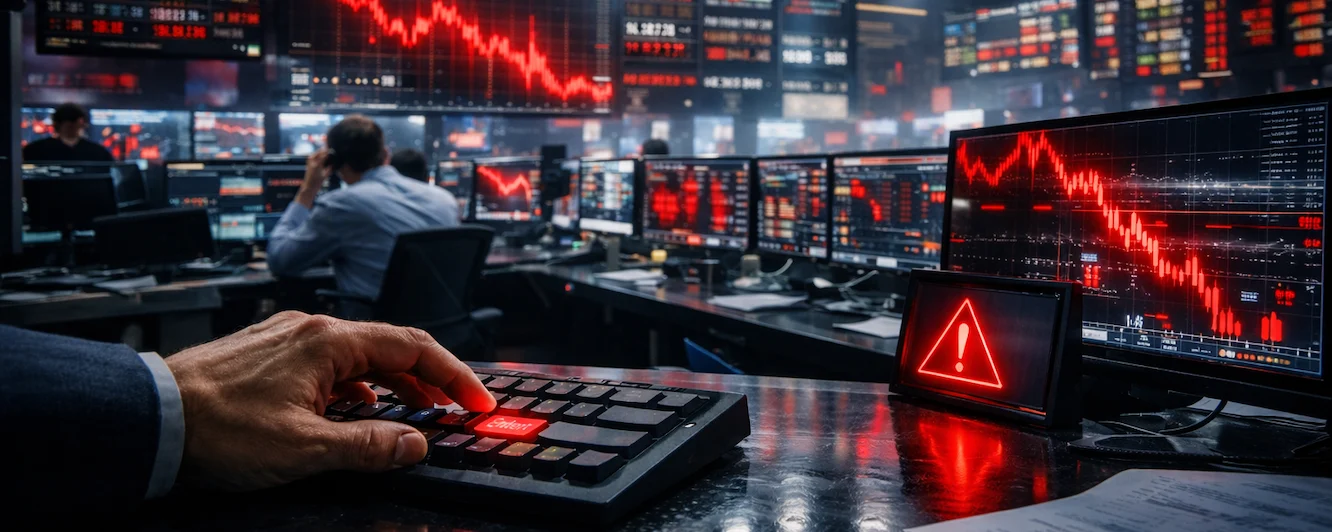
THE 50-WORD SUMMARY: A single human error at Mizuho Securities turned a routine trade into a $225 million catastrophe. By mistyping a “sell” order, a trader exposed the lethal rigidity of the Tokyo Stock Exchange’s systems. This case study explores how inflexible design and missing safety nets can trigger a global market meltdown.
The winter sun had barely risen on December 8, 2005, when Tokyo eased into what seemed like another ordinary trading day, the kind where markets move on instinct and human error feels impossible in the disciplined rhythm of the Tokyo Stock Exchange. December carried its usual cocktail of year-end volatility and traders pushing hard for one last profitable swing, yet nothing hinted at the financial earthquake that would unfold within hours.
In the middle of this quiet tension sat J-Com Co., a modest but promising staffing-services firm preparing for its market debut. The air hummed with anticipation. Analysts watching closely; promoters whispering hopes of a strong opening.
And then it happened.
An order was entered. A human error slipped through the cracks. In the span of a heartbeat, a single typo detonated into one of the most expensive trading mistakes in global financial history. Setting off a chain reaction that would ultimately cost around $225 million and leave Japan’s financial ecosystem stunned.
If you’re wondering how a simple human error managed to blow a hole through one of the world’s most disciplined markets, stay with me.
Let me take you back to where the story truly begins.
Six Seconds to Disaster
Mizuho Securities, one of Japan’s most respected financial institutions, is a jewel in the vast Mizuho Financial Group. It embodies competence, stability, and an almost ceremonial precision. For traders at Mizuho, numbers were their brushstrokes and precision was their parchment. In a world where a single human error could ripple through entire markets, discipline was not just expected; it was sacred.
Among these professionals sat a relatively young dealer, a man who had punched in tens of thousands of orders without a hiccup. A glance at the ticket, a flicker of movement, and the trade would glide smoothly into the system. The morning had barely begun, and he was already in full stride, syncing effortlessly with the rhythm of execution.
His supervisor walked over, offering a simple instruction. Sell one share of J-Com at six hundred and ten thousand yen. A tiny order. A rounding error in the grand theatre of Japanese finance. The kind of trade that hardly raised an eyebrow yet still demanded absolute accuracy.
The dealer nodded, turned to his screen, and began typing. Maybe the chatter around him blurred into background noise. Maybe the tension of the J-Com listing nudged his concentration. Maybe his attention drifted for the briefest fraction of a second. Whatever the cause, his fingers moved into a configuration they had never taken before.
Instead of entering 1 share @ 610,000 yen, he keyed in 610,000 shares @ 1 yen.
And then he pressed Enter.
In that moment, a six-second lapse became an uncancelable nightmare. The kind that exposes how even the most sophisticated markets can crumble when systems aren’t built to anticipate or quickly undo a simple human error.
The Mechanics of the Meltdown
Human Error Meets a Fragile System
The trading floor stayed eerily calm in the seconds after the erroneous order slipped through. No alert, no blinking screen, not even a gentle “Are you sure?” It glided into the system unnoticed, as if the architecture of one of the world’s most sophisticated exchanges had quietly approved it.
A massive block of J-Com shares, 41 times what the company actually had in circulation, was suddenly being offered for one yen each. It defied logic, yet the market reacted exactly as markets are built to react. With speed, instinct, and an unfiltered appetite for mispriced opportunity. Screens lit up, phones rang off the hook, and within minutes, orders began pouring one after another, draining Mizuho’s books while enriching anyone fast enough to seize the anomaly.
By the time the dealer realised what had happened, a cold shiver ran through him. His supervisor bolted toward the desk. “Cancel it. Cancel it now.” The command was fired off instantly, then repeatedly, but the TSE’s outdated system refused to accept a cancellation. It simply kept processing the catastrophic order as though nothing was amiss.

Crowds gathered around the dealer’s terminal. Every new trade meant more zeroes slipping into the void. Without a functioning cancellation mechanism, Mizuho sank deeper into financial quicksand. The dealer’s hands pressed helplessly against the keyboard, but the damage had already outrun human intervention. The system had trapped them inside their own mistake.
Human Error Without a Safety Net
Within minutes, executives abandoned meetings and flooded the risk room. By noon, Tokyo’s newsrooms were ablaze. Cameras circled Mizuho’s headquarters. A single trading typo had ignited a $225 million market implosion. Investors were stunned, analysts furious, and the incident quickly became a spectacle across financial media.
Inside Mizuho, disbelief was palpable. Losses soared beyond the lifetime earnings of most traders. The exchange eventually acknowledged its cancellation failure, far too late to rescue anyone. The order was executed. The damage was irreversible. The market had moved on.
In the days that followed, Mizuho was forced to buy back the shares at punishing premiums. Some firms returned their windfall profits under pressure; others lawyered up and hid behind “fair execution.” Regulators demanded answers. Politicians demanded accountability.
Leadership Insight: A single human error can reveal how fragile a system truly is. When safeguards are weak, and reversals aren’t effortless, one keystroke can unravel an entire operation.
The Autopsy of a Rigid System
Mizuho conducted a forensic review of the disaster. What surfaced was unsettling. The infamous typo was not just a human error; it exposed a brittle and outdated trading ecosystem. Beneath the polished sheen of Japan’s financial markets lay a system so rigid it could neither prevent the mistake nor forgive it. The Tokyo Stock Exchange was running on creaking architecture, missing automated sanity checks, real-time alerts, and a simple, intuitive way to cancel an accidental order. The market had evolved, but the rails supporting it were stuck in another era.
The TSE faced a harsh reckoning. Officials admitted flaws in their cancellation logic, ordered audits, dismissed personnel, and promised a sweeping technological overhaul. Regulators issued reprimands. Years later, the court ordered the Tokyo Stock Exchange to pay Mizuho roughly ¥10.7 billion, acknowledging that the system’s inability to cancel the trade was a shared liability. Confidence in Japan’s market infrastructure wavered. It would take years for the exchange to regain its footing.
Ultimately, the Mizuho fat-finger incident became more than a headline. It became a defining parable of modern finance: a world where billion-dollar markets hinge on keystrokes, where technology must protect against human error, and where even the strongest institutions can fall to a single misplaced tap of a finger.
Leadership Learnings on Human Error Proofing
1. The “Swiss Cheese” Model of Failure
In James Reason’s Swiss Cheese Model, each slice of cheese represents a protective layer. A process, a safety rule, a technological safeguard, all designed to keep mistakes at bay. But like a real Swiss cheese slice, every security layer contains holes. These holes are the hidden vulnerabilities born from human error or outdated systems.
One hole rarely brings down a system. The real danger emerges when holes of multiple layers quietly line up and create a clear path for human errors to slip straight through, turning an ordinary oversight into a full-blown systemic meltdown.

In the Mizuho incident, three holes aligned:
- A dealer made a simple human error, a mistyped order.
- An outdated exchange interface accepted the order without warnings.
- The TSE cancellation mechanism failed repeatedly.
And within minutes, those aligned vulnerabilities transformed one keystroke into a $225 million catastrophe.
Leadership Insight: Failures rarely happen because of one mistake. They happen when multiple small weaknesses collide at the same moment, and the system has no foolproof or user-friendly way to stop them.
2. Human Error Proofing (Poka-Yoke)
Even the smallest human error can snowball into a market-shaking catastrophe if systems lack the intelligence to catch, question, or reverse it. This is where Poka-Yoke becomes indispensable. Here is how each mechanism ties back to our story:
Input Validation
Modern systems must challenge anomalies, especially when an extraordinary input is made. In Mizuho’s case, a simple validation prompt, “Are you sure you want to sell 610,000 shares at 1 yen?” could have stopped the disaster cold. A protective buffer helps validate wrong inputs due to human errors.
The Two-Man Rule
High-stakes decisions need a mandatory dual-authorisation process to flag errors. At Mizuho, an automated circuit breaker in the software would have caught the mismatch in seconds, preventing the human error. In environments where risk runs high, shared responsibility is the only insurance.
Grace Periods
High-impact actions must have a waiting period. A short “cooling window” of even 30–60 seconds would have allowed Mizuho to retract the order before the market swallowed it whole. A grace period creates breathing room and offers a second shot at correcting human error before it becomes permanent.

3. Psychological Safety Net
Mizuho’s IT developers and system engineers were likely aware that the platform had glaring vulnerabilities that could allow a human error to pass through. Yet no one raised a red flag loudly enough, and the system remained unchanged.
Leaders must build a culture where reporting a glitch is valued more than hiding a mistake. When teams feel safe to speak up, even minor anomalies are treated as early warning signs. Otherwise, every unreported weakness becomes another hole in the Swiss Cheese slice, waiting for the next human error to slip through.
4. Designing for Human Error
Human error is a system design flaw waiting to be exposed. One mistyped order shouldn’t have had the power to drain hundreds of millions. It was the missing validation prompts, the brittle cancellation system, and outdated architecture that amplified a tiny slip into a $225 million catastrophe.
Leaders who blame people fix nothing; leaders who fix systems prevent disasters. Treating human error as a trigger for improving processes, not shaming individuals, creates safer, smarter, foolproof systems. That shift in mindset is what separates resilient institutions from vulnerable ones.
Leadership Insight: When teams don’t feel safe to speak up, and systems aren’t designed to absorb mistakes, a simple human error becomes the moment that exposes everything an organisation chose not to fix.
Conclusion: The Most Expensive Lesson in Finance
For Mizuho Securities, the meltdown became a turning point. The firm rebuilt its trading architecture from the ground up, redesigning its order-entry interface, strengthening its risk controls, and hard-coding humility into its processes. Speed gave way to caution. Habit gave way to validation. Certainty gave way to thoughtful doubt. Mizuho survived, even grew, but the scar remained as a quiet reminder of what a single human error can unleash when systems lack guardrails.
Across global trading floors, this story still travels like institutional folklore. Traders recount it to juniors as proof that the tiniest lapse can awaken the biggest demons in a system. Engineers revisit it in design meetings when arguing that technology must anticipate human fallibility.
In the end, the message is disarmingly simple. Technology should be a safety net, not a trapdoor. Systems must be foolproof, interfaces must be humane, and cancellations must be effortless. Because when human error meets rigid design, even one keystroke can become a market-shaking catastrophe.
If you found this perspective useful, consider subscribing to my blog by sharing your email below. You will receive regular insights on strategy, leadership, and building sustainable systems.
Stay Connected: For short-form thoughts and business storytelling, follow me on X and Facebook for regular updates.
Beyond the Blog: If stories of power, ambition, and passion interest you, explore my books on Amazon. They examine the fine line between success and surrender, and the choices that define both.
Disclaimer: This article is written for informational and educational purposes only, based on details available in the public domain. It is intended to analyse the event from a strategic and historical perspective. It does not intend to absolve, accuse, or defame any individual, entity, or corporation of wrongdoing, criminal intent, or dereliction of duty beyond what has been documented in historical records and legal proceedings.
Leave a Reply