
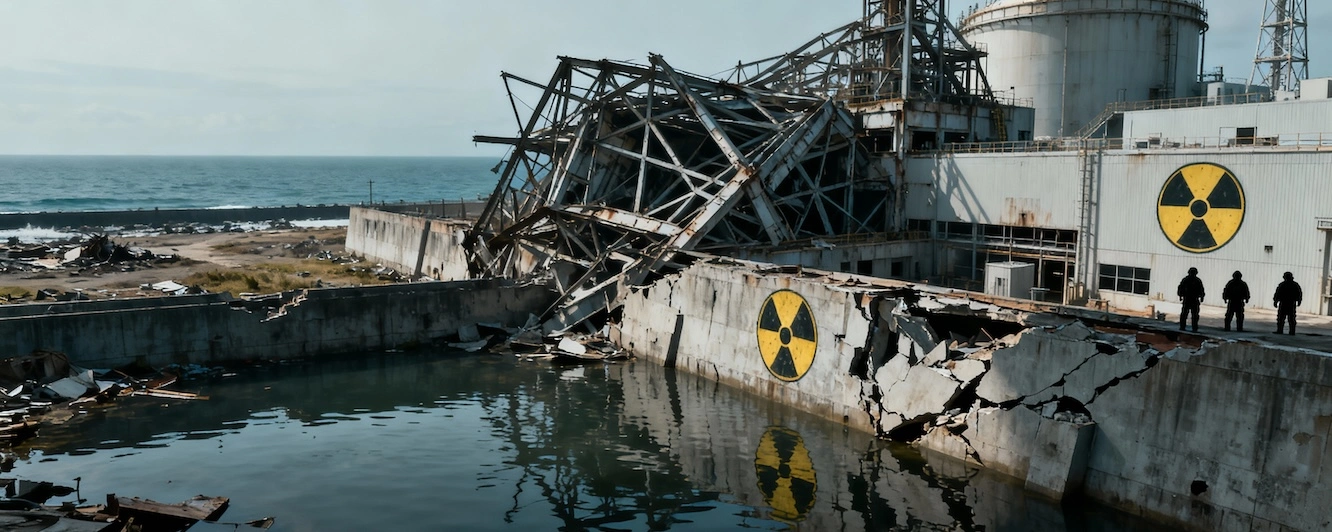
There are moments in history when nature and human error collide, creating devastation beyond imagination. A natural calamity, destructive on its own, becomes catastrophic when it triggers a manmade disaster. The world witnessed one such tragic combination on 11 March 2011.
While the world watched in shock as the Great East Japan Earthquake unleashed a massive tsunami, the real crisis was unfolding inside the control rooms of a nuclear power plant, where cascading failures turned an act of nature into a manmade disaster of epic scale.
Welcome back to our ongoing Manmade Disasters series. In earlier articles, we looked at the 1986 Chernobyl Nuclear Explosion and the 1984 Bhopal Gas Leak. In this edition, we shift our focus eastwards to Japan, a nation admired for precision, planning, and technological leadership, yet brought to its knees by a combination of nature’s fury and human oversight.
This is the story of how the Fukushima Daiichi Nuclear Plant became a manmade disaster that haunted Japan long after the waters receded. It stands as a powerful reminder that no infrastructure, no matter how advanced, can survive when strategy fails, risks are ignored, and preparedness collapses.
Japan: The Industrial Powerhouse
Japan has long been recognised as a symbol of resilience, efficiency, and precision. Often called the phoenix of Asia, it rose from the devastation of World War II to become a global industrial powerhouse.
With limited natural resources, the country relied on smart engineering, innovation, and strategic investments in technology. From bullet trains to high-tech factories, Japan became a benchmark of excellence and modernisation.
By the late 20th century, Japan had become synonymous with world-class manufacturing: automotive giants like Toyota and Honda, electronics pioneers like Sony and Panasonic, and robotics and automation that shaped global industries. The standard of living surged, creating a fast-paced, neon-lit economy that operated around the clock.
Infrastructure expanded rapidly. The Shinkansen sliced across the nation with remarkable precision, and automated assembly lines powered cities such as Nagoya and Osaka. All of this growth depended on one critical resource: electricity.
Japan’s industrial engine demanded massive amounts of uninterrupted power. Even a few seconds of outage meant production delays, financial losses, and damaged global credibility. The economy simply could not tolerate disruptions.
This relentless need for reliable energy pushed Japan into pursuing diverse power sources, ultimately shaping policy decisions that contributed to the chain of events behind the Fukushima manmade disaster.
Importance of Nuclear Power for Japan
Japan faces a unique strategic disadvantage: it is a resource-poor nation with almost no domestic reserves of oil, natural gas, or coal. To sustain its position as an economic giant, Japan needed to innovate and rethink energy dependence.
After the 1973 oil crisis exposed Japan’s vulnerability, the government made a decisive strategic shift. Nuclear energy emerged as the most reliable path to self-sufficiency and long-term stability. It was viewed as clean, powerful, and economically sustainable. Ideal for a growing industrial economy.
By 2011, Japan operated more than 50 nuclear reactors, and nuclear power supplied nearly 30% of the country’s electricity needs, with plans to increase that share to 50%. Nuclear energy became a central pillar of national strategy. It supported industrial competitiveness, reinforced Japan’s global reputation for scientific innovation, and powered millions of households that needed uninterrupted electricity.
The Tokyo Electric Power Company (TEPCO) stood at the heart of this system. It ran major facilities, including Kashiwazaki-Kariwa, the largest nuclear power plant in the world, and of course, Fukushima Daiichi.
Nuclear power was no longer merely an option; it had become a necessity. But this level of dependence created a dangerous mindset. A belief that the system was too big to fail, often the first step toward a manmade disaster.
Japan and Earthquakes: A Tryst with Destiny
Geographically, Japan sits on the Pacific Ring of Fire, a horseshoe-shaped belt known for some of the world’s most frequent and intense earthquakes and volcanic eruptions. In Japan, earthquakes are not unusual events; they are part of everyday life.
The Japanese are among the most disaster-prepared populations in the world. School children practise evacuation drills regularly, and buildings are engineered to bend and sway instead of collapsing. Yet history has proven that even the strongest resilience cannot always prevent large-scale devastation. From the Great Kanto Earthquake of 1923, which killed more than 140,000 people, to the Great Hanshin (Kobe) Earthquake of 1995, which claimed over 6,000 lives, Japan has repeatedly faced the raw force of nature.
In business terms, Japan understood risk management better than most modern economies. The nation respected nature and invested heavily in advanced safety systems. However, preparedness can sometimes create a dangerous illusion of invincibility.
While Japan was ready for the shaking, it was not ready for what came next. Strategic misjudgement about the aftermath of a major quake laid the foundation for a manmade disaster waiting to unfold.
Fukushima Daiichi Nuclear Plant
The Fukushima Daiichi Nuclear Power Plant stood on the eastern coast of Honshu in Fukushima Prefecture, looking directly into the Pacific Ocean. Commissioned in 1971, it was considered a technological achievement of its time. Positioned roughly 250 kilometres north of Tokyo, it played a critical role in powering the capital and surrounding industrial hubs.
The plant housed six boiling water reactors (BWRs) designed by General Electric and generated approximately 4.7 gigawatts of electricity. For decades, Fukushima Daiichi ran reliably, becoming a symbol of Japan’s post-war economic rise. It was seen as stable, dependable, and strategically essential to national growth.
By 2011, however, the plant was ageing. Reactor 1 was close to the end of its planned 40-year lifecycle, yet operations continued because shutting it down would threaten Japan’s already stretched power supply.
Its coastal location was intentional, allowing easy access to seawater for cooling. While this was standard practice globally, it also placed the facility directly in the path of extreme ocean forces. The weak link that triggered the manmade disaster the world would never forget.
A Manmade Disaster in the Making
The Fukushima Daiichi plant carried known design vulnerabilities that ultimately turned a natural event into a manmade disaster. This catastrophe’s roots were embedded in engineering decisions, ignored warnings, and corporate choices made years earlier.
- The Seawall Miscalculation: The plant was protected by a seawall built to withstand a tsunami of 5.7 meters. Internal research and external scientific reports in 2008 warned that waves exceeding 15 meters were entirely possible. TEPCO leadership, prioritising cost savings, postponed reinforcing the barrier.
- Generator Placement: The backup diesel generators for cooling the reactors during power loss were installed in the basements of the turbine buildings. Many experts consider this single decision the most direct cause of the manmade disaster.
- Regulatory Oversight: The Nuclear and Industrial Safety Agency (NISA) failed to enforce stricter standards on TEPCO. Safety recommendations became paperwork exercises instead of an actionable strategy, allowing unresolved risks to go unchecked.
Decisions driven by convenience, cost control, and complacency laid the foundation for the manmade disaster that followed.
The 2011 Tsunami: The Ocean Rises
On the afternoon of 11 March 2011, at 2:46 PM, a massive 9.0-magnitude earthquake struck Japan’s northeastern coast. It was one of the most powerful earthquakes ever recorded. Buildings shook violently, roads split open, and crowds rushed into open spaces. Yet Japan’s advanced infrastructure performed as designed. Skyscrapers swayed instead of collapsing, alarms activated instantly, and bullet trains halted automatically. Within minutes, nationwide tsunami warnings were issued.
At Fukushima Daiichi, the reactors shut down automatically through a process known as SCRAM. Control rods dropped immediately to halt the fission reaction. Transmission towers collapsed, disrupting the external power supply, but emergency diesel generators started functioning. Up to that moment, every system responded as planned.
The earthquake did not trigger the manmade disaster at Fukushima Daiichi. The tsunami did.
As the seabed surged upward, an enormous mass of ocean water was displaced, creating a towering wall of waves. Some reached heights close to 40 meters, racing towards the coastline at the speed of a jet aircraft, ready to swallow everything in their path.
Tsunami Meets Fukushima
At approximately 3:35 PM, the tsunami made landfall. It was not the 5.7-meter wave the engineers had planned for. It was a towering 14 to 15-meter wall of water. The ocean surged over the seawall effortlessly, crashing through the facility and engulfing buildings within seconds. Water poured into the basements where the backup diesel generators were operating, and within moments, they were flooded and rendered useless.
This triggered a catastrophic Station Blackout (SBO). With no grid power and no emergency generators, the cooling pumps shut down. Although the reactors had stopped fission, they remained intensely hot from residual decay heat. Without water circulation, the coolant inside the reactor pressure vessels began to evaporate rapidly.
The fuel rods became exposed. Temperatures soared. The zirconium cladding reacted with steam, generating massive volumes of hydrogen gas trapped inside the containment structures. Pressure built uncontrollably.
This was the moment the manmade disaster became unavoidable. Hydrogen explosions ripped through the reactor buildings, sending shockwaves across Japan and around the world.
Chaos and Confusion
Within minutes of the explosions, emergency response forces were mobilised. Command centres were activated, and thousands of firefighters, engineers, and Self-Defence Force soldiers worked around the clock. Helicopters attempted to cool the reactors by dropping water from above. Medical teams rushed to monitor radiation exposure among plant workers and nearby residents.
Inside the plant, the situation descended into chaos. Darkness, rising heat, blaring radiation alarms, and broken communication systems created a battlefield-like environment. In one of the most critical decisions of the crisis, plant manager Masao Yoshida defied TEPCO headquarters when they ordered him to stop injecting seawater, a last-resort cooling measure. His refusal likely prevented an even larger catastrophe and remains one of the defining moments of leadership in a manmade disaster.
Outside the facility, confusion dominated. The Prime Minister’s office struggled to get accurate information. TEPCO delayed releasing critical data, downplaying the severity of the core damage and the risks. This lack of transparency is often a key characteristic of any manmade disaster, where corporate communication failures worsen public panic and operational response.
Dealing with the Aftermath
On March 12, 13, and 15, massive hydrogen explosions blew apart the roofs of Units 1, 3, and 4. The images shocked the world, marking the moment when Japan’s technological confidence collapsed in front of global television audiences.
The consequences were immediate and heartbreaking. The government expanded the evacuation zone from 3 KMs to 10 KMs, and eventually to 20 KMs.
- The Evacuees: More than 150,000 residents were forced to leave with almost no belongings, expecting to return in days. Many never saw their homes again.
- The Fukushima 50: A core group of workers stayed behind to manually open valves, fight fires, and stabilise reactors while facing lethal radiation levels. Their courage and sacrifice prevented a manmade disaster from spiralling out of control.
- Stigma and Trauma: Residents from Fukushima Prefecture later faced discrimination and social isolation, unfairly labelled as “radioactive” by fellow citizens. The emotional toll became another painful consequence of the meltdown.
The explosions marked not just a failure of technology but a failure of planning, communication, and trust.
Ghost Towns and Silent Springs
More than a decade later, the scars of this manmade disaster remain painfully visible. Radiation contamination poisoned soil, forests, and the surrounding oceans. Once-fertile agricultural land was abandoned. Japan’s fishing communities faced years of uncertainty, and local wildlife showed signs of genetic damage that scientists continue to study.
The economic impact was staggering. Japan faced losses running into hundreds of billions of dollars. Entire communities were permanently displaced, and vast regions of Fukushima remain uninhabitable, turning into ghost towns where nature has reclaimed silent streets and empty houses.
The soil remains contaminated with Caesium-137, and millions of tonnes of radioactive wastewater are stored in tanks, creating another long-term challenge and global debate, especially after the recent release of treated water into the ocean.
In the aftermath, Japan shut down its entire nuclear industry, forcing greater reliance on costly fossil fuel imports and pushing the country into trade deficits. A single failure reshaped national policy and global energy debates.
While direct deaths from radiation exposure were limited, the disaster-related deaths caused by suicide, evacuation stress, and lack of medical access exceeded 2,000. The psychological trauma of displacement, stigma, and uncertainty has become one of the deepest wounds of this manmade disaster.
Strategic Lessons Learnt
Analysing Fukushima Daiichi as a manmade disaster provides crucial lessons for business leaders, policymakers, and operational strategists around the world. This tragedy proves that even the most advanced systems fail when strategy, communication, and foresight fail first.
- Plan for the Black Swan: An effective risk strategy must prepare for low-probability, high-impact events. Planning only for what seems probable is the fastest path to a manmade disaster.
- Break Silo Mentality: In a crisis, information silos are lethal. Transparent, real-time collaboration saves lives and infrastructure.
- Safety over Cost: In critical infrastructure, safety investments are not expenses but non-negotiable insurance against failure. Profit-first decisions are often the seeds of a manmade disaster.
- Independent Oversight: When the same institutions promote and police an industry, a conflict of interest weakens safety protocols. Without strong oversight, warning signs are missed, and systemic blind spots grow.
The Fukushima crisis shows that manmade disasters are built slowly, one ignored risk at a time.
The Legacy of a Manmade Disaster
The 2011 Fukushima Daiichi Nuclear Meltdown was a tragedy shaped by overconfidence, delayed decisions, and ignored warnings. A failure to plan for the unimaginable and to invest in long-term safety and governance. The tsunami was an act of nature, but the meltdown that followed was unquestionably a manmade disaster.
It stands as a powerful reminder that as we pursue technological advancement and operational speed, ambition must be balanced with humility, caution, and strategic foresight. For businesses, governments, and institutions, Fukushima reinforces the importance of transparent leadership, resilient systems, and risk-aware decision-making. Safety is not a cost to optimise; it is an investment that protects lives, economies, and reputations.
Every crisis managed responsibly strengthens the future. Every warning ignored becomes the blueprint for the next failure. Today, the silent exclusion zones around Fukushima remain a haunting monument to a manmade disaster, reminding the world of the price we pay when we overlook what truly matters.
I am positive that you found this article interesting and useful. Please subscribe to my blog by filling in your details below:
My blog has countless such articles and stories to guide you and quench your thirst for knowledge.
If you enjoy stories woven with power, passion, and desire, explore my books on Amazon. My stories unravel the fine line between success and surrender, reminding us that in a world ruled by strategy, love remains the ultimate game changer.
If you enjoy videos, you can watch interesting thoughts and stories on my YouTube channel. You can also follow me on X and Facebook to read more such stories and posts.
PS: Gemini and/or ChatGPT have been used to create parts of this post.
Disclaimer: This article is written for informational and educational purposes only, based on details available in the public domain. It is intended to analyse the event from a strategic and historical perspective. It does not intend to absolve, accuse, or defame any individual, entity, or corporation of wrongdoing, criminal intent, or dereliction of duty beyond what has been documented in historical records and legal proceedings.
Leave a Reply