
THE 50-WORD SUMMARY: Readiness is the invisible engine of excellence. While talent handles the spotlight, systems handle the 200-cover dinner rush. By adopting the culinary discipline of Mise en Place, business leaders can transform chaotic operations into a choreographed performance. Learn to master supply chain quality, resource allocation, and expeditor leadership.
It is 8:30 PM. The air outside is crisp and cold, but inside your favourite restaurant, everything feels warm and cosy. You are seated with your partner for a quiet dinner. Around you, the restaurant moves with clinical precision. Servers glide between tables. Orders are taken without fuss. Plates emerge from the kitchen as if summoned on cue. Cutlery hums softly against porcelain. The aroma of freshly baked Garlic Naan drifts through the room like a promise kept.
Your server places a bowl of fresh salad before you. Crunchy lettuce leaves that almost sparkle under the light. Cherry tomatoes so vibrant they seem freshly plucked from the vine. As you lift your fork, a thought crosses your mind. What kind of preparation makes this moment possible? What level of readiness ensures that every plate arrives fresh, precise, and exactly on time?
Behind this seamless experience lies an invisible discipline. A system that transforms potential chaos into calm execution. In the culinary world, it is called Mise en Place. In business language, it is structured operational readiness.
Today, I take you inside the kitchen to explore this powerful concept. Because just like any high-performing organisation, a restaurant does not survive on talent alone. It thrives on preparation. On systems. On putting everything in its place before the first order is fired.
The Dawn of Readiness
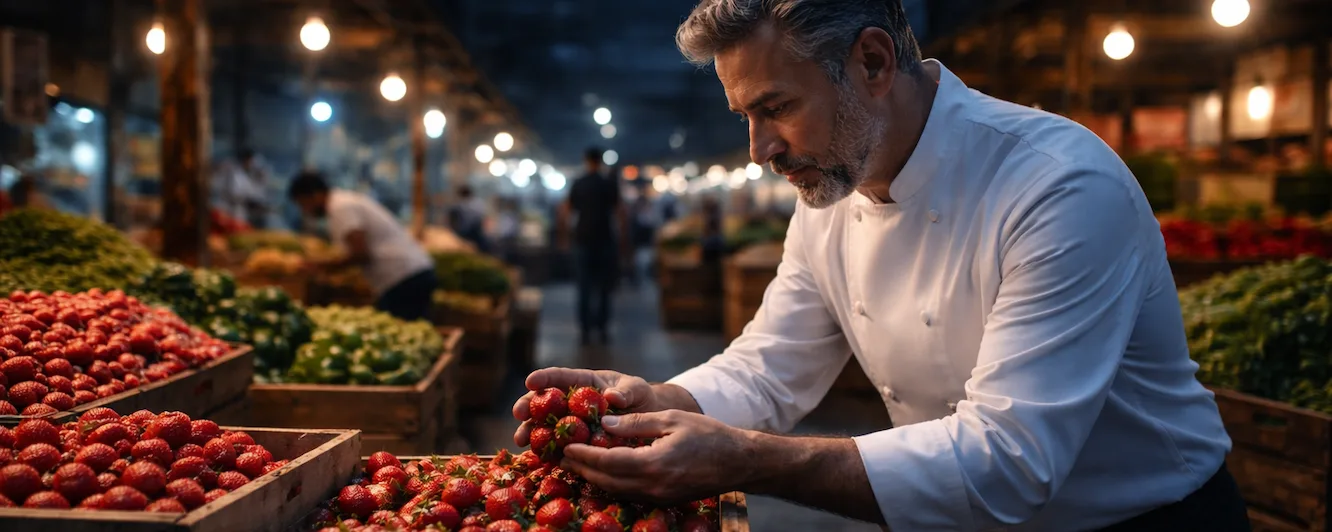
Chef Gustavo, owner of Dolce Cucina, is doing what he has done for 21 years. Walking through crowded market stalls before sunrise, searching for the right ingredients. It is early, yet trucks of every shape and size are already unloading. Fresh vegetables from Nashik farms. Fish and shrimp from the docks. Seasonal fruits from across the country.
Tonight, he is preparing Strawberry Reverie as the Chef’s special dessert. For that, he needs the juiciest, freshest strawberries. Navigating the maze of stalls, he reaches his regular fruit monger. A crate of freshly arrived Mahabaleshwar Strawberries is set before him.
Chef Gustavo selects them like precious jewels. He checks the size, the deep scarlet colour, and the firmness of the calyx to ensure peak freshness. Every strawberry must earn its place.
Because the success of a 200-cover night is not decided when the first guest sits down. It was decided at 4:30 AM in a damp wholesale market, over a crate of strawberries.
In restaurants, as in high-stakes business, your service is only as good as your readiness.
10:00 AM Prep: Engineering Readiness Before the Rush
At 10:00 AM, the first wave arrives. The junior associates, the Commis Chefs, begin trickling into Dolce Cucina. Their role is not glamorous, but it is foundational. They handle the repetitive yet essential tasks that quietly determine whether the evening will glide or stumble.
The restaurant operates on two distinct formats. A four-course Fixed Menu, predictable and high-volume. And a 21-dish À La Carte Menu, complex and high-variability, shaped by individual guest preferences. One demands consistency at scale. The other demands agility under pressure.
By 10:15, the kitchen hums with intent. Preparation for the Fixed Menu moves into disciplined motion. Vegetables are peeled and diced with mechanical precision. Sauces go onto burners to simmer. Reductions bubble patiently, building depth and texture. Seasoning is adjusted repeatedly. Every batch is tasted. Nothing is delegated to luck.
This is not a random activity. It is a structured mise en place. A repeatable operating system refined over the years. Each task follows a sequence. Each station knows its deliverables. Supervision is minimal because the system is embedded.
This early rhythm is pure readiness. It is the act of clearing the deck. Finishing the routine before complexity arrives. By stabilising the predictable workload, the team creates capacity to handle the unpredictable demands of the À La Carte Menu later.
In restaurants, as in business, excellence during peak hours is rarely spontaneous. It is engineered in the quiet hours of preparation.
17:30 IST Strategic Alignment: The Final Readiness Check
It is 17:30. Chef Gustavo makes his final round of the kitchen, clipboard in hand. This is not a casual walk-through. It is a deliberate audit of readiness. He inspects every station, checks the prep, and verifies that the mise en place is complete. Each item earns a precise tick on his checklist.
He clearly demarcates responsibilities. Which stations will handle the Fixed Menu. Which will focus on the more demanding À La Carte Menu. Roles are sharpened. Ownership is clarified. Ambiguity is removed.
Then the team gathers at the pass.
The pre-shift briefing begins.

Chef Gustavo walks them through the evening’s menu. Each dish is explained in detail. Servers are coached on how to present them to the guests, how to describe flavour profiles, and which recommendations to make if guests seek guidance. Today’s specials are highlighted. Three VIP guests are expected, each with their preferences and quirks. The team is briefed so the service feels personalised, not improvised.
He pauses and looks around. Does anyone have doubts about their role? Are responsibilities clear? Questions are invited now, not during peak service.
They also review capacity. The kitchen has confirmed readiness for 125 covers on the Fixed Menu. Once orders approach 100 covers, servers will tactfully steer demand to maintain balance and protect execution quality. Mitigation is planned before pressure builds.
This pre-shift alignment is the restaurant’s equivalent of a shopfloor huddle. It is the final checkpoint before the storm. A moment to assess bandwidth, confirm deliverables, and prepare contingency plans.
Because when the doors open, there is no time for strategy. Only execution. And execution is only as strong as your readiness.
The 200-Cover Surge
It is showtime. At 19:30 sharp, the diner opens for business. Guests begin to trickle in. Familiar faces exchange pleasantries with servers. New guests scan the menu, weighing indulgence against restraint. Mojitos and Margaritas glide across the bar. A few disciplined diners sip diet soda instead.
At exactly 19:39, the printer whirs to life and releases the first order. A four-course meal for a table of three.
Act I begins.
Act I: The Early Jitters
As orders start flowing, Chef Gustavo takes position at the pass. He has transitioned into the role of expediter, the command centre of the kitchen. Tickets are arranged by sequence and preparation time. Sous Chefs are called out by name. Orders are acknowledged. Delivery times are confirmed.
There are nerves across the line, but Chef Gustavo stands composed, marshalling his team like a seasoned general. Years of repetition have turned pressure into fuel. This is not chaos. It is controlled intensity, built on readiness.
Dishes begin arriving at the pass. He inspects presentation, aroma, and finish before approving them for service. Occasionally, his voice rises when standards slip. One plate is discarded because the chicken is overcooked. Nothing substandard crosses the window.
Because during a 200-cover service, precision is non-negotiable.

Act II: The Kitchen Curveball
By 20:00, the kitchen finds its rhythm. It is no longer cooking. It is performing. Orders move like notes in an orchestra. Then at 20:09, disruption strikes.
The high-pressure burner dedicated to Golden Chicken Ravioli, a bestseller from the Fixed Menu, fails. Three orders are already pending. Historically, at least seventeen more are expected tonight.
Delay is not an option.
Chef Gustavo acts instantly. Pending tickets are reviewed. Station capacities are assessed. It becomes clear that orders for Spaghetti al Pomodoro and Alette di Pollo al Burro are unusually light. He merges those stations and reallocates the freed capacity to the ravioli line. The mise en place is shifted with surgical precision.
Traffic is cleared before it becomes a bottleneck.
This is operational readiness under fire. Not avoiding problems, but absorbing them without disturbing service flow.
Act III: The Calm After the Storm
Finally, the last order leaves the kitchen. A measured calm settles in. Chef Gustavo takes a quiet sip of his favourite wine, reflecting on the evening’s service. He replays incidents in his mind, not to celebrate, but to extract lessons.
Tonight balanced the structured efficiency of the Fixed Menu, almost assembly-line in nature, with the customised demands of the À La Carte Menu. The failed burner tested contingency planning. The last-minute recovery for VIP guests tested coordination.
He surveys his kitchen, his team, and the now-thinning dining room. Another successful service.
Not because nothing went wrong, but because everything was built on readiness.
The Corporate Mise en Place
In a professional kitchen, excellence is not improvised. It is prepared. Every garnish trimmed, every sauce reduced, every station aligned before the first order prints. This discipline of mise en place is not merely culinary etiquette. It is a framework of readiness that businesses would do well to emulate.
The similarities are too obvious:
| Culinary Action | The Corporate Equivalent |
| Mise en Place | Operational Readiness / Data Hygiene |
| The Expeditor | The Project Manager / COO |
| The Pass | The Quality Assurance Gate |
| “Heard!” / “Behind!” | Radical Transparency / Closed-Loop Communication |
Let us translate what unfolded at Dolce Cucina into the language of corporate execution.
1. The Taxonomy of Readiness
Physical Readiness
The tangibles, like Chef Gustavo at 4:30 AM selecting flawless Mahabaleshwar strawberries. It is vegetables diced at 10:15 AM, sauces simmering, burners tested, and stations stocked. In corporate terms, this is infrastructure. Systems configured. Data validated. Resources allocated. Tools kept ready before the market opens.

Mental Readiness
It is about cognitive alignment. At 17:30, during the pre-shift briefing, roles were clarified. VIP preferences were discussed. Capacity limits were acknowledged. Questions were invited. The team entered service with clarity, not confusion. In business, this translates to aligned objectives, defined accountability, and shared understanding of risks before execution begins.
Temporal Readiness
The timing discipline. The kitchen knew it had the readiness for 125 covers on the Fixed Menu. Mitigation strategies were planned once orders approached 100. This is capacity planning. This is workload forecasting. In the corporate world, failure often occurs not because teams lack skill, but because they misjudge timing and bandwidth.
When the burner failed at 20:09, these three layers of readiness prevented paralysis. Physical systems were flexible enough to reallocate stations. Mental clarity enabled swift decision-making. Temporal awareness prevented backlog escalation.
Readiness is not one dimension. It is a layered preparation.
Operations Note: When Gustavo moves the Ravioli team to the Spaghetti line, he is performing Dynamic Resource Allocation. He didn’t just “help out“; he shifted “human capital” into a “high-demand silo” to prevent a “systemic bottleneck.”
2. The Expeditor Leadership Model
At 19:30, Chef Gustavo stepped away from the stove and took position at the pass as expediter. He was not sauteing. He was orchestrating.
This is a critical leadership insight.
When the Golden Chicken Ravioli burner failed, he did not grab a pan. He assessed pending tickets. He evaluated station occupancy. He redeployed capacity from Spaghetti al Pomodoro and Alette di Pollo al Burro. He saw the entire board.
In corporate environments, leaders often remain buried in the “tools.” Writing code. Reviewing spreadsheets. Closing minor deals. But during peak pressure, leadership must shift from doing to coordinating.
The Expeditor Leadership Model demands altitude. It requires stepping back from execution to manage flow. To prioritise. To remove bottlenecks. To protect throughput.
Chef Gustavo protected service not by cooking faster, but by reallocating intelligently.
That is strategic readiness.
3. Radical Communication
Professional kitchens operate on sharp, unmistakable communication. When an order is called, the response is immediate. “Heard!” When someone passes behind a colleague with a hot pan, they announce, “Behind!”
There is no ambiguity. No assumption. No silent dependency.
During the 17:30 alignment, Chef Gustavo reconfirmed roles. During service, Sous Chefs acknowledged tickets. When stations were merged after the burner failure, instructions were explicit and confirmed.
Contrast this with corporate silos. Emails unread. Messages buried. Assumptions untested. Deadlines missed because someone believed someone else was “looped in.”
Radical communication eliminates friction. It compresses response time. It reinforces readiness under pressure.
The kitchen does not tolerate vague signals because vague signals burn food. In business, they burn timelines and trust.
Operations Note: Operational excellence is not forged in the rush, but in the discipline of readiness built before it. Layer your preparation, lead from the pass, not the pan, and communicate with surgical clarity. When everything is in its place, performance stops being dramatic and starts being dependable.
Readiness for Tomorrow: Resetting to Zero
It is 21:45 in the kitchen of Dolce Cucina. Chef Gustavo has retreated to his office, already sketching tomorrow’s service. But on the production floor, the real closing ritual has begun.
Stations are wiped down. Pots are scrubbed until they reflect the overhead lights. Knives are sharpened with quiet intent. Floors are mopped. Every surface is returned to order. The kitchen must go back to its pristine baseline.

This is not housekeeping. This is operational readiness.
Resetting to zero is the final discipline of the day. Because tomorrow’s excellence cannot be built on yesterday’s residue. When the shutters rise again, the team should be planning the menu, refining the mise en place, and aligning for service, not cleaning up unfinished business.
In corporate parlance, resetting to zero means an empty inbox, a cleared CRM, and a debriefed team. If you start Tuesday morning answering Monday’s emails, you have already lost your ‘Dawn of Readiness’.
A clean canvas sharpens focus. A clear station accelerates execution. In restaurants, as in business, readiness begins the moment the last order leaves the pass.
Success is not a one-time performance. It is a cycle. Prepare. Execute. Reset. Repeat.
Step back into your own kitchen, office, or shop floor and ask yourself, are you starting tomorrow at zero, or carrying forward yesterday’s clutter? Build your systems. Clear your decks. Elevate your readiness.
If you found this perspective useful, consider subscribing to my blog by sharing your email below. You will receive regular insights on strategy, leadership, and building sustainable systems.
Stay Connected: For short-form thoughts and business storytelling, follow me on X and Facebook for regular updates.
Beyond the Blog: If stories of power, ambition, and passion interest you, explore my books on Amazon. They examine the fine line between success and surrender, and the choices that define both.


Leave a Reply to blissfuld7325b2db2Cancel reply