
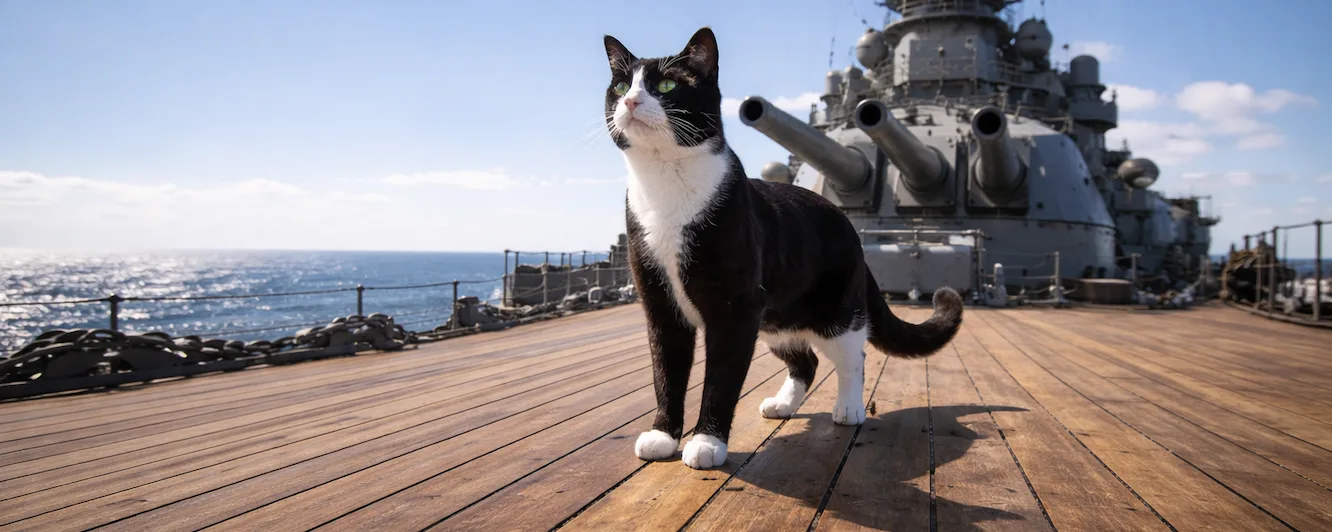
THE 50-WORD SUMMARY: Unsinkable Sam is the legendary World War II cat who survived three shipwrecks, including the Bismarck. His story serves as a metaphor for resilience and radical adaptability. By mastering emotional buoyancy, Sam teaches us to survive corporate shipwrecks, find a floating plank, and start over with defiant hope.
In our professional and personal lives, we all hit moments that feel like a shipwreck. The waters turn rough, the ground slips away, and even staying afloat becomes a challenge. In those moments, we search for even the smallest spark of inspiration to help us push through.
This is where Sam comes in.
A cat, also known as the Unsinkable Sam, served on not one, not two, but three doomed warships during the Second World War. Sam had no medals, rank or allegiance to any country, yet he left behind a story so improbable that it almost reads like fiction.
In many ways, Sam is a quiet metaphor for resilience, for surviving repeated setbacks, and for finding a way to begin again when everything seems lost.
Let us see how Sam used three of his nine lives with remarkable timing to survive the impossible. It all began aboard the Bismarck.
The Irony of the Iron Cross: A Feline on the Bismarck
Bismarck was a formidable German battleship, the crown jewel of Nazi Germany’s naval ambition. A floating fortress and armed to intimidate anything foolish enough to cross its path, the Bismarck was meant to dominate the Atlantic. Amidst the thunder of 15-inch guns and the smell of heavy fuel oil, Sam, then Oscar, was the Bismarck’s most unlikely inhabitant.
Cats rarely volunteer for naval warfare; Oscar was also not enlisted. He was likely brought aboard for the usual shipboard reasons: companionship, morale, and the practical task of keeping vermin in check. A humble job, though one suspects Oscar viewed himself as a senior officer in charge of rodent control.
Bismarck Sinks, Oscar Survives
In May 1941, after sinking the British battlecruiser HMS Hood, the Bismarck became the most hunted ship in the Atlantic. The Royal Navy unleashed everything it had. The relentless pursuit culminated in the Bismarck being battered into submission and finally sinking beneath the waves.
As the Bismarck slipped into the abyss, Sam didn’t panic; he simply upgraded his ‘office’ to a floating plank of wood. Later, an oil-soaked, wide-eyed, and very much alive Oscar was rescued by the crew of the HMS Cossack, who likely expected to pull out hardened sailors, not a feline with an expression suggesting mild inconvenience rather than trauma.

It was an extraordinary escape. While hundreds perished, Oscar floated. No training, no equipment, no grand plan. Just instinct, timing, and perhaps a quiet refusal to participate in the ship’s unfortunate destiny.
If irony had a sense of humour, it was already enjoying itself.
From Hunter to Hunted: The British Chapter and the HMS Cossack
Oscar was promptly adopted by his British rescuers and given a new name: Sam. One imagines this was less about ceremony and more about convenience. “Oscar” may have felt a bit too German for wartime sensibilities.
Aboard HMS Cossack, Sam settled into his new role with admirable professionalism. He patrolled the decks, supervised operations with feline indifference, and provided sailors with a rare slice of normality in a world defined by uncertainty. Warships, after all, are tense places. Having a cat around somehow made the constant threat of torpedoes feel marginally less grim.
For five months, Sam lived what could almost be described as a stable life at sea. Meals were regular, the crew was fond of him, and the Atlantic, for once, seemed content to leave him alone. But fate, it appears, had developed a particular interest in this cat.
Sam Survives a Torpedo
In October 1941, HMS Cossack was struck by a torpedo fired by U-563, a German submarine. The explosion was catastrophic. The forward section of the ship was obliterated, killing 159 crew members instantly. The survivors scrambled to control the damage, but the ship was fatally wounded.
Cossack did not sink immediately. Instead, it was taken under tow, an injured vessel being dragged across hostile waters in the hope of reaching safety. For a few tense days, it seemed possible that the ship might survive.
It did not. Heavy seas and structural damage proved too much. The ship finally succumbed, slipping beneath the surface despite the crew’s efforts.
And Sam?

Once again, he was found floating on wreckage. Wet, exhausted, and perhaps slightly annoyed at the repeated inconvenience, but alive.
Two shipwrecks in six months. At this point, even the most sceptical observer would begin to raise an eyebrow. Sailors, being a superstitious lot, began to regard Sam with a mix of affection and awe. Was he lucky? Unlucky? Or something altogether beyond classification?
What was clear is that wherever Sam went, ships had an unfortunate tendency to follow him to the bottom of the ocean. Yet, he himself remained stubbornly afloat.
The Final Plunge: The HMS Ark Royal and the Legend of Sam
By now, Sam had become something of a maritime celebrity. His reputation travelled faster than most naval dispatches. A cat who survived two sinkings was no longer just a mascot. He was a phenomenon. Naturally, the Royal Navy decided the best course of action was to put him on another ship.
This time, Sam was transferred to the HMS Ark Royal, an aircraft carrier with a reputation for being remarkably lucky. Ark Royal had dodged torpedoes, survived air attacks, and generally behaved as though it had an agreement with fate.
There was, however, a small detail that added a layer of irony so thick it could be cut with a knife. Ark Royal had played a crucial role in the sinking of the Bismarck, Sam’s original home. But Sam didn’t care that the Ark Royal sank his first home; he cared that the Ark Royal had a kitchen.
For a brief period, it seemed that perhaps Sam had finally found a vessel capable of withstanding his peculiar track record. Life aboard Ark Royal was, by wartime standards, relatively uneventful. The crew admired him, the ship performed its duties, and the sea remained, at least temporarily, cooperative.
Sam Evades One More Torpedo
Then came November 1941.
A torpedo from U-81 struck Ark Royal. Unlike the sudden destruction of Cossack, this was a slower, more deliberate disaster. The ship listed gradually, giving the crew time to organise evacuation efforts. Discipline held, and most of the sailors were able to abandon ship safely.
Ark Royal eventually capsized and sank. And Sam?
Rescuers later found him clinging to a floating motor launch. According to eyewitness accounts, he was “angry but quite unharmed.” It is perhaps the most fitting description in the entire saga. Surviving three shipwrecks in a single year is impressive. Doing so while maintaining a sense of indignation is exceptional.
Sam Receives a Well-Deserved Retirement
At this point, the Admiralty made a decision that can only be described as sensible. Sam’s naval career was officially over. He was retired.
No more ships, no more Atlantic crossings, and certainly no more opportunities to test the limits of his survival instincts. Instead, he was sent to live in the relative safety of the Governor of Gibraltar’s office, far removed from torpedoes and sinking hulls.

Later, he moved to a sailors’ home in Belfast, where he spent the remainder of his days in peace. No explosions, no wreckage, no dramatic rescues. Just a quiet life, which, after everything, must have felt profoundly unusual.
My Take: Sam didn’t survive because the ships were strong; he survived because he knew when to let go. In a shipwreck, your edge is not control; it is the ability to stay afloat and begin again.
Life Lessons from Sam’s Story: Survive, Reset and Start Over
Sam wasn’t a stoic philosopher; he was a cat. But his survival offers a blueprint for the ‘Corporate Shipwrecks’ we face today: sudden layoffs, sinking industries, and the total collapse of the structures we trusted.
Here are four sharp lessons from Sam on how to stay afloat and move forward.
1. Navigating Corporate Shipwrecks: The Art of the Floating Plank
Just like Sam’s journey in our lives, corporate shipwrecks also show up as sudden layoffs, restructures, or even entire industries fading out. Conditioning yourself for survival requires finding your floating plank. A floating plank isn’t a new job; it’s a freelance gig, a networking coffee, or a skill you haven’t used in five years. It’s anything that stops you from sinking while you scan the horizon.
Consider a mid-level manager whose division is shut overnight. Instead of waiting for the “perfect role”, they pick up short-term consultancy, reconnect with old clients, and build momentum. It may not look impressive at first, but it keeps them afloat until the next stable opportunity arrives.
Survival is not about saving the ship; it is about staying afloat till you find the next one.
2. Emotional Buoyancy: Building an Unsinkable Mindset
To be unsinkable, one must learn to transition without losing mental balance, just like Sam moved across ships without carrying the weight of the last disaster. In careers, this translates to emotional buoyancy and transferable skills. Many professionals tie their identity to a job title or organisation. When that “ship” sinks, it feels personal.
A startup founder whose venture shuts down often struggles more with identity loss than financial loss. But those who recover faster treat the experience as one chapter, not the entire story. They carry forward their learning, not their baggage.
Remember, your role is temporary, but your capability is permanent.
3. Radical Adaptability: Thriving After the Shipwreck
Sam knew when to move on and when to stabilise. Survival is not the end goal; it is just a phase. In the aftermath of a disruption, adaptability becomes your strongest asset. The aim is to retain your core strengths while letting go of what no longer serves you.
Take the example of professionals who pivoted during the pandemic. Many moved from traditional roles into digital, consulting, or independent work. Those who adapted early found new ground to grow.
True resilience is not clinging to the wreckage, but having the clarity to board the next ship.
4. The Discipline of Letting Go: Moving Without Drag
Sam never tried to carry pieces of the old ship onto the new one. In real life, we often do the opposite. We carry past failures, regrets, and “what ifs” into new opportunities, slowing ourselves down.
A senior executive moving into a new organisation sometimes struggles because they try to replicate old systems instead of adapting to the new environment. The result is friction, not progress.
The discipline lies in letting go. Not of learning, but of emotional weight. In the end, staying afloat is about moving light enough to keep going.
Conclusion: Not All Is Lost in a Shipwreck
Sam’s story sits at the intersection of history and legend. It is tempting to dress it up as myth, yet the facts, improbable as they are, stand firm on their own.
Three ships. Three sinkings. One cat.
Sam survived not because he was grand or traditionally heroic, but because he was stubbornly, almost defiantly, hopeful. The takeaway is simple. Not all is lost in a shipwreck. If you look closely, there are always a few floating planks within reach.
The strategy is not to panic or give up. It is to identify the right plank, one that can carry your weight, and hold on with patience until the next opportunity comes into view.
Because, like Sam, survival is not about saving the ship. It is about staying afloat long enough to start again.
If you found this perspective useful, consider subscribing to my blog by sharing your email below. You will receive regular insights on strategy, leadership, and building sustainable systems.
Stay Connected: For short-form thoughts and business storytelling, follow me on X and Facebook for regular updates.
Beyond the Blog: If stories of power, ambition, and passion interest you, explore my books on Amazon. They examine the fine line between success and surrender, and the choices that define both.


Leave a Reply