
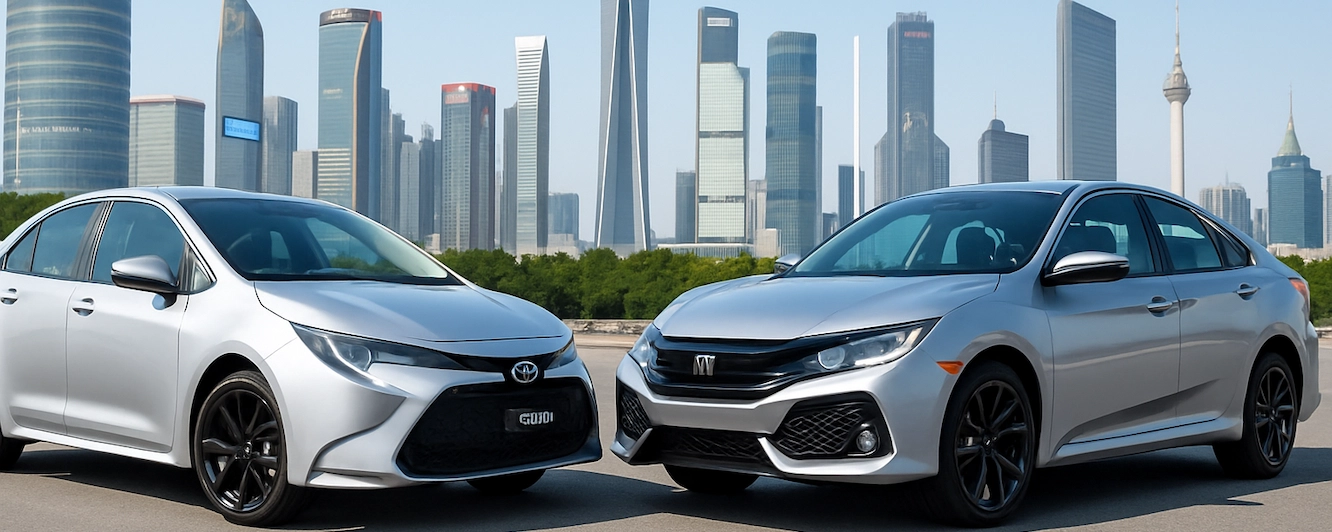
The history of automobiles boasts of many rivalries that shaped its direction and future. While in the US, Ford and GM (click to read more) were vying for market shares, a gripping rivalry was shaping up across the Pacific Ocean, in Japan. And ironically, most of their battle was fought in the US market.
Today, I share with you the story of the rivalry between two of Japan’s most iconic car manufacturers: Toyota and Honda. This rivalry goes beyond engines, horsepower, or market share. It rather wades into differing philosophies, bold innovations and a relentless pursuit of excellence.
Post World War II Japan was reeling under a massive defeat and complete annihilation of Hiroshima and Nagasaki due to the ‘Bomb’. It was then, these two giants rose from the ashes and drove their way to become the global automotive legends. Two Ninjas, writing a saga of respect, resilience, and revolution.
Let’s buckle up and drive through the fascinating rivalry that has shaped the way the world moves.
Toyota: The Stoic Elder
Toyota’s automobile journey began in 1937, when Kiichiro Toyoda, son of inventor Sakichi Toyoda, transformed his father’s loom company into an automobile manufacturer. The company’s first passenger car, the Model AA, rolled out in 1936, and by the 1950s, Toyota was making waves in Japan.
The launch of the Toyota Corolla in 1966 turned out to be a game-changer for Toyota. It became the world’s best-selling car and a symbol of reliability. Toyota’s strategy was to win the customers’ trust by being dependable, practical and durable and by the late 70s, Toyota had become synonymous with reliability.
The key to Toyota’s success was its intense focus on quality and efficiency. Toyota developed the legendary Toyota Production System, a revolutionary approach to manufacturing that emphasised lean production, just-in-time inventory, and continuous improvement or kaizen.
To read more about Toyota, please visit my blog – The Toyota Group: Pivoting From Toyoda to A Powerful Global Brand


Honda: The Bold Sibling
If Toyota was the stoic elder, Honda was the bold younger sibling with a rebellious streak. While Toyota was building cars, Soichiro Honda had a vision to create affordable mobility for everyone. In 1948, he founded Honda Motor Company and started manufacturing motorcycles. By 1959, Honda became the world’s largest motorcycle manufacturer. A title it still holds.
Honda entered the 4-wheeler business in 1963 with the T360 mini truck and S500 sports car. Honda focused on performance, innovation, and individuality. Honda’s breakthrough came with the Civic in the 1970s, which put Honda on the global map. Fuel-efficient, compact, and fun to drive, the Civic became a favourite among young drivers and urban commuters.
During the oil crisis, Civic’s fuel efficiency wowed American consumers. The Accord followed, making waves for its refined driving dynamics and reliability. Honda’s engineering prowess was unmatched. It introduced VTEC engines, pioneered clean emissions technology. In 1986, Honda launched Acura, the first Japanese luxury brand in the US.


What Ignited the Rivalry
The Toyota vs Honda rivalry ignited in the 1970s as both brands expanded aggressively into the US market. They were equally matched. While Toyota had the Camry, Honda had the Accord. Toyota had the Corolla; Honda had the Civic. Each time one brand launched a new model, the other responded with something better or different.
This rivalry intensified throughout the 80s and 90s. While Toyota was winning hearts with cars like the Camry and the Land Cruiser, Honda was creating a buzz with the Accord, Prelude, and the sporty Integra.
Their rivalry was beyond sales. It was about the design philosophy. Toyota focused on long-term reliability and conservative designs. Honda, on the other hand, leaned into performance, innovation, and youthful appeal.
The result was a rivalry that pushed both companies to constantly inspire them to outdo the other and, in doing so, elevate the entire industry.
Finding Their Niche
Despite their rivalry, over time, both brands carved out distinct identities:
Toyota built a reputation for unmatched reliability, durability, and family-friendly vehicles. The Camry, RAV4, and Highlander became staples in suburban driveways. From trucks to hybrids to luxury sedans, Toyota became a global behemoth offering the full spectrum of products. It’s Kaizen culture ensured that even minor tweaks led to major gains in efficiency and quality.
“When consumers purchase a Toyota, they are not simply purchasing a car, truck or van. They are placing their trust in our company.”
Akio Toyoda
Honda, on the other hand, built its niche by positioning itself as the sportier, more driver-focused brand. Models like the Civic Si, Accord Coupe, and CR-V appealed to younger, more adventurous buyers.
Driven by innovation and performance, Honda became the first Japanese carmaker to win a Formula One Grand Prix. It was also the first to launch a dedicated Japanese luxury car brand, Acura, in the US. Honda’s VTEC engines became the stuff of legend among performance enthusiasts.
Differences and Similarities
Toyota is all about breadth and depth. Offering everything from family sedans to full-sized SUVs and pioneering hybrid tech through the Prius. Honda is more compact, with a sharper focus on the driver’s experience, from sporty Civics to nimble CR-Vs.
Toyota often plays the long game. It refines over time. Honda experiments boldly, often ahead of the curve. Toyota made headlines with hybrids; Honda wowed with its hydrogen fuel cell Clarity. Toyota built the global Corolla empire. Honda built the NSX supercar.
Differences
- Design Philosophy: Toyota plays it safe; Honda takes risks.
- Powertrains: Toyota leads in hybrids; Honda excels in naturally aspirated engines.
- Brand Image: Toyota is the dependable family car; Honda is the spirited daily driver.
Similarities
- Both are Japanese giants with global reach.
- Both emphasise quality, safety, and fuel efficiency.
- Both have fiercely loyal customer bases and high resale values.
Despite their rivalry, both are deeply Japanese in their roots: precision, discipline, pride in craftsmanship, and respect for quality.
Anecdotes from the Rivalry
- In the 1980s, when Toyota launched Lexus to take on German luxury cars. Honda beat them to the punch with Acura and became the first Japanese luxury brand in America.
- During the 1990s, Toyota’s Camry and Honda’s Accord became locked in a legendary sales battle in the US. One year, Camry won. Next, Accord struck back. Reviewers often claimed it was too close to call.
- The Toyota Supra and Honda NSX went head-to-head in the sports car arena. The NSX, with its aluminium body and F1-inspired engineering, was a revelation. The Supra, with its turbocharged inline-six, became a legend.
- In 2006, Honda’s Civic Si and Toyota’s Corolla XRS battled for the hearts of young enthusiasts. The Civic won on performance; the Corolla on practicality.
- In 2020, Toyota’s RAV4 overtook Honda’s CR-V in global sales, sparking a new chapter in the SUV wars.
Their rivalry was about bragging rights, fan loyalty, and pushing boundaries.
A Rivalry Driving the World
As much as they compete, Toyota and Honda have together reshaped the global automobile landscape. They made Japanese quality a household term. They democratised technology by putting ABS, hybrid systems, and advanced safety suites in everyday cars.
During the 2008 global financial crisis, while American auto giants struggled, Toyota and Honda weathered the storm, showing the resilience of their lean business models. When climate change became the new challenge, Toyota led with hybrids, and Honda explored electric and hydrogen solutions.
Together, their rivalry has transformed the global auto industry by:
- Setting benchmarks for fuel efficiency and emissions standards.
- Pioneering hybrid and clean engine technologies.
- Raising the bar for manufacturing quality and safety.
- Making Japanese engineering a global gold standard.
Their competition has forced the American, European, and Korean automakers to step up their game. In many ways, the Toyota-Honda rivalry has been a gift to consumers everywhere.
Going Beyond Cars
While competing aggressively in the cars segment, both brands have boldly expanded into new territories, proving their ambitions run far deeper than just the auto market.
Honda
- Honda is the world’s largest two-wheeler manufacturer, with legendary models like the Activa and CBR series dominating roads across Asia and beyond.
- Honda took to the skies with the HondaJet, a sleek, efficient business aircraft that showcases the brand’s engineering finesse in aviation.
- Honda also builds marine engines and humanoid robots like ASIMO.
- Honda has achieved huge success with the Red Bull Racing Formula 1 team, including Max Verstappen’s 4 world titles from 2021 to 2024, establishing it as a performance powerhouse.
Toyota
Toyota, while not in bikes or planes, has quietly been reshaping the future.
- Its focus on robotics, AI, and mobility solutions has led to innovations like assistive robots and autonomous tech.
- The futuristic Woven City near Mount Fuji is a testament to Toyota’s prowess.
- Toyota Financial Services is one of the largest auto finance companies globally.
- Toyota also dominates endurance racing with its Gazoo Racing division and continues to lead in hydrogen fuel cell innovation through the Mirai.
Visionaries Behind the Wheels


Kiichiro Toyoda
The visionary founder of Toyota, Kiichiro, believed in innovation through discipline. His legacy lives on in the Toyota Production System, which revolutionised manufacturing worldwide.
Soichiro Honda
A maverick and a dreamer, Soichiro was obsessed with engineering perfection. He once said, “Success is 99% failure.” His rebellious spirit still defines Honda’s DNA.
“Success represents the 1% of your work which results from the 99% that is called failure.”
Soichiro Honda
Akio Toyoda
The grandson of Kiichiro, Akio, led Toyota through the 2008 financial crisis and championed the return of performance with the GR Supra and GR Yaris.
Toshihiro Mibe
Honda’s current CEO, Mibe, is steering the company toward electrification and sustainability, while preserving its core values of innovation and performance.
The Road Today
Today, Toyota is the world’s largest automaker by sales. It sells over 10 million cars annually. It has a global presence and continues to lead in hybrid and electrification strategies. It’s Lexus brand rivals BMW and Mercedes. The Corolla and Camry still rule the roads.
Honda, while smaller in scale, punches above its weight. The Civic remains a favourite across generations. It’s motorcycles and scooters, dominate globally. Honda’s commitment to clean energy, hydrogen fuel, and autonomous tech is driving its next chapter.
Rivalry with Respect
Toyota and Honda have written one of the most exciting and enduring chapters in automotive history. Their rivalry is a dance of innovation, philosophy, and pride. It’s a rivalry that has pushed both to excel, think better, build smarter, and drive harder.
One gave us cars that last forever. The other gave us cars we want to drive forever. The real winner of the Toyota vs Honda rivalry is us, the consumers.
So, whether you cruise in a Camry or race in a Civic, remember this: behind that steering wheel is not just a machine, but a legacy of excellence born from one of the world’s most iconic rivalries.
And this ride is far from over.
I am positive that you found this article informative and useful!
Please subscribe to my blog by filling in your details below:
My blog has countless such articles and stories to guide you and quench your thirst for knowledge.
You can also follow me on X and Facebook to read more such stories and posts.
PS: ChatGPT and/or Copilot have been used to create parts of this post.
Leave a Reply