
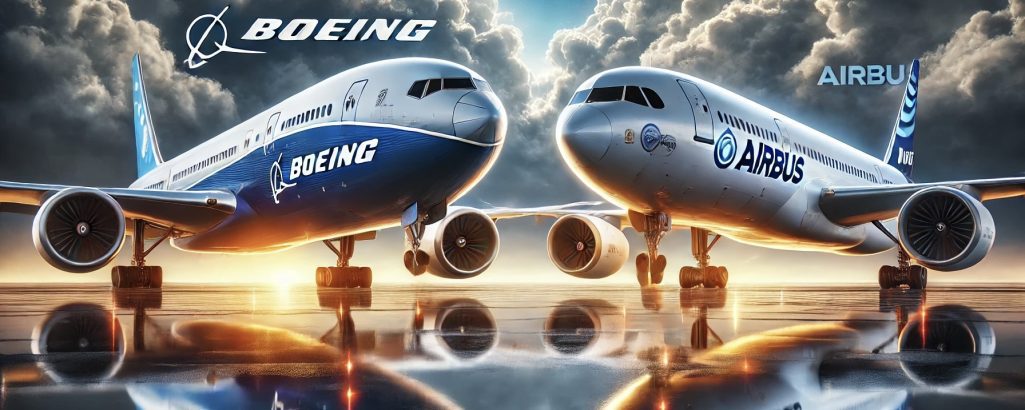
In our business rivalry series, today we talk about a battle that shaped the modern aviation industry and our air travel. The skies have long been a battlefield for these two titans of the aviation industry.
In the world of aviation, the rivalry between Boeing and Airbus is quite remarkable. These industry giants have been striving to outdo each other in innovation, safety, and market dominance for the last 55 years.
With their origins on opposite sides of the Atlantic, Boeing and Airbus represent not just competing companies. They also represent a rivalry fulled with competing ideologies, strategies, and visions for the future of flight. Their epic rivalry has captivated the imaginations of aviation enthusiasts worldwide.
So fasten your seatbelt and join me on a journey through the skies as I explore this fascinating rivalry.
Boeing: The Early Starter
William Boeing, a timber magnet, realised the potential of aviation quite early. He founded Boeing in 1916 in Seattle, Washington, for building seaplanes. Boeing quickly pivoted to become a major player in the aviation industry and started producing military aircraft by the 1920s.
During World War II, Boeing played a crucial role by producing bombers such as the B-17 Flying Fortress and the B-29 Superfortress. These aircraft showcased Boeing’s engineering prowess and cemented its reputation as a leading aircraft manufacturer.
Boeing’s foray into commercial aviation started in the 1930s with the Model 247, one of the first modern airliners. Boeing’s real breakthrough came in 1958 when it introduced the 707. World’s first commercially successful jet airliner. The 707 revolutionised air travel, cutting transatlantic flight times in half and cementing Boeing’s dominance in the skies.


“By the time you finish reading this sentence, a Boeing jetliner will take off or land somewhere in the world.”
Bret Easton Ellis
Airbus: The Challenger
Across the Atlantic, Europe wanted to challenge Boeing’s dominance of the skies. In 1970, French, German, Spanish and British aerospace companies formed a consortium to take on Boeing.
They pooled their resources and expertise to create a European aviation powerhouse capable of competing with the American giant. And thus, Airbus was born.
Airbus entered the fray with the A-300 in 1974. The A-300 was the world’s first twin-engine wide-body aircraft, offering fuel efficiency at a time when rising oil prices were squeezing airline profits. By the 1980s, Airbus had begun eating into Boeing’s market share.
The game-changer A-320, launched in 1987, established Airbus as a true challenger to Boeing. It featured a fly-by-wire system. An advanced technology that replaced traditional mechanical controls with electronic ones, making the aircraft lighter, safer, and more efficient.


Global Rivalry For Market Share
As Boeing and Airbus expanded their product lines, their rivalry extended to all corners of the globe. Both companies aggressively pursued orders from airlines in emerging markets, including Asia, the Middle East, and Latin America. These regions became battlegrounds for securing lucrative contracts and establishing long-term partnerships.
Boeing’s strategic alliances with American carriers and its established presence in North America provided a competitive edge. On the other hand, Airbus leveraged its European roots and strong relationships with airlines in Europe and the Middle East. The rivalry intensified as they vied for market share, each seeking to outmanoeuvre the other.
The Single Aisle War
The rivalry intensified in the 1990s and 2000s as both companies fought fiercely for market share. The competition extended beyond technology to pricing, marketing, and even politics.
In the single-aisle segment, Boeing’s 737 and Airbus’s A320 became the two most popular aircraft families in history. Airlines loved these models for their efficiency, versatility, and ability to serve both short-haul and medium-haul routes.
Each new iteration of Boeing’s 737 and Airbus’s A320 promised better fuel efficiency, lower operating costs, and greater passenger comfort. The competition in this segment remains so fierce that even a single major order from an airline can tilt the balance temporarily.
The Wide Body Battle
Boeing’s 777 and 787 Dreamliner competed head-to-head with Airbus’s A330 and A350. These long-range aircraft allowed airlines to connect cities across the globe directly, bypassing traditional aviation hubs.
In 2007, Airbus upped the ante with the A380, the world’s largest passenger plane. The double-decked behemoth could carry up to 800 passengers in an all-economy configuration. Airbus believed the A380 would dominate high-traffic routes like London to New York or Dubai to Sydney.
Boeing took a different approach with the 787 Dreamliner. Instead of focusing on capacity, Boeing prioritised efficiency, advanced materials, and passenger comfort, betting on a future of more direct, point-to-point flights.
Eventually, Boeing’s bet paid off. While the A380 remains a technological marvel, its sales were disappointing, and production was discontinued in 2021. The 787 Dreamliner, on the other hand, became a commercial success.
Mixing Trade With Politics
The Boeing-Airbus rivalry has always had a political dimension. Both companies have been accused of receiving unfair government subsidies. Airbus from European governments and Boeing from the US government.
These accusations led to a long-running trade dispute at the World Trade Organization (WTO), with each side claiming the other had an unfair advantage. The tit-for-tat allegations resulted in tariffs being imposed on everything from aeroplanes to wine, escalating tensions between the USA and the EU.
Despite periodic efforts to resolve the dispute, the political wrangling continues to this day, adding another layer of complexity to the rivalry.
A Few Interesting Tiffs
The rivalry between Boeing and Airbus isn’t confined to engineering and manufacturing. It has also spilled over into the public arena. Marked by aggressive marketing campaigns, ad wars, and even political lobbying. Here are a few memorable incidents that showcase their head-to-head battles:
If It’s Not Boeing, I’m Not Going
One of the most iconic phrases in aviation history came from Boeing’s marketing team: “If it’s not Boeing, I’m not going.”. This slogan became synonymous with Boeing’s identity, emphasising its reputation for reliability and innovation.
Airbus, however, didn’t take it lying down. Airbus countered with ads highlighting the advantages of their quieter, more efficient aircraft.
4 Engines 4 Long-Haul
Airbus once mocked Boeing’s twin-engine designs with a slogan that read, “4 Engines 4 Long-Haul”. This was a jab at Boeing’s reliance on twin-engine planes for long-haul flights. It suggested that four engines were safer and more reliable for extended journeys over water.
Boeing responded indirectly by doubling down on its innovative twin-engine technology, citing its exceptional reliability, safety records, and operational efficiency. Over time, Airbus itself moved away from the slogan as the aviation industry embraced twin-engine efficiency.
The A-320 Vs 737 PR Clash
The competition between the Airbus A320 and the Boeing 737 is perhaps the most intense. Both manufacturers have touted their planes as the best-selling single-aisle jets. Airbus frequently highlighted the A320’s wider cabin and advanced fly-by-wire technology, while Boeing pointed to the 737’s proven track record and better operational efficiency.
Airbus even ran campaigns comparing the A320neo to the 737 MAX, emphasising better fuel efficiency and reduced emissions. Boeing retaliated by underscoring the 737’s reliability and suggesting that Airbus’s claims were overstated.
Positive Aspects of the Rivalry
The fierce rivalry between Boeing and Airbus has been a driving force behind numerous innovations and quality improvements in the aviation industry. Competing to outdo each other, both companies have continually pushed the boundaries of technology, efficiency, and passenger experience.
A few aspects worth mentioning are:
Safety and Efficiency
Boeing and Airbus have invested heavily in research and development, resulting in significant advancements in safety, efficiency, and passenger experience. Boeing introduced the 777, with its advanced aerodynamics and extended range due to efficiency.
Airbus responded with the A330 and, later, the A350. Both these aircraft incorporated composite materials, advanced avionics, and improved fuel efficiency.
Digitalisation and Connectivity
Boeing and Airbus embraced digitalisation and connectivity to enhance their aircraft’s performance and passenger experience. The introduction of in-flight entertainment systems, Wi-Fi connectivity, and real-time data analytics transformed air travel.
Boeing’s Connected Aircraft initiative is aimed at harnessing the power of data to optimise flight operations, maintenance, and passenger services. Similarly, Airbus’s Skywise platform enables airlines to monitor and analyse data from their fleets, improving efficiency and reducing costs.
The Future of the Rivalry
The rivalry between Boeing and Airbus shows no signs of abating. As we look to the future, the Boeing-Airbus rivalry is set to evolve. A few interesting aspects to watch out for are:
The Next-Gen Aircrafts
Boeing and Airbus are continually working on the next generation of aircraft, incorporating cutting-edge technologies to meet evolving market demands.
Boeing’s upcoming 777X features new composite wings and advanced engines and aims to set new standards in long-haul travel. Airbus, in turn, is developing the A321XLR, a long-range narrowbody aircraft designed to offer greater operational flexibility and efficiency.
Collaborations
Boeing and Airbus have realised the importance of partnerships. Both companies have forged alliances with other aerospace manufacturers, technology firms, and research institutions. These alliances are crucial to staying at the forefront of innovation.
Boeing’s partnership with Embraer aims to strengthen its position in the regional aircraft market. Airbus, on the other hand, is collaborating with companies like Bombardier to expand its product offerings.
Sustainable Flights
With aviation under pressure to reduce its environmental impact, both companies are investing heavily in sustainable technologies. Airbus has unveiled concepts for hydrogen-powered aircraft, aiming for entry into service by 2035. Boeing, meanwhile, is exploring sustainable aviation fuels (SAFs) and advanced aerodynamics to lower emissions.
Urban Air Mobility
Both Boeing and Airbus are eyeing the emerging market for urban air mobility, including electric vertical take-off and landing (eVTOL) aircraft. While this market is still in its infancy, it represents a new frontier in aviation.
The China Factor
China’s state-owned COMAC is developing the C919 to challenge the dominance of Boeing and Airbus in the single-aisle market. The C919 is unlikely to dethrone the 737 and A320 immediately. However, it represents a long-term threat. Neither Boeing nor Airbus can ignore this challenge.
Conclusion
The rivalry between Boeing and Airbus is a relentless pursuit of excellence. From their humble beginnings to becoming the global aviation giants, Boeing and Airbus have continually pushed the boundaries of innovation, safety, and efficiency.
Their competition has driven advancements in aircraft technology and has shaped the way we travel. The battle for supremacy continues. One thing is certain: the rivalry between Boeing and Airbus will captivate aviation enthusiasts, industry professionals, and travellers alike.
I am positive that you found this story amusing and informative!
Please subscribe to my blog by filling in your details below:
Here, you can read interesting stories, exciting ideas and insights. You will also get an email update once a new story or article is published.
You can also follow me on X and Facebook to read more such stories and posts.
PS: Copilot, ChatGPT and Grammarly have been used to create parts of this post.
Leave a Reply