
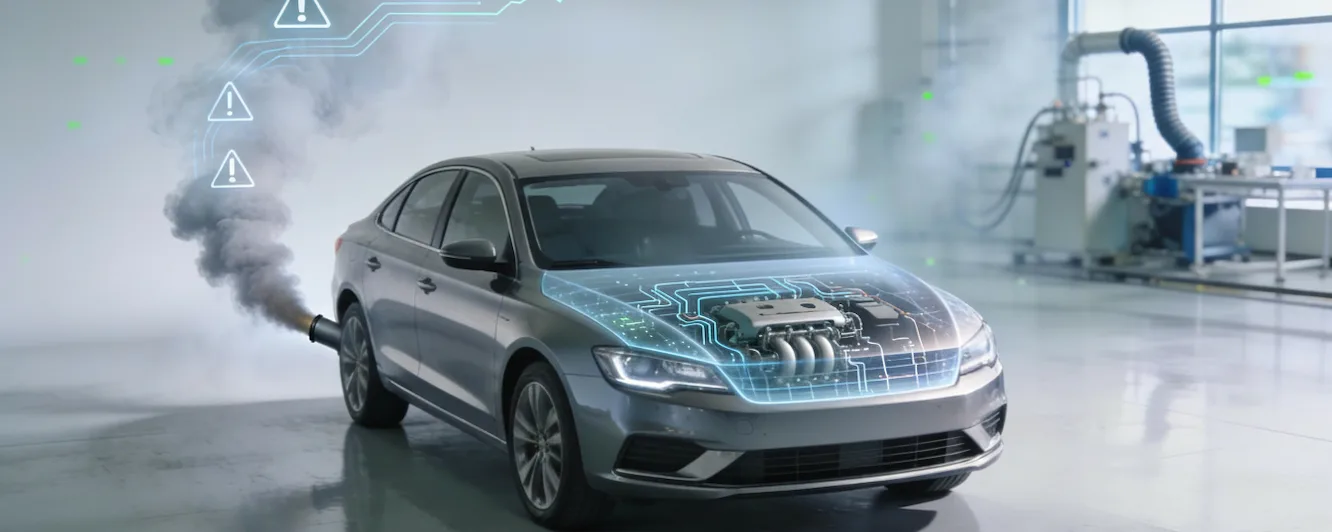
The world was stunned when it emerged that Volkswagen, long regarded as a benchmark of German engineering excellence, had indulged in large-scale manipulation of vehicle emission levels. By deploying sophisticated software to circumvent regulatory testing systems, the company chose market dominance over environmental responsibility, compromising trust in the process.
At a time when climate change is no longer a distant concern but a lived reality, governments across the globe have enforced strict emission norms. Standards such as Bharat Stage (BS) in India and Euro norms in Europe are designed to reduce toxic tailpipe emissions and improve air quality for citizens. These regulations exist to protect public health and the environment. Yet, in 2015, the race to appear environmentally compliant took a troubling turn.
The Volkswagen Dieselgate scandal became one of the most disturbing examples of corporate manipulation in modern automotive history. The issue was not limited to excessive emissions alone. It was the calculated, systematic bypassing of regulations, combined with a carefully crafted image of environmental leadership. This manipulation triggered global outrage, regulatory crackdowns, and a severe erosion of customer confidence.
In this article, I examine the technical, regulatory, and customer service dimensions of the Dieselgate scandal, and explore how this manipulation reshaped Volkswagen and sent shockwaves across the global automotive industry.
Volkswagen: The People’s Car
Volkswagen, which literally means “People’s Car” in German, was founded in 1937 with a clear and ambitious goal: to build affordable and reliable vehicles for the masses. The iconic Beetle came to symbolise simplicity, durability, and value, eventually becoming one of the best-selling cars in automotive history and a defining pillar of the Volkswagen brand.
For a deeper look at these early years, you may read my detailed blog, Volkswagen Beetle: From Hitler’s Bold Vision to a Cultural Icon.
From its modest beginnings in Wolfsburg, Germany, Volkswagen steadily expanded its footprint across continents. Models such as the Golf, Jetta, and Passat became household names in India and global markets alike, known for their solid build quality, engineering precision, and understated elegance. By the early 21st century, Volkswagen was no longer just a car manufacturer; it had evolved into a global automotive institution.
This reputation was built on the foundations of German engineering, durability, and customer confidence. Ironically, it was this very trust that magnified the impact of the later emissions manipulation. When a brand long associated with engineering integrity was exposed for deliberate manipulation, the sense of betrayal among customers, regulators, and industry observers was deep and lasting.
Building a German Automotive Empire
Volkswagen did not remain a single-brand manufacturer for long. Its rise to the top was driven by a relentless strategy of acquisition and amalgamation. Volkswagen did not just build cars; it built a German automotive empire. Through calculated takeovers, the group created one of the most powerful automotive portfolios in the world. Audi strengthened the premium segment. Porsche brought performance and motorsport credibility. Skoda and SEAT addressed mass-market and value-driven customers, while Bentley, Lamborghini, and Bugatti added luxury and supercar prestige.
This consolidation enabled the Volkswagen Group to dominate global automotive markets. Shared vehicle platforms, engines, electronics, and software helped reduce costs and improve efficiency at scale. However, this dominance also created intense internal pressure. Retaining the title of the world’s largest automaker gradually became a priority, sometimes overshadowing ethical decision-making and regulatory discipline.
At this scale, even a small technical manipulation could have far-reaching consequences. When manipulation occurred, it impacted millions of vehicles across brands, regions, and customer segments. The Dieselgate manipulation was therefore not an isolated failure of one model or market. It was systemic, embedded across the group’s diesel strategy, and amplified by the very size and influence Volkswagen had built.
Understanding Vehicular Pollution
To grasp the true gravity of the manipulation, it is essential to understand what actually comes out of a vehicle’s tailpipe. Vehicle emissions contain several harmful substances that contribute to smog, acid rain, and climate change. More importantly, they have a direct impact on human health, leading to respiratory illnesses, cardiovascular problems, and long-term health complications. This is precisely why emissions manipulation is treated as a serious environmental and public health offence.
Diesel engines, in particular, emit a combination of especially harmful pollutants like:
- Nitrogen Oxides (NOx): Highly reactive gases that cause smog and acid rain.
- Particulate Matter (PM): Tiny soot particles that penetrate deep into human lungs.
- Carbon Monoxide (CO) and CO2: Contributing to respiratory issues and global warming.
While petrol engines are cleaner in certain respects, diesel engines gained popularity due to superior fuel efficiency and torque. The trade-off, however, is significantly higher NOx emissions. In dense urban environments, this becomes a severe public health risk. As a result, regulators across the world tightened emission norms to control these pollutants. Any manipulation of emission testing directly defeats these safeguards and undermines the very objectives of environmental protection and public health.
The Evolution of Emission Norms
The journey of vehicle emission norms began in the 1970s with the introduction of the US Clean Air Act, a landmark move to control air pollution from automobiles. Europe soon followed with a series of Euro emission standards, each more stringent than the last. India later adopted Bharat Stage norms, broadly aligned with European regulations, to address rising pollution levels in rapidly growing cities.
Over the decades, these standards evolved into highly complex frameworks such as Euro 6 and BS-VI. The objective remained consistent: push manufacturers to innovate and reduce harmful emissions. Euro 6, introduced in the early 2010s, marked a turning point, especially for diesel vehicles.
It mandated steep reductions in nitrogen oxide emissions without compromising performance or fuel efficiency. For some manufacturers, this challenge created intense pressure. It was at this critical stage that manipulation began to appear as a shortcut, exposing the tension between regulatory compliance, cost control, and competitive positioning.
Lower Emissions Mean Higher Costs
Producing low-emission vehicles is inherently expensive. It demands advanced exhaust after-treatment systems, high-precision sensors, complex control software, and costly materials. Technologies such as Selective Catalytic Reduction, Diesel Particulate Filters, and AdBlue dosing systems added high cost to every vehicle produced, often running into thousands of dollars per car.
For mass-market manufacturers like Volkswagen, maintaining price competitiveness while meeting strict emission norms was a persistent challenge. Passing these additional costs to customers risked losing market share, especially in price-sensitive segments.
Absorbing the costs internally reduced margins and affected profitability. This sustained cost pressure created an environment where manipulation could be misjudged as a practical shortcut, turning a commercial challenge into a serious ethical and regulatory failure.
Volkswagen’s Big Bet on Diesel
Volkswagen aggressively promoted diesel vehicles, particularly in Europe. Diesel engines delivered better fuel efficiency and lower carbon dioxide emissions per kilometre compared to petrol engines. Through its TDI (Turbocharged Direct Injection) branding, Volkswagen positioned diesel as the ideal solution, promising the performance and economy of diesel with the perceived “cleanliness” of petrol.
From a marketing standpoint, it was a highly effective strategy. While several competitors began shifting toward hybrid technologies, Volkswagen doubled down on diesel as its core proposition. However, beneath this confident narrative, engineers were running into serious technical limitations that could not be easily resolved.
Meeting Euro 6 emission norms for diesel engines without sacrificing performance or fuel efficiency proved extremely challenging. Reducing nitrogen oxide emissions required either costly after-treatment systems or significant compromises in engine calibration.
Volkswagen engineers were constrained by limited space for additional hardware, strict cost targets set by management, aggressive development timelines, and high expectations on performance and efficiency. Faced with these pressures, Volkswagen opted for manipulation instead of redesign or higher investment. That choice converted a complex engineering problem into a far-reaching ethical, regulatory, and legal crisis.
The Great Manipulation: How They Did It
When engineering solutions reached their limits, manipulation took over. Volkswagen implemented what later became known as a “defeat device.” This was not a physical component, but a sophisticated software algorithm embedded within the Engine Control Unit (ECU). Its sole purpose was to manipulate emission behaviour during regulatory testing while delivering quite different results in real-world driving.
The Technical Step-by-Step of the Manipulation:
- Test Detection: The software continuously monitored parameters such as steering wheel movement, vehicle speed, and atmospheric pressure. When the steering wheel remained stationary, and the wheels rotated on a dynamometer, essentially a treadmill for cars, the system identified that the vehicle was undergoing an emission test.
- The “Switch”: Once a test condition was detected, the ECU activated a special “dyno calibration” mode. In this mode, emission control systems operated at maximum efficiency, ensuring the vehicle complied with all regulatory emission limits.
- Real-World Driving: During normal on-road use, the software recognised real driving patterns. It then reduced or deactivated emission controls to enhance fuel efficiency, performance, and perceived engine durability.
- The Result: This manipulation enabled Volkswagen vehicles to clear laboratory emission tests while emitting dramatically higher pollution levels on the road, in some cases releasing up to 40 times the legally permitted Nitrogen Oxide (NOx) levels.
This calculated manipulation blurred the line between software optimisation and deliberate deception, making it one of the most technically intricate and ethically troubling episodes in automotive history.
Early Warning Signs and Whistleblowers
The manipulation was not uncovered by a government regulator at first, but by a small non-profit organisation, the International Council on Clean Transportation (ICCT). In collaboration with researchers from West Virginia University, the group conducted real-world emission tests on diesel vehicles outside controlled laboratory conditions.
The expectation was simple: the vehicles would perform within legal limits. Instead, the results revealed staggering discrepancies between laboratory data and on-road emissions. These findings raised early red flags and pointed directly toward possible manipulation.
Despite growing evidence and conflicting technical reports, Volkswagen spent nearly a year deflecting scrutiny. The company attributed the abnormal readings to vague “technical glitches,” effectively stonewalling regulators and delaying accountability while the manipulation continued unchecked.
Dieselgate: The Explosion
In September 2015, the US Environmental Protection Agency (EPA) formally accused Volkswagen of installing illegal defeat devices in its diesel vehicles. The company initially denied any wrongdoing, attributing the issue to technical anomalies. However, as investigations deepened and evidence accumulated, Volkswagen was forced to admit to deliberate manipulation.
The revelation triggered a global scandal that quickly became known as Dieselgate. Then, CEO Martin Winterkorn resigned, and several senior engineers and executives across Volkswagen, Audi, and Porsche were suspended or investigated. What was initially portrayed as a software irregularity was exposed as a coordinated, systemic manipulation of emission laws.

What began as an internal technical workaround rapidly escalated into one of the largest corporate scandals in automotive history. Dieselgate soon became synonymous with emissions manipulation, regulatory failure, and corporate deception, permanently altering how the world viewed Volkswagen and the diesel technology it once championed.
A Global Embarrassment
The fallout from the manipulation was severe and far-reaching. Investigations quickly spread across dozens of countries, including India, Germany, the United Kingdom, and the United States. What began as a regulatory action in one market soon became a global crisis.
Millions of vehicles were recalled, and court cases multiplied across jurisdictions. Production of several models was suspended, and the “Made in Germany” label, once seen as a benchmark of engineering integrity, suffered serious reputational damage. From a customer service perspective, the impact was devastating. Millions of owners discovered that their so-called “eco-friendly” vehicles were, in reality, significant environmental polluters due to deliberate manipulation.
Regulators responded with tighter scrutiny and tougher enforcement. Governments began questioning the credibility of existing emission testing frameworks. The manipulation did not damage Volkswagen alone; it shook confidence in the entire automotive industry, exposing systemic weaknesses in regulation, compliance, and corporate accountability.
The Massive Damages of Manipulation
Volkswagen has paid more than $33 billion (approximately ₹2.7 lakh crore) in fines, penalties, settlements, vehicle buybacks, and recall-related costs. Several senior executives faced criminal charges, while shareholder lawsuits severely dented investor confidence and market value.
However, the most damaging consequence went far beyond money. The true long-term cost of the manipulation was trust. Customer service systems were pushed to the breaking point as complaints, recalls, legal queries, and compensation claims surged across markets. Rebuilding credibility with customers and regulators proved far more difficult than settling financial penalties.
In response, Volkswagen sharply reduced its dependence on diesel vehicles and accelerated investments in petrol, hybrid, and electric mobility. Dedicated platforms such as MEB were developed exclusively for electric vehicles.
Marketing messages shifted away from diesel efficiency toward sustainability and electrification, while internal compliance and governance systems were tightened. Yet, these changes were largely reactive, driven by the fallout of manipulation rather than a proactive commitment to ethical innovation.
Still Paying the Price: 2025 Reality
Nearly a decade later, the shadow of the manipulation still hangs over Wolfsburg. Volkswagen continues to pay the price for its past decisions. The brand image remains visibly bruised, customer scepticism has not fully faded, and while financial performance has seen partial recovery, the scars of manipulation are still evident.
In late 2024 and early 2025, Volkswagen was hit by a fresh crisis. Weak demand for its new electric vehicle range, combined with the long-term financial burden created by Dieselgate, forced the company into a historic decision. For the first time in its 88-year history, Volkswagen announced the closure of production plants in Germany.
The lingering financial strain from the manipulation, along with intense competition from fast-moving Chinese automakers, has pushed the once-dominant giant into a phase of deep restructuring. This includes plans to lay off more than 35,000 employees, underscoring how far-reaching and enduring the consequences of manipulation can be, even years after the scandal first erupted.
Conclusion: Manipulation Never Pays
The Volkswagen Dieselgate scandal stands as a clear reminder that manipulation may deliver short-term advantages but inevitably results in long-term damage. No level of technical brilliance or engineering sophistication can compensate for ethical failure. Once customer trust is broken through manipulation, rebuilding it becomes a slow and uncertain process.
In its pursuit of growth, efficiency, and global dominance, Volkswagen chose manipulation over transparency and accountability and paid the price. For organisations across industries, the lesson is unmistakable. Manipulation may postpone consequences, but it never eliminates them. In the end, integrity, strong governance, and a genuine customer-centric approach remain the only sustainable paths to long-term success.
I am positive that you found this article interesting and useful. Please subscribe to my blog by filling in your details below:
My blog has countless such articles and stories to guide you and quench your thirst for knowledge.
If you enjoy stories woven with power, passion, and desire, explore my books on Amazon. My stories unravel the fine line between success and surrender, reminding us that in a world ruled by strategy, love remains the ultimate game changer.
If you enjoy videos, you can watch interesting thoughts and stories on my YouTube channel. You can also follow me on X and Facebook to read more such stories and posts.
PS: Gemini and/or ChatGPT have been used to create parts of this post.
Disclaimer: This article is written for informational and educational purposes only, based on details available in the public domain. It is intended to analyse the event from a strategic and learning perspective. It does not intend to absolve, accuse, or defame any individual, entity, or corporation of wrongdoing, criminal intent, or dereliction of duty beyond what has been documented and shared publicly.
Leave a Reply