
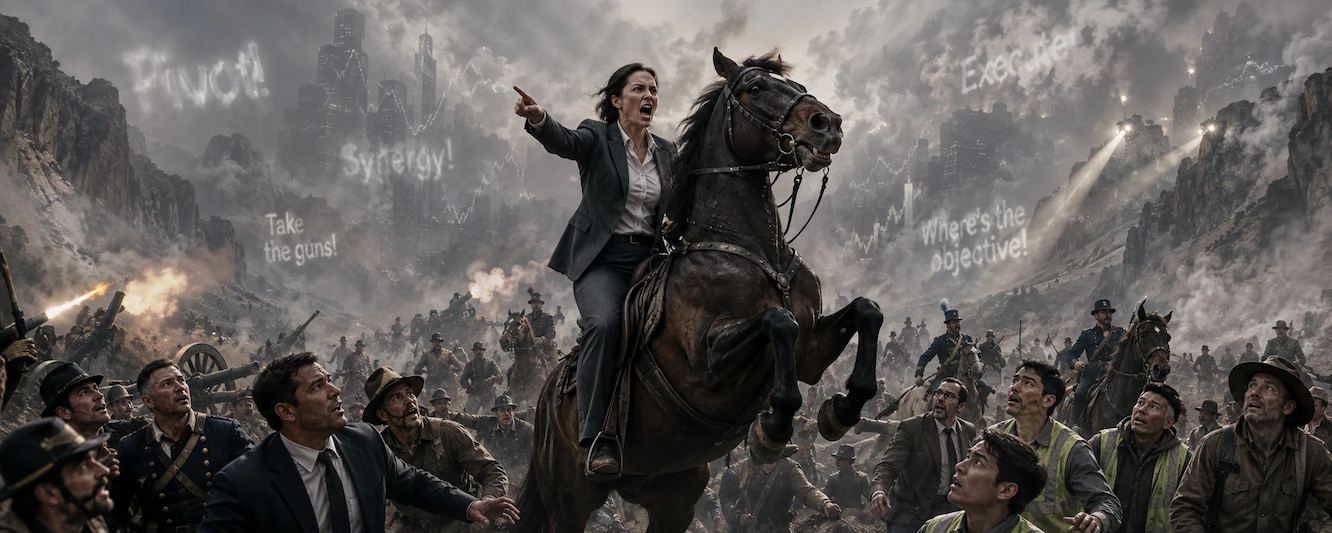
50-WORD SUMMARY: In 1854, misaligned perspectives destroyed the Light Brigade. When senior executives and frontline managers view the battlefield from different angles, even simple commands trigger catastrophic business operations failures. Discover how leaders can eliminate ambiguous orders, challenge unquestioned assumptions, encourage psychological safety, and build cohesive team dynamics across all organisational tiers.
Imagine standing on a high cliff overlooking a broad valley. You can see the enemy’s positions, their weak spots and their attempt to haul away artillery. You write a brief directive and expect a swift response.
Now imagine standing on the valley floor. Dust, smoke and steep ridges block your view. You cannot see the artillery mentioned in the message. Ahead is a heavily defended battery, ready to punish anyone who approaches. Yet the order is clear: advance. What do you do?
On 25 October 1854, during the Battle of Balaclava in the Crimean War, this was not a thought experiment. A misaligned command moving through the ranks sent about 670 British cavalrymen into a disastrous charge. The Charge of the Light Brigade remains a sharp lesson in how misaligned perspectives, incomplete instructions and unquestioned assumptions can undo even a capable team.
Modern leaders rarely send people towards cannon fire. But misaligned work still brings lost revenue, exhausted people, weakened customer trust and reputational harm. The setting has changed; the management problem has not.
The Valley of Death: How a Tragic Command Unfolded
The situation at Balaclava was simple in theory. Lord Raglan, commander of the British forces, watched from the Sapouné Heights. He saw Russian troops removing captured naval guns from redoubts along the Causeway Heights.
Raglan wanted to stop them. He sent an urgent note to Lord Lucan, his cavalry commander in the valley:
“Lord Raglan wishes the cavalry to advance rapidly to the front, follow the enemy, and try to prevent the enemy carrying away the guns.”
Captain Louis Nolan, a talented but impulsive officer, carried the message to Lucan.
This was the fault line. Raglan had a wide view from the heights; Lucan had a narrow view from below. Lucan could not see the redoubts. From the valley, the only obvious “guns” were a formidable Russian battery at the far end of the North Valley, protected on both sides.

Lucan asked Nolan which guns Raglan meant. Nolan, frustrated by Lucan’s caution, gestured towards the far end of the valley and snapped, “There, my Lord, is your enemy! There are your guns!” The explanation was more heat than clarity. It left the order dangerously misaligned with the commander who had to act on it.
Lucan did not seek further clarification. He passed the command to his brother-in-law, Lord Cardigan, who led the Light Brigade. The two men had a poor relationship and communicated sparingly. Cardigan understood that a frontal charge through a cannon-lined valley made little sense, but he did not challenge the instruction.
When a leader feels misaligned with senior intent but does not feel able to question it, compliance can replace judgement. Cardigan drew his sword and led roughly 670 men into what became known as the Valley of Death.
As the brigade moved, Nolan appears to have realised the error. He rode forward, waving to redirect the men towards the correct hills on the right. An artillery shell killed him before he could explain.
For more than a mile, the Light Brigade rode into crossfire. They reached the battery and briefly took the position. With no infantry support, they retreated through the same fire. In around twenty minutes, roughly 110 men were dead, more than 160 wounded, and the brigade was shattered.
The failure was not one person’s mistake alone. Each leader held a different view of the same situation, and the chain of command remained misaligned until action made correction impossible. It was a misaligned strategy from the start.
Why Teams Become Misaligned: The Mechanics of Operational Failure

The Charge of the Light Brigade is a case study in organisational failure. Leaders at different levels have different vantage points. A chief executive sees market movements, competitive pressure and financial outcomes. A director sees constraints, resources and dependencies. People close to delivery see technical debt, bottlenecks and workarounds no dashboard captures.
None of these views is wrong. The danger arises when they remain misaligned. Four patterns commonly create that gap.
1. Divergent Vantage Points
When executives set a mandate without understanding the view from the valley floor, misaligned delivery becomes likely. An executive board may decide to launch a digital transformation in three months to gain market share. The engineering team may know that ageing infrastructure makes that timetable unsafe without putting core services at risk.
Without a shared picture of the terrain, strategic ambition becomes operational fantasy. Test the plan against facts closest to the work.
2. Ambiguous Communication and Vague Directives
Raglan’s note referred only to “the guns”. The context was obvious to him and unclear to Lucan. Business leaders do something similar when they ask teams to “improve customer engagement”, “drive operational excellence” or “move faster”. Such phrases can start useful conversations, but they are not instructions.
If the outcome, trade-offs and boundaries are unclear, managers fill the gaps using their own assumptions. Different departments then produce misaligned versions of the same strategy, each reasonable in isolation and damaging together.
3. Unquestioned Assumptions in High-Stakes Work
Lucan and Cardigan were constrained by hierarchy, personal friction and military protocol. Cardigan recognised the risk but acted without clarification. The modern equivalent is a culture where people keep quiet because challenging a senior decision feels career-limiting.
Employees assume leadership knows something they do not; leadership assumes everyone understands. The result is misaligned execution wrapped in apparent agreement. A polite meeting is not alignment.
4. Distorted Messages and Broken Information Channels
Nolan was not a neutral messenger. His frustration shaped how he explained the order, replacing precise context with an emotional gesture. In organisations, information can be filtered by hurried managers, siloed teams or people with an incentive to frame the message their way.
Once the channel is compromised, teams begin operating from misaligned versions of reality. The answer is not more messages. It is clearer ownership, direct access to context and a reliable way to check what has been understood.
Warning Signs of an Impending Misalignment Crisis
Leaders should spot drift before it becomes expensive. Early action can realign a misaligned organisation before financial loss, staff strain or customer damage takes hold.
- Siloed execution and conflicting priorities: When two departments pursue goals that undermine each other, the work is misaligned. For example, sales may offer bespoke features to close deals while product teams build a standardised, scalable platform.
- Passive compliance without feedback: If a major shift receives no questions, debate or challenge from operational leaders, pay attention. The absence of constructive friction can mean people are planning their own misaligned interpretations in silence.
- Frequent firefighting and scope drift: Constant emergencies rarely signal a lack of effort. They often point to misaligned requirements at the start: teams are solving problems that do not serve the wider objective.
- Metrics that do not match results: If departmental dashboards are green while the business is underperforming, the measures may be misaligned. A support team might reduce ticket times while customer retention falls because cases are closed rather than properly resolved.
Frameworks for Coherent, Effective Alignment
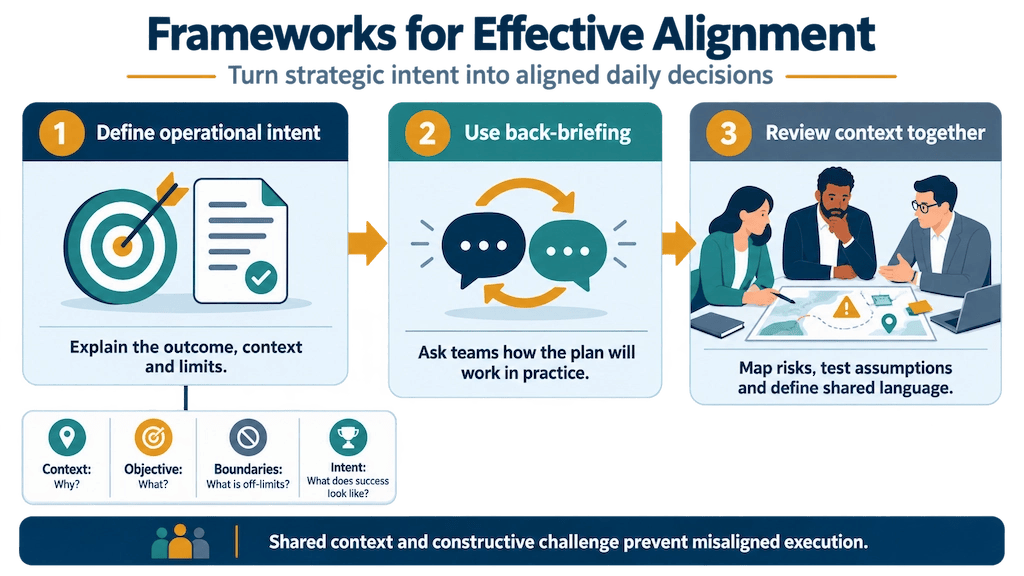
To avoid operational traps, leaders need systems that connect strategic intent to daily decisions. These practices stop plans from becoming misaligned as they travel through the organisation.
1. Use an Intent-Based Operational Framework
Rather than issuing rigid procedural commands, explain the intent behind the work. A good directive states the desired result, the context and the limits within which people can act.
| Element | Question it answers |
| Context | Why are we undertaking this initiative? |
| Objective | What specific, measurable goal must be achieved? |
| Boundaries | Which actions or risks are off-limits? |
| Intent | What does success look like when the work is complete? |
When people understand the why, they can adapt when conditions change and flag action misaligned with the goal.
2. Make Back-Briefing a Habit
In military planning, a brief-back asks the subordinate to explain how they will carry out an order in their own words. It exposes gaps before movement begins.
In business, avoid asking, “Does everyone understand?” Ask instead: “Given your team’s operating reality, how will this strategy play out over the next quarter?” The response reveals misaligned assumptions, timing and dependencies while there is room to act.
3. Hold Multi-Level Context Reviews
Before a significant operational change, bring executives, middle managers and frontline delivery leads into the same conversation.
- Map the landscape: Agree where the “enemy guns” really are: risks, dependencies, customers and constraints.
- Validate assumptions: Invite frontline colleagues to test strategic beliefs against what is happening on the ground.
- Establish common vocabulary: Replace ambiguous jargon with terms people define in the same way.
These reviews prevent leadership and operational views from becoming misaligned before commitment hardens.
Real-Life Applications: How Leaders Maintain Alignment
These examples show how structured conversation can prevent expensive mistakes.
Example 1: The Tech Rollout That Avoided Chaos
A global financial firm planned to migrate its core databases in one weekend. The Chief Technology Officer stressed speed to limit downtime.
Aware that the plan could be misaligned with delivery risk, the project manager held a back-briefing. Engineers explained that the compressed window would require them to skip essential data-validation checks.
The discussion revealed the CTO’s real intent: protecting data mattered more than a rigid 48-hour target. The firm used two maintenance windows, avoiding potential outages and corrupted customer records.
Example 2: Aligning Sales and Product Teams
A fast-growing software company faced constant friction between its sales and product teams. Sales representatives promised custom features to win immediate enterprise contracts, while product teams focused on standardising the platform for longer-term growth. Their incentives were misaligned.
The Chief Executive adopted an intent-based framework. Sales incentives were linked to product-roadmap adoption, and product leads joined key client discussions. Aligning commercial targets with engineering capacity reduced client churn by 35% in six months.
Bridging the Gap Between the Heights and the Valley
The Light Brigade’s tragedy was not caused by a lack of bravery, loyalty or skill. The soldiers who rode into the valley had all three. Their courage was spent on the wrong task because leaders on the heights did not align their context with the officers below.
When directives travel through an organisation without clarity, context and mutual understanding, misaligned execution is likely. The financial cost, human toll and reputational damage are leadership responsibilities, even when the failure appears much lower in the hierarchy.
Never assume that a view from the high ground is visible on the valley floor. Clarify intent, invite informed challenge and check that every level shares the same picture. That turns direction into coordinated action rather than a misaligned charge.
Your Next Step as a Leader
Before issuing your next strategic directive, pause and ask: “From where you stand, what risks or obstacles do you see in carrying out this plan?”
The answers may expose a misaligned assumption, a missing dependency or a dangerous trade-off. More importantly, they give your team permission to surface the reality you cannot see from the heights.
If you found this perspective useful, consider subscribing to my blog by sharing your email below. You will receive regular insights on strategy, leadership, and building sustainable systems.
Stay Connected: For short-form thoughts and business storytelling, follow me on X and Facebook for regular updates. Beyond the Blog: If stories of power, ambition, and passion interest you, explore my books on Amazon. They examine the fine line between success and surrender, and the choices that define both.


Leave a Reply