

50-WORD SUMMARY: During the Taiping Rebellion, desperate currency debasement triggered an economic collapse. Leaders often repeat history by reacting to isolated symptoms with short-term fixes. By adopting a 360-degree assessment and structured decision-making, executives can prevent bad choices from compounding, protecting their financial prudence, team dynamics, and long-term organisational health.
When business pressure mounts, panic becomes a silent killer. It convinces executives to trade long-term stability for immediate relief. History shows that when a leader makes a reactive, half-baked decision, it triggers a chain reaction of bad choices that leads to operational paralysis, financial ruin, and systemic collapse.
In the nineteenth century, the Qing dynasty learned this lesson in the costliest manner imaginable. Their story offers a masterclass in how knee-jerk decisions compound into absolute doom.
When Improvisation Caused an Imperial Collapse
In the 1850s, the Qing Empire in imperial China operated on a dual-currency system. Ordinary citizens used copper cash coins for daily purchases, while merchants and the government transacted in silver taels. Taxes had to be paid in silver. However, British trade imbalances and widespread opium smuggling had drained silver from the country. This shortage caused silver’s value to surge against copper.
For the average peasant, the real-term tax burden doubled overnight. Frustration bubbled beneath the surface, creating fertile ground for civil unrest. Then came Hong Xiuquan, a visionary leader who launched the Taiping Rebellion.
When Taiping forces captured Nanjing in 1853, the Imperial Court faced a sudden revenue shortfall. The rebellion cut off the Grand Canal, stopping the flow of grain and tax revenues from the wealthy southern provinces to Beijing. The empire needed funds immediately to pay its soldiers and keep the military machine running.
Instead of stepping back to evaluate the structural realities of their economy, Emperor Xianfeng and his advisors panicked. They chose quick-fix financial tricks over sound fiscal policy.
The Domino Effect of Flawed Decisions
The imperial treasury took its first disastrous step: currency debasement. The mints began issuing multi-value copper coins stamped with nominal values of 10, 50, or 100 cash. Yet, these coins contained only a fraction of the actual metal weight required. The government expected the market to accept this artificial value simply because the state demanded it.
Merchants were not fooled. Trust in the currency evaporated instantly. Prices skyrocketed as vendors demanded far more copper coins to cover the real value of their goods.
Rather than pausing to reverse this mistake, the court doubled down. Facing a severe shortage of copper, they introduced iron and lead coinage. These cheap, brittle coins rusted in people’s pockets and were utterly worthless for trade. When citizens refused to accept iron coins, the treasury made another rushed move: issuing unbacked paper banknotes called Guanpiao and Baochao.
Without gold or silver reserves to back these paper promises, hyperinflation exploded across the empire. Citizens hoarded real silver and foreign coins, driving legitimate currency out of circulation. The local trade network suffered a total economic collapse.
Decentralisation and the Final Blow
Desperate to fund the war effort, the imperial court made one more impulsive decision. They permitted regional governors to levy their own local transit tax, known as Likin, on goods moving through internal trade checkpoints.
The Likin tax raised immediate war funds, but it choked domestic commerce with endless tax barriers. More dangerously, it transferred financial independence from Beijing to regional commanders. The central government had surrendered its fiscal power to survive a short-term crisis.
While the imperial forces eventually defeated the Taiping rebels in 1864, the damage was done. The monetary improvisations caused an economic collapse across all provinces. Beijing never recovered its central authority, leaving a fractured empire that fell apart decades later.
Half-Thought Decisions Trigger a Total Collapse
The downfall of the Qing economy was not caused by a single bad policy, but by a cascade of unexamined choices. Modern business leaders frequently fall into the same trap during financial stress or operational disruption.

When a company experiences a sales decline or supply chain shock, executives often feel intense pressure to act immediately. This urgency creates a dangerous cognitive bias where speed is mistaken for effectiveness. Leaders attempt to fix symptoms rather than root causes, starting a downward spiral.
Effect of Compounded Mistakes in Modern Business
Consider a software startup that experiences sudden churn among its enterprise customers.
1. The Initial Rash Decision: To cover the revenue shortfall, the leadership cuts customer support staff by 40% to preserve cash flow.
2. The Unintended Consequence: Response times double. Service quality drops, driving even more customers away.
3. The Reactive Escalation: To replace lost revenue, sales reps make wild feature promises to prospective buyers without consulting product engineering.
4. Operational Overload: Engineers stop working on core stability to build custom features for new clients, creating technical debt and system outages.
5. Systemic Failure: The product stability collapses, top engineering talent resigns in frustration, and the brand reputation breaks down completely.
This pattern demonstrates how an unanalysed fix creates secondary problems that are far worse than the original issue. Each bad choice limits future options until the business suffers a complete financial collapse.
360-Degree Evaluation of High-Stakes Decisions
To prevent an operational or financial collapse, one must adopt a 360-degree perspective before executing critical choices. This requires looking beyond immediate financial spreadsheets to understand how a decision impacts team dynamics, customer trust, market perception, and operational limits.

When evaluating a major pivot, cost-cutting measure, or product change, you can run the proposal through four critical lenses:
1. Financial Soundness: Look beyond immediate cash flow impact. Ask how this choice affects long-term unit economics, working capital, and balance sheet resilience. Avoid solutions that trade structural health for temporary liquidity.
2. Operational Feasibility: Assess whether the current infrastructure can handle the change. Will this decision burn out key personnel, create supply bottlenecks, or compromise product quality?
3. Human and Team Factors: Evaluate how the decision alters internal morale, psychological safety, and organisational culture. A policy that looks great on paper can fail if it damages team cohesion and trust.
4. Market and Ecosystem Impact: Determine how suppliers, competitors, and clients will react. Will this choice erode customer goodwill or create market vulnerabilities for rivals to exploit?
Practical Decision Framework to Prevent Strategic Collapse
When crisis strikes, intuition is often compromised by stress. Leaders need a structured framework to make rational choices under pressure. The 360-Degree Pause Framework helps you evaluate options systematically, avoiding the trap that broke the Qing dynasty.
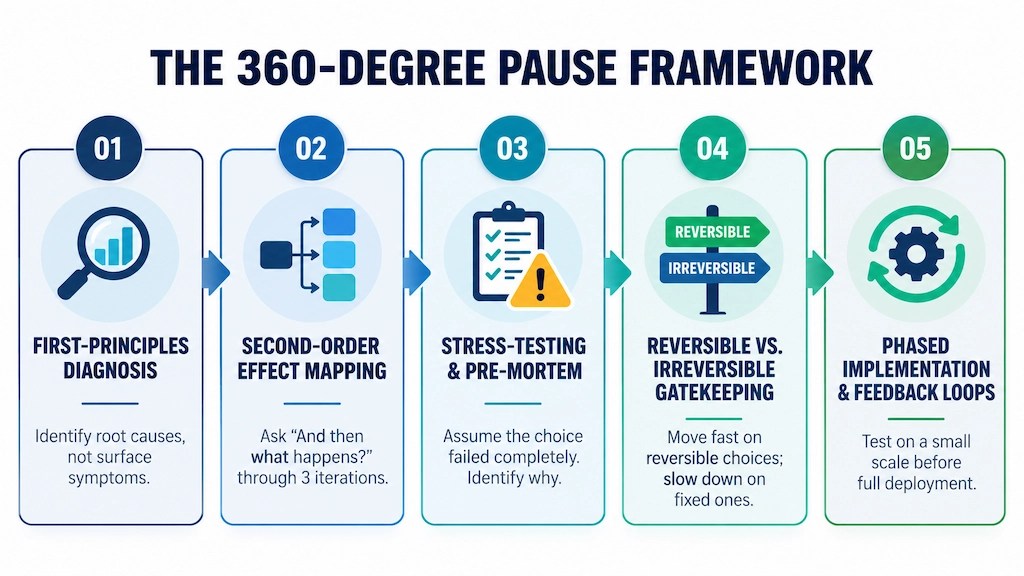
Step 1: First-Principles Diagnosis
Before acting, separate symptoms from root causes. Emperor Xianfeng thought his problem was a simple shortage of coins; the real issue was a broken tax model and loss of trade routes.
Application: Use the “5 Whys” technique during management meetings. If revenue falls, do not automatically slash prices or fire staff. Ask why conversion dropped until you reach the underlying structural problem.
Step 2: Second-Order Effect Mapping
Every decision has consequences, and those consequences have consequences. The Qing court failed to ask what would happen once merchants received debased copper coins.
Application: Before launching any crisis plan, hold an explicit second-order analysis session. Draw a branch diagram on a whiteboard and answer this question three times: “If we take this action, what happens next? And then what happens after that?”
Step 3: Conduct a Pre-Mortem
Instead of asking if an idea will work, assume it has already failed catastrophically six months into the future.
Application: Gather your core team and state: “It is now next year, and this decision has caused our business to collapse. What went wrong?” This exercise breaks team-think, removes optimism bias, and uncovers hidden operational risks.
Step 4: Reversible vs Irreversible Gatekeeping
Categorise choices as “Two-Way Doors” (reversible) or “One-Way Doors” (irreversible).
Two-Way Doors: Decisions like testing a new marketing message or trialling a software tool can be reversed easily. Execute these quickly.
One-Way Doors: Decisions like issuing unbacked currency, selling core assets, or implementing mass redundancies are difficult to undo. Take time, gather comprehensive data, and consult diverse perspectives before proceeding.
Step 5: Phased Implementation and Feedback Loops
Never roll out a high-risk policy across the entire organisation at once. The Imperial Court forced debased currency on the entire population immediately, triggering a widespread market collapse.
Application: Run pilot programs. Test major operational pivots within a single department, region, or customer group first. Set measurable key performance indicators (KPIs) to assess performance before full-scale deployment.
Actionable Strategies to Build Financial and Operational Resilience
Preventing an organisational breakdown requires proactive habits built into your company’s daily operations. Here are four practical tricks to strengthen your leadership team against panic-driven decisions:

Establish a “Red Team” Protocol
Assign a rotating group of team members to act as internal critics for any major strategic proposal. Their sole job is to expose flaws, question assumptions, and present alternative scenarios. This protects leadership from echo chambers and confirmation bias.
Maintain a Strict Cash Buffer
Financial panics occur when liquid reserves run dry. Build a minimum buffer of 3 to 6 months of operational expenses into your treasury management plan. Having runway prevents the need for emergency measures that compromise long-term stability.
Create Transparent Operational Dashboards
Misaligned communication accelerates crises. Ensure department heads share visible real-time data across finance, operations, sales, and customer success. Early warning metrics allow teams to address small issues before they snowball into a major threat.
Enforce the 24-Hour Cooling-Off Rule
When faced with an unexpected operational emergency, enforce a mandatory pause before executing major financial decisions (unless there is an immediate safety threat). Taking 24 hours to review data, consult trusted advisors, and run the 360-degree framework prevents emotional, short-sighted mistakes.
Conclusion: Lead with Clarity, Not Panic
The story of the Taiping Rebellion Money Crisis shows how easy it is for intelligent leaders to destroy their own organisations. Under pressure, Emperor Xianfeng reached for quick fixes. Every unanalysed decision created deeper problems, turning a manageable budget deficit into a total monetary collapse.
When faced with your next corporate challenge, resist the urge to react instantly. Take a 360-degree view. Are you implementing short-term “fixes” that could trigger long-term operational collapse?
Gather your leadership team this week, apply the pre-mortem technique to your largest project, and address vulnerabilities before they turn into a crisis.
Enjoyed this perspective? Drop your email below, subscribe to my blog and receive regular insights on strategy, leadership, and sustainable systems.
Follow along: Catch short-form thoughts and business storytelling on X and Facebook.
Read the books: Find my work on Amazon covering power, ambition, and the choices that shape success.

Leave a Reply