
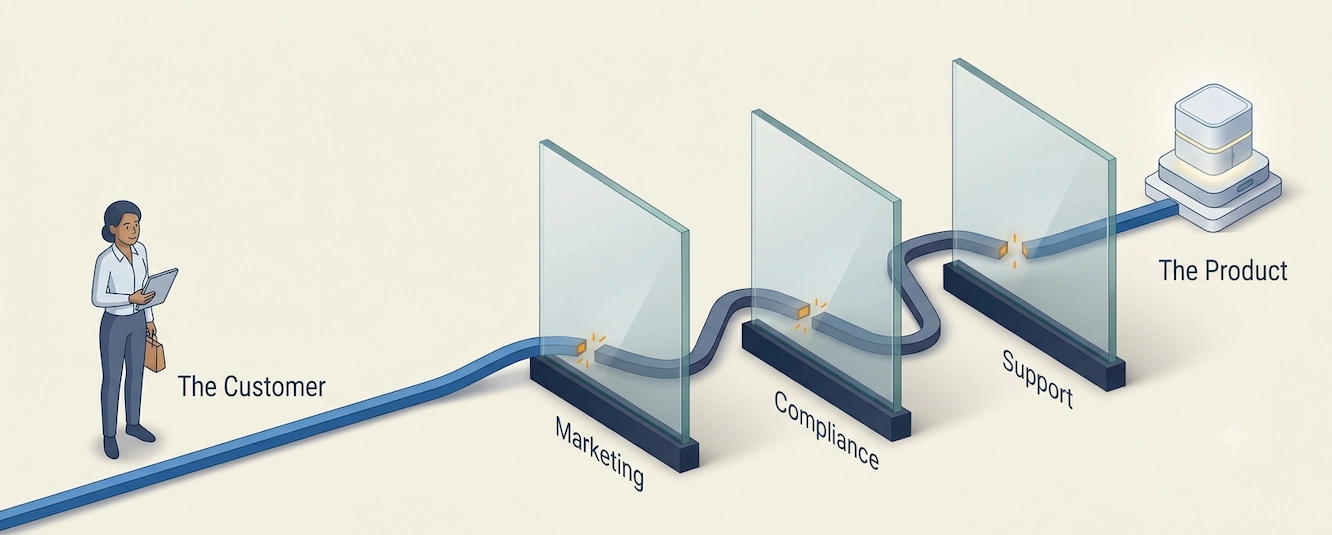
The 50-Word Summary: Internal silos do more than slow teams down: they shape the customer experience. Through Conway’s Law, disconnected communication becomes disconnected products, broken hand-offs and lost trust. Leaders can diagnose each silo, align incentives, connect data and structure teams around customer journeys, turning internal friction into stronger customer outcomes and loyalty.
The boardroom at Apex Financial fell silent as Marcus, the Chief Operating Officer, displayed a graph showing a 22% drop in quarterly customer retention.
Three months earlier, Apex had launched Seamless Onboarding: a digital overhaul designed to let new clients open an account, verify their identity and build a portfolio in under ten minutes.
The launch began with champagne. The marketing campaign was sharp, and the app looked polished. Yet customer feedback quickly became a mess.
Marcus brought in Sarah from Digital Growth, Dev from Compliance and Security, and Elena from Customer Operations.
“Walk me through what happens when a client signs up,” Marcus said, looking at each of them in turn.
Sarah spoke first, already defensive. “From our side, the funnel is immaculate. The campaign brings people to the landing page, and sign-up conversion is up 40%. Marketing did its job.”
Dev adjusted his glasses. “Once a customer submits their details, our risk algorithms flag address or identity discrepancies. Even a minor typo can pause the account setup for compliance reasons. We cannot compromise on risk. The automated system emails customers and directs them to support.”
Elena put her head in her hands. “When those customers call, my agents cannot see Dev’s compliance platform. We do not know why they were flagged. So we ask them to complete a paper KYC form, scan it and send it back by email. They are furious because Marketing promised a ten-minute digital process. They leave, post a one-star review and go to our biggest competitor.”
Marcus was looking at three capable leaders, three high-performing departments and three isolated systems. Marketing owned the promise. Compliance owned the risk. Operations owned the fallout. Nobody owned the customer experience.
Apex had a classic corporate silo problem. And it was quietly turning an internal working arrangement into an external customer disaster.
Understanding the Anatomy of a Silo
What is a silo in a modern organisation?
At its simplest, a silo is an isolated part of a business that behaves like an island. Information, goals and culture stay inside its boundaries instead of moving freely to the people who need them. Once a silo takes hold, collaboration becomes harder, and customer friction becomes normal.

In any organisation, silos are built gradually, through a mix of psychology, incentives and organisational design.
- Territorial leadership and ego: Leaders can mistake control for security. When a department head treats their people, budget or data as a private kingdom, they build a defensive wall around it. Sharing information feels like giving away leverage, so the silo becomes a way to protect status.
- Misaligned incentives: Teams measured against isolated KPIs will optimise locally. Marketing is rewarded for lead volume. Compliance is rewarded for low risk. Support is rewarded for shorter handle times. Each team can hit its target while the customer journey still fails. The silo does not need bad people to survive; it only needs narrow measures of success.
- Tool fragmentation: As companies grow, technology often creates a second silo alongside the functional one. Engineering works in Jira, Sales in Salesforce and Operations in Zendesk. When systems cannot share context, people eventually stop sharing it too.
- Us-versus-them thinking: Without regular cross-functional contact, every department becomes its own cultural island. Engineering blames Product for weak requirements. Product blames Marketing for ambitious promises. Customer Support blames everyone else for shipping avoidable problems. A silo turns colleagues into hand-off points rather than partners.
Conway’s Law: Why Internal Messes Become External Problems
In 1967, computer programmer Melvin Conway observed that organisations tend to design systems that mirror their internal communication structures.
Applied to customer experience, Conway’s Law reveals an uncomfortable truth:
Customers experience your company the way it communicates.
If your business works as a collection of disconnected teams, your product will feel like a collection of disconnected features. Each silo eventually leaves its fingerprints on the customer journey.
Customers see one brand. They do not care which department owns the website, the billing system, the risk process or the helpdesk. But when internal barriers exist, the seams become visible. A silo boundary inside the business becomes an extra step, repeated question or dead end for the customer.
Consider these examples of Conway’s Law in action.
The Airline Hand-off Nightmare
You book a flight online but need to add extra baggage. The website throws an error. You call customer service, only to be told that baggage is managed through a digital partner portal and the agent cannot see your booking details.
You are told to deal with it at the airport. At the airport, the counter agent asks why you did not do it online, because it costs twice as much at the desk.
In this case, as a customer, you are not seeing a technical fault. You are feeling the silo between the website team, call centre and ground operations.
The Telecom Context Drop
Your internet connection goes down. The automated phone system asks for your account number and a description of the problem. When an agent finally answers, they ask for exactly the same information again.
Somewhere between the IVR system and frontline operations, your context disappeared. That silo has made a routine service issue feel like the company was not listening.
The B2B Software Disconnect
A customer signs an enterprise software contract after Sales promises a specific custom integration. During onboarding, the implementation team explains that the integration is technically impossible and has never been on the product roadmap.
Sales has achieved its quarterly target. Implementation has inherited a damaged relationship. The customer has bought a promise that the business could not keep.
That is the commercial cost of a silo: one team wins on paper while the wider business loses trust.
When internal teams cannot communicate across structural boundaries, they pass the cost of that failure directly to the customer.
Breaking the Silo: A Diagnostic and Leadership Framework
To dismantle a siloed culture, you as a leader must first see where the walls are. You cannot fix a silo if you cannot identify the point at which information, accountability or empathy stops moving.
The Diagnostic Framework

Use these four questions to find operational traps in your business.
- The Metric Test: Do your team’s primary KPIs conflict with the goals of an adjacent department?
- The Context Test: Can frontline staff see a customer’s history across platforms, or is critical data locked away in another system?
- The Escalation Test: When a cross-department issue appears, can employees solve it directly, or does every problem need executive intervention?
- The Language Test: Do different departments use different words for the same stage of the customer journey?
If you answer “yes” to two or more questions, you probably have a silo problem that is shaping customer experience. The goal is not to remove every specialist function. It is to stop specialist functions behaving as if the rest of the journey belongs to someone else.
Strategies to Break Departmental Barriers
- Use the Inverse Conway Manoeuvre: Instead of repeatedly patching software or retraining frontline staff, structure teams around the experience you want customers to have. Build cross-functional journey teams around end-to-end outcomes. For example, a Customer Onboarding Stream could include a marketer, engineer, compliance officer, designer and support specialist. Give them one shared measure: successful, low-friction customer activation. This removes the silo from the operating model, not just the symptom.
- Unify customer data: Create a reliable source of truth for customer context. When a compliance flag is raised, support should see it immediately alongside the onboarding status and next best action. Joining up systems will not solve every human problem, but it removes the technical silo that allows confusion to hide.
- Create shared customer-experience KPIs: Tie leadership incentives and departmental bonuses to end-to-end outcomes such as retention, Customer Effort Score or Net Promoter Score. When Sales, Product and Support share responsibility for retention, the silo has less room to grow.
- Build rotational immersion into the work: Ask product managers and engineers to spend time listening to support calls each month. Let marketing leaders sit in on sales conversations and onboarding sessions. Customer pain becomes much harder to dismiss when people hear it in the customer’s own words. This is one of the fastest ways to challenge a silo mindset without turning it into a compliance exercise.
Siloed Working vs Focused Work: Know the Difference
It is easy to treat every isolated team as a management failure. That would be a mistake.
Focused work is not the same as a silo. Some business challenges need a dedicated, protected group. When Apple developed the original Macintosh, Steve Jobs placed a core team in a separate building to shield it from corporate bureaucracy. In aerospace and defence, Skunk Works projects often need separation for security, speed and experimentation.
The difference is purpose. A focused team is deliberately separated to produce an outcome. A silo is separated by friction, poor incentives or politics.
Deep technical problem-solving, regulatory audits and radical innovation can all require concentrated work. The question is whether the group still exchanges the right information with the wider business.
How to Stop Focused Groups Becoming a Silo

- Focus on boundaries, not walls: A focused team has clear inputs and outputs, while its information remains accessible to those who depend on it. A silo blocks the flow of context altogether.
- Time-box the separation: Form task forces or strike teams for a defined sprint or project period. Once the work is complete, reconnect them to wider cross-functional teams before temporary isolation hardens into a permanent silo.
- Make outputs transparent: Ask focused groups to publish project updates, design decisions and weekly progress notes. Visibility keeps the working boundary clear without creating a black box.
Isolation can be a useful tactical choice. It should never become a permanent cultural habit.
Conclusion: Fix the Inside to Improve the Outside
When customer experience fails, leaders often blame external factors: weak marketing channels, difficult market conditions or demanding customers. But the source of friction is often much closer to home.
Conway’s Law is a practical reality of business operations. You cannot deliver a seamless customer experience when your internal teams operate through secrecy, friction and division.
Every poor hand-off, unshared database and departmental rivalry eventually reaches the people paying your bills. The customer may never see the org chart, but they will feel every silo it creates.
Find where customers stumble. Trace that moment back through the business. Then identify the silo behind it: the broken hand-off, hidden data, conflicting metric or missing conversation.
Fix the inside, and the outside starts to make sense.
If you found this perspective useful, consider subscribing to my blog by sharing your email below. You will receive regular insights on strategy, leadership, and building sustainable systems.
Stay Connected: For short-form thoughts and business storytelling, follow me on X and Facebook for regular updates. Beyond the Blog: If stories of power, ambition, and passion interest you, explore my books on Amazon. They examine the fine line between success and surrender, and the choices that define both.


Leave a Reply