
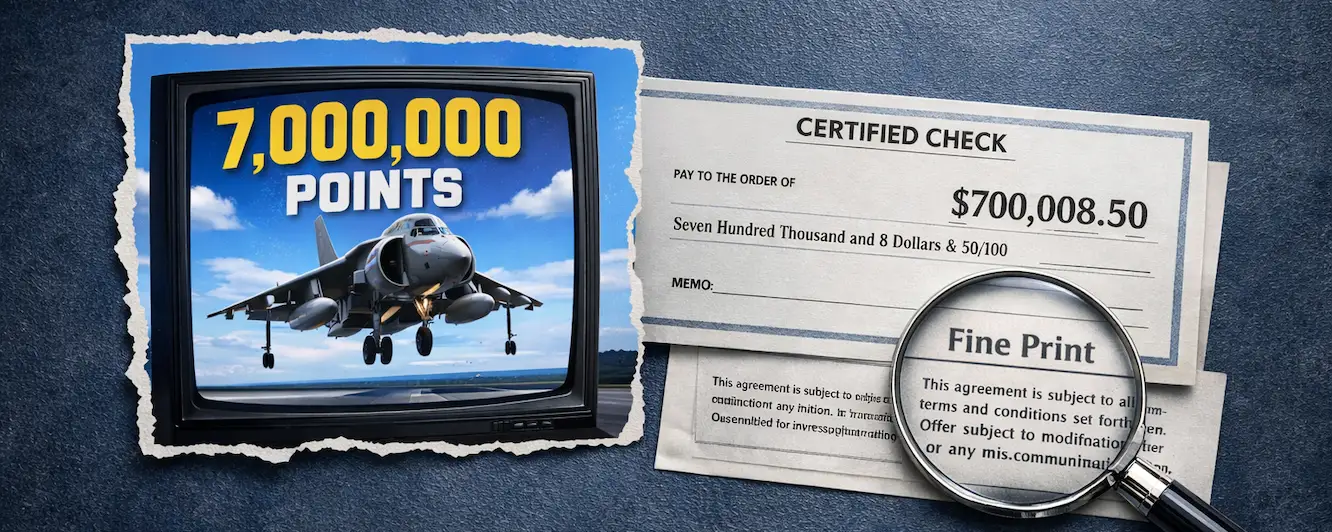
THE 50-WORD SUMMARY: In 1996, a marketing stunt offering a Harrier Jet for Pepsi Points backfired when student John Leonard exploited a literal loophole. This classic case of operational oversight vs. creative ambition remains the ultimate lesson in fine print, proving that brand trust is won in the details, not just the hype.
The roar of a Rolls-Royce Pegasus engine isn’t something you expect to hear in a suburban high school parking lot. But in 1996, Pepsi promised exactly that.
The mid-1990s were a hyper-charged battlefield where carbonated drinks fought for cultural dominance. The “Cola Wars” were a spectacle of marketing bravado. An era where billboards, celebrity endorsements, and television commercials were the cultural events shaping pop culture with extraordinary force.
Michael Jackson electrified the Pepsi ads with his moonwalk and explosive choreography. And then came Cindy Crawford’s iconic gas-station commercial. Pepsi was spending hundreds of millions to transform a simple soda into a symbol of aspiration, cool, and youthful swagger, selling not the beverage but the lifestyle wrapped around it.

Every teenager became a target. Every living room felt like a battleground. To further dominate this restless arena, Pepsi needed something more than another celebrity moment. It needed a campaign that transcended sales, something collectable, tribal, and irresistibly gamified.
That idea arrived in 1996. A breakthrough loyalty program that spiralled into one of the most surreal marketing misadventures of that decade. A 21-year-old business student from Washington decided that he was sharp enough to game the system.
So, fasten your seatbelts.
This is the story of the Pepsi jet that never landed and how one audacious student turned a marketing fantasy into a multimillion-dollar courtroom drama.
An Audacious Marketing Campaign
The Arrival of “Pepsi Stuff”
Pepsi had always played the rebel in the Cola Wars. The “Pepsi Generation” had youthfulness built into its DNA, and in 1996, it unveiled something that felt genuinely revolutionary: the Pepsi Stuff campaign.
This was not a routine giveaway. It was a full-blown lifestyle movement engineered through bold marketing psychology. Consumers collected Pepsi Points printed on every bottle and can, trading them for merchandise that signalled identity, attitude, and belonging. You weren’t just drinking a soda; you were earning your way into a tribe.
Shirts, leather jackets, sunglasses, caps. The catalogue looked like a teenage dreamscape. Pepsi had accidentally cracked the code of modern loyalty long before the word “gamification” became a trend. The more you drank, the more points you accumulated, and the cooler the rewards became.
And then came the commercial that changed everything.
The Commercial: Frame by Frame
The TV spot opened with the irreverent swagger that defined the decade. A teenage boy strides across a schoolyard, the soundtrack thumping with confidence.
A Pepsi T-shirt: 75 points.
If you had the points, you got the shirt.
A leather jacket: 1,450 points.
Accumulate enough points, and it’s yours too.
Then came the punchline that would take the brand from clever marketing to a courtroom circus.
A thunderous roar. Papers flying. Students diving for cover as a Harrier Jump Jet descends from the sky and lands outside the school. The teenage hero steps out with effortless cool, the screen freezing just as the caption appears:
Harrier Jet: 7,000,000 Pepsi Points.
Then the unforgettable tagline: “Sure beats the bus.”
It was designed to be absurd, cheeky, and irresistibly over-the-top. A piece of pure marketing mischief meant to get a laugh, not a legal filing. The ad agency believed everyone would catch the joke. The production team believed no viewer would treat it as anything more than playful hyperbole.
But one viewer did.
And he surely wasn’t laughing.
The Strategic Exploit
Enter John Leonard
John Leonard was a 21-year-old business student from Washington. Where most viewers saw teenage bravado and marketing theatrics, Leonard saw numbers. And more importantly, he saw an opportunity hiding in plain sight.
When he watched the commercial, he didn’t laugh. He paused. Rewound. Rewatched the points.
Seven million.
Then he opened the Pepsi Stuff catalogue and found the fine print that would ignite one of the most fascinating marketing loopholes of the decade:
“If you don’t have enough points, you may purchase additional points for 10 cents each.”
A harmless clause meant to cover small shortfalls suddenly looked like a gaping door. Pepsi never imagined someone would use it to bypass the entire system. But Leonard’s mind went into overdrive. The gears turned. The maths sharpened. The joke in the commercial had unintentionally become a market exploit waiting to be claimed.
The Maths of the Loophole
Leonard did the maths with the precision of someone spotting a once-in-a-lifetime opportunity. A Harrier Jump Jet, even in demilitarised form, was worth roughly $23 million.
If the jet required seven million points:
7,000,000 points × $0.10 = $700,000.
The final maths was nothing short of astonishing:
– Market Value: ~$23,000,000
– Leonard’s Cost: $700,000
– The Upside: 3,185% ROI
Even with incidental fees, the acquisition would cost a fraction of its real value. Leonard didn’t see humour; he saw arbitrage. He realised he didn’t need to drink thousands of cans or hoard millions of labels. All he needed was a strategy sharp enough to exploit the gap between marketing fantasy and operational oversight.
He simply needed investors.
Five Investors Join the Mission
Leonard built a formal business plan around the jet acquisition. He mapped out risk, reward, and timelines. He spoke to acquaintances, entrepreneurs, and outdoor enthusiasts from his climbing expeditions, pitching what he framed as a uniquely engineered marketing opportunity.
Five investors, including his friend Todd Hoffman, the main investor, signed on.
This was no longer a college prank. It had evolved into a structured venture. A calculated market play born from a brand’s own marketing oversight. A $23 million asset, potentially secured for $700,000.
The team pooled funds, formalised agreements, and prepared their move.
On March 27, 1996, John Leonard mailed Pepsi a certified check for $700,008.50. An extra $8.50 reserved for shipping and handling. He attached 15 real Pepsi Points to meet the minimum requirement and included meticulous documentation referencing the commercial.
The packet was sealed.
The Packet: 15 original Pepsi Points, a certified check for $700,008.50, and a one-sentence demand: “Item 1510, one Harrier Jet.”
It went out.
And then, the only thing left was the wait.
The Corporate Panic & The Courtroom Drama
Pepsi Responds
Pepsi’s reply arrived sooner than Leonard expected.
The corporation returned the check.
The accompanying letter declared that the Harrier Jet in the commercial was merely a “humorous and fanciful addition.” It further clarified that the jet was not part of the Pepsi Stuff catalogue and therefore not a redeemable item under any circumstances.
Leonard saw it differently. To him, the commercial was a unilateral offer, and he had accepted it by performing exactly as required. In his mind, this was not a misunderstanding. It was a contract.
So, he escalated.
Leonard v. PepsiCo Inc.
Leonard filed his case in the United States District Court for the Southern District of New York. Pepsi countered with a motion to dismiss.
What followed wasn’t a dramatic courtroom showdown but a clinical dissection of contract law. Leonard argued that operational oversight and marketing ambiguity, born from an overly daring campaign, had created a binding promise. Pepsi argued that the commercial was simply an advertisement, and no reasonable person would expect a multinational corporation to hand over military hardware in exchange for soda points.
On one side stood a student determined to prove the system had failed.
On the other stood PepsiCo, insisting that common sense alone dissolved his claim.
The “Reasonable Person” Standard
The case came before Kimba Wood, a respected federal judge known for precision and clarity. Her decision hinged on a foundational principle in contract law: the Reasonable Person Standard.
Would a reasonable person, watching the commercial, believe that Pepsi was genuinely offering a Harrier Jet for Pepsi Points?
Judge Wood’s answer was emphatic.
She noted the commercial’s exaggerated tone, its humorous style, and its obvious intent to entertain. Her ruling delivered one of the most cited lines in advertising law:
“No schoolchild would actually believe a jet could be redeemed for soda points.”
With that, Leonard’s argument collapsed.
There was no contract. No enforceable promise.
Pepsi had won.
Pepsi Fixes the Loophole
Pepsi moved swiftly. The commercial was edited and re-released. This time, the Harrier Jet’s price tag appeared as: 333,000,000 Pepsi Points.
The humour stayed. The loophole vanished.
Marketing executives ensured that no future Leonard would attempt a similar acquisition. And just like that, a bold marketing misfire became legal folklore. A cautionary tale of what happens when someone sharp enough decides to play the system a little too well.
The “Fine Print” Fallout
Sometimes the most spectacular corporate mishaps don’t come from hostile competitors or market crashes; they come from within. From a marketing idea so bold, so dramatic, and so poorly stress-tested that it spirals into a case study for the ages. The Pepsi Jet saga is exactly that kind of story, one where ambition, silos, and fine print collided in full public view.
This legendary episode leaves behind some powerful strategic lessons worth revisiting.
1. The Operational Silo Trap
As organisations grow, they often drift into rigid silos. Departments chase their own KPIs with such ferocious focus that they forget the enterprise runs on interconnected logic.
In this story, the marketing team came up with the “7 million points” figure purely because it looked bold, cinematic, and noisy enough to light up a TV screen. The Harrier Jump Jet wasn’t realism; it was theatre. The kind of audacity marketing teams adore to make campaigns unforgettable.
But the legal and operations teams weren’t in the room when the idea took flight. They overlooked the implications of the “points-for-cash” clause. An oversight that transformed a harmless gag into a multi-million-dollar risk. Had legal cross-checked the jet’s actual cost or flagged the loophole, this episode would have remained an internal laugh instead of a courtroom headline.
Leadership Lens: A marketing “Yes” means nothing without an operational “How,” so pressure-test every bold idea before it becomes a brand-damaging fiasco. Today, an “exploit” doesn’t take months to mail a check. It just takes 30 seconds on TikTok or one post on social media for a “glitch” to go viral.
2. Clarity vs Cleverness
In the pursuit of impact, brands often forget a simple truth: when a marketing campaign needs a Federal Judge to interpret it, the messaging has already derailed. Being witty, clever, or flamboyant is perfectly acceptable until it comes at the cost of clarity. Any communication leaving a corporate door must be unmistakably clear, coherent, and immune to creative misinterpretation. The moment you become “clever and a half,” you risk losing the plot entirely.
In the Pepsi story, landing a Harrier Jet on a school campus may have looked spectacular on screen, but pairing it with a points-based reward system pushed the fantasy from playful exaggeration to juvenile overreach. A simple disclaimer, “For representation purposes only, not an actual reward,” could have extinguished the entire fiasco before it took flight.
Leadership Lens: Before making tall claims, pause and ask, “If someone took this literally, how would it impact us?” This simple check separates a bold marketing innovation from an avoidable brand embarrassment.
3. The PR Debt of Legal Victories
In the corporate world, mistakes are never buried. They linger, they travel, and eventually they become folklore that outlives product cycles, leadership changes, and even entire generations. Pepsi may have won the courtroom battle, but in the wider world of public perception, they were immortalised as the “giant that got sued by a kid.”
And here we are, nearly three decades later, still narrating the same saga. Countless storytellers before me have retold it, and many more after me will continue to resurrect it. It has also been immortalised in the Netflix documentary Pepsi, Where’s My Jet?.
That is the unavoidable PR debt a brand pays when a bold marketing stunt collides with a legal rebuttal and spirals into a cultural punchline. Once a fiasco enters the public imagination, it tends to stay there.
Leadership Lens: Legal compliance is the floor, not the ceiling. Ethical, audience-aware marketing weighs brand sentiment just as heavily as contractual safety nets.
Conclusion: When Marketing Ambition Met Real-World Consequences
The Leonard v. PepsiCo saga has outlived its courtroom verdict and become a cultural staple, resurfacing every few years as marketing campaigns grow bolder, more ironic, and far more viral. It remains a textbook example of how a playful marketing gimmick can collide head-on with legal reality, how operational blind spots can open unexpected loopholes, and how one sharp-eyed student forced a global corporation to defend the fine line between marketing ambition and contractual accountability.
Leonard never got the jet.
Pepsi never admitted fault.
The investors lost interest.
The check was returned.
And the ruling stood firm.
Yet the story refuses to fade. It thrives because it captures the spirit of the wild 90s, the swagger of the Cola Wars, and the sheer audacity of someone who believed that if a corporation promised something on TV, it should be ready to honour it.
The Harrier never took off.
But the story? It soared.
All the way into business folklore.
Have you ever spotted a ‘fine print’ fail in the wild? Let’s discuss in the comments.
If you found this story useful, consider subscribing to my blog by sharing your email below. You will receive regular insights on strategy, leadership, and building sustainable systems.
Stay Connected: For short-form thoughts and business storytelling, follow me on X and Facebook for regular updates.
Beyond the Blog: If stories of power, ambition, and passion interest you, explore my books on Amazon. They examine the fine line between success and surrender, and the choices that define both.
Disclaimer: This article is written for informational and educational purposes only, based on details available in the public domain. It is intended to analyse the event from a strategic and historical perspective. It does not intend to absolve, accuse, or defame any individual, entity, or corporation of wrongdoing, criminal intent, or dereliction of duty beyond what has been documented in historical records and legal proceedings.

Leave a Reply