

IKEA hadn’t just changed the way we furnish our homes but, quietly transformed how the world thinks about design, affordability, and everyday living. Behind those flat-pack boxes and winding store aisles lies the remarkable story of a boy from rural Sweden, Ingvar Kamprad, whose humble beginnings and relentless curiosity built one of the most iconic brands on the planet.
This story is of Ingvar Kamprad and his creation, IKEA. It is not just a tale of furniture; it’s the journey of a visionary who believed that better living should be within everyone’s reach.

Humble Beginnings
In the heart of Smaland, a forested region of southern Sweden, the pines stand tall and the winters bite cold. Life here has always demanded grit, resilience, and a nose for frugality. It was in this modest countryside, in 1926, that Ingvar Kamprad was born. Not into privilege or fame, but into a farming family that valued hard work and clever thrift over extravagance.
From a young age, Ingvar Kamprad understood that creativity and perseverance could unlock possibilities far beyond what tradition dictated. He grew up hearing stories of his grandfather’s struggle to keep the family farm afloat after emigrating from Germany to Sweden, a challenge that nearly failed.
But it was his father, Feodor Kamprad, who turned things around through sheer determination and hard work. That legacy shaped Ingvar deeply. In his world, resilience wasn’t a choice; it was inherited. Hard work was more than a value. It was the foundation of life.
The Matchstick Boy
Long before the world would come to associate his name with minimalist Scandinavian design and flat-packed furniture, Kamprad was a boy with a bicycle and a dream. And like the best entrepreneurial stories, his began not in a corner office or startup hub, but on dirt roads and doorsteps.
Ingvar’s first business venture was humble but telling. At just five years old, he discovered he could buy matches in bulk from Stockholm and sell them at a profit in his neighbourhood. He sold them door-to-door, and when matches went well, he moved on to pencils, fish, and Christmas cards.
At an incredibly young age, Kamprad grasped the fundamental truth of business. Understand the margins, treat your customers well, and always keep an eye on what they truly need. He didn’t invent something new; he simply saw inefficiencies and found a way to do better.
The Birth of a Dream
Each evening, Ingvar observed the villagers salvaging materials, repurposing old furniture, and transforming scraps into functional objects. This local ingenuity inspired the essence of what would later become IKEA. A company that is driven by the principle of making good design accessible.
By 17, with money saved from his small-time ventures and some help from his father, Ingvar founded IKEA. The name was an acronym: I for Ingvar, K for Kamprad, E for Elmtaryd (his family farm), and A for Agunnaryd (his hometown village). It was 1943, and he was just getting started.
Initially, IKEA sold small items like wallets, picture frames, and nylon stockings, through mail orders. Ingvar had catalogues printed and mailed them to customers across Sweden. Orders came in, and he shipped items out, always focusing on keeping prices as low as possible. But the real breakthrough came in 1948 when he began selling furniture, manufactured by local craftsmen.
He spent hours sketching product ideas and studying ways to reduce costs without sacrificing quality. The Swedish countryside served as both his inspiration and a testing ground for practicality. Every idea had to make life easier for the many, not just the privileged few.
In the early days, Ingvar personally delivered orders, often navigating rough roads in his old truck. Each sale reinforced his belief that furniture shouldn’t be expensive, nor should it be inaccessible to those with modest means.
The Flat-Pack Revolution
During a product demonstration, Ingvar noticed how difficult it was for customers to transport assembled furniture. He watched as a frustrated staffer struggled to fit a bulky table into the customer’s car. After several failed attempts, the staffer simply unscrewed the legs. Kamprad saw this and had a revelation: what if all IKEA furniture came disassembled?
The notion was radical. The industry had long believed that customers preferred pre-assembled furniture. But Ingvar wasn’t interested in doing things the conventional way. He was determined to make life easier for people, and the flat-pack system was the answer.
The first flat-pack success came with the Lovet table, designed by one of IKEA’s earliest designers, Gillis Lundgren. By disassembling the legs and packaging it flat, production costs decreased, transportation became easier, and customers could carry home their furniture without hassle.
Flat-pack furniture became IKEA’s identity, revolutionising the way people furnished their homes. Ingvar’s relentless drive to challenge the norms fuelled the company’s next phase of expansion.

Affordable Furniture for All
Established Swedish furniture makers viewed IKEA as a disruptive force that threatened their traditional business models. Suppliers boycotted IKEA, refusing to sell raw materials to Ingvar. Competitors dismissed the company as a passing trend, arguing that customers would never choose self-assembly over traditional furniture.
But Ingvar refused to back down. Blocked from traditional supply chains, he decided to go vertical. If suppliers wouldn’t sell to him, he would make the furniture himself.
He travelled across Europe in search of options. In Poland, he discovered highly skilled workers who could produce quality furniture at lower costs. It was a crucial breakthrough; by shifting production outside Sweden, IKEA became independent from domestic constraints, ensuring continued innovation.
And so, IKEA’s own manufacturing and design arm was born. More than a workaround, it turned out to be a masterstroke. Kamprad could now control costs, ensure quality and most critically, design with shipping in mind.
Designing for the People
Ingvar’s philosophy centred around one simple truth: Great design should be available to everyone, not just the wealthy.
“To design a desk which may cost $1,000 is easy for a furniture designer but to design a functional and good desk which shall cost only $50 can only be done by the very best.”
Ingvar Kamprad
Unlike many designers who catered to the elite, Ingvar challenged his team to create functional, stylish, and affordable furniture that appealed to ordinary people. He worked alongside visionary designers like Niels Gammelgaard and Thomas Sandell, pushing boundaries to ensure that every product retained simplicity, usability, and aesthetic appeal.
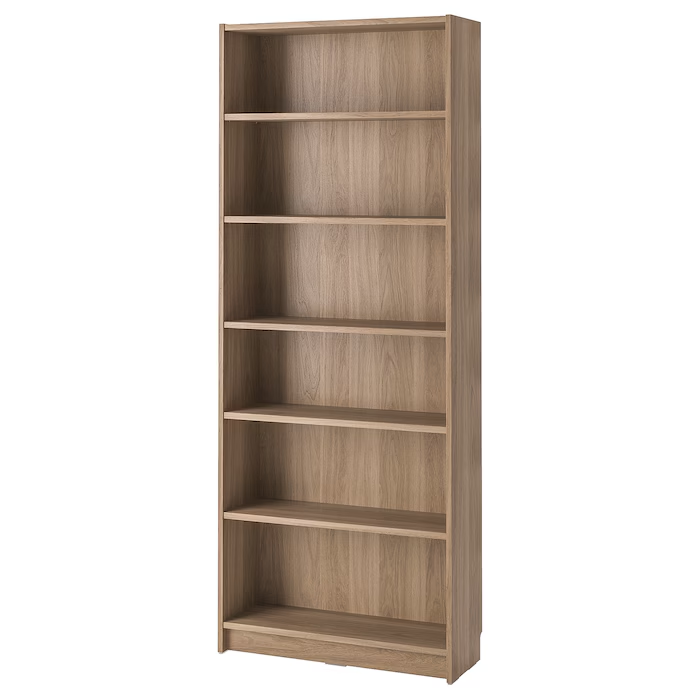
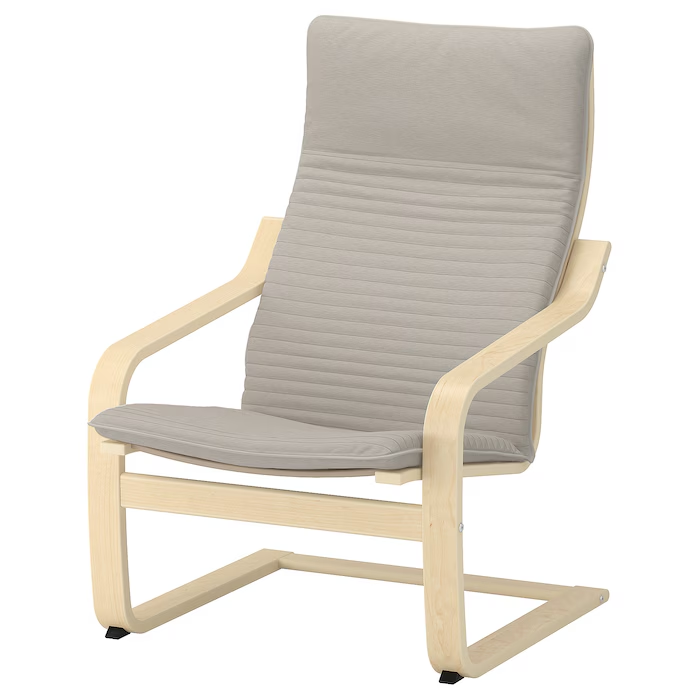
The Billy bookcase, the Poang chair, the Klippan sofa, each of these iconic pieces was designed with affordability and practicality in mind. Customers embraced IKEA’s democratic approach to furniture, drawn to the idea that well-designed products were no longer reserved for the privileged few.

Kamprad believed in constraints as catalysts for creativity. Designers were told to keep costs low, materials minimal, and instructions universally understandable. So that a customer in Mumbai or Malmö could assemble a table without speaking a word of Swedish.
The Eternal Disruptor
Ingvar Kamprad didn’t just build a company. He built a philosophy. His approach to business was always about function over flair. The IKEA culture became one of frugality, problem-solving, and relentless experimentation. Even as the company grew, Kamprad insisted on flying economy, staying in budget hotels, and driving a 20-year-old Volvo.
He wasn’t trying to be eccentric. He believed that a business serving the many had to live like the many. It wasn’t just branding. It was in IKEA’s DNA.
At the company’s headquarters, executives ate in the same cafeteria as floor workers. Kamprad would often walk the aisles of IKEA stores anonymously, watching how customers moved, what they touched, and what they ignored. He wanted to see with their eyes.
This customer obsession extended to the designs. IKEA products were beautiful not because they were adorned, but because they were stripped to the essentials. Clean lines, thoughtful functionality, and above all, affordability.
The Store as Theatre
IKEA stores themselves were revolutionary. Instead of salesmen and cash registers in every aisle, customers were invited to walk through fully furnished ‘mini homes’ that sparked ideas. The layout was a maze by design, encouraging discovery. Want a sofa? On your way, you’d stumble on rugs, lamps, and kitchen gadgets and end up buying more than you planned.
Yet Kamprad didn’t aim to manipulate. He aimed to delight. IKEA stores became weekend destinations. Play areas for kids and cafeterias for families. Complete with the now-iconic Swedish meatballs. It was a retail theatre. Efficient, joyful, and engineered down to the last screw.
The Man Behind the Empire
Kamprad was not without controversy. In the 1990s, it became known that as a young man, he had briefly been involved with a pro-fascist group in wartime Sweden. He acknowledged it with humility and regret, calling it ‘the greatest mistake of my life’. But even in criticism, he didn’t hide. He apologised publicly and asked to be judged not by his past, but by his life’s work.
He expanded IKEA into more than 40 countries, creating one of the most recognisable brands in the world. By the time he stepped down from the board in 2013, IKEA had over 300 stores and was generating billions in revenue annually.
Despite immense wealth and once being ranked among the richest people in the world, Kamprad lived modestly. He wore off-the-rack clothes, recycled tea bags, and discouraged luxury. His three sons, while involved in the company, were not automatically given power or privilege. He didn’t believe in dynasties. He believed in merit.
He once wrote a ten-point manifesto called ‘The Testament of a Furniture Dealer’. It reads more like a monk’s vow than a CEO’s playbook. It preaches simplicity, humility, and the pursuit of efficiency. It says: ‘Wasting resources is a mortal sin.’.
“Expensive solutions to any kind of problem are usually the work of mediocrity.”
Ingvar Kamprad
The Legacy of Ingvar Kamprad
Kamprad passed away in 2018 at the age of 91. He died in his beloved Smaland, in the same corner of Sweden where it all began. By then, IKEA was not just a furniture company. It was a symbol.
It symbolised the power of democratised design. It proved that good taste didn’t need to come with a high price. It embodied the values of simplicity, utility, and integrity.
More than anything, it reminded the world that greatness doesn’t have to start with capital or connections. Sometimes, it starts with matches in a suitcase.
Kamprad’s story is about more than business success. It’s about a worldview. A belief that the best companies solve everyday problems with empathy and humility.
Today, as new entrepreneurs chase billion-dollar valuations and viral growth, Kamprad’s model stands as a quiet rebuke. He didn’t chase investors. He chased ideas. He didn’t scale with flash. He scaled with discipline.
And perhaps most importantly, he never lost sight of the people he was building for.
Interesting Trivia of IKEA
Here are some fascinating and lesser-known trivia facts about IKEA:
- IKEA Prints More Catalogues than Bibles Printed by the Bible Society: IKEA’s catalogue was once one of the most widely printed books in the world. More than 200 million copies annually in multiple languages. That’s more than most religious texts!
- The Iconic Allen Key: That little hex key, also known as the ‘Allen Key’ that comes with IKEA furniture is so synonymous with the brand that it has become a part of pop culture, representing DIY perseverance, frustration, and triumph.
- The IKEA Effect: Behavioural economists coined the ‘IKEA Effect’ to describe how people value things more when they’ve helped build them, even if it’s just assembling a shelf.
- IKEA Sells Over 1 Billion Meatballs a Year: Yes, over 1 billion Swedish meatballs are sold every year in IKEA stores worldwide, making it one of the largest restaurant chains by volume.
- IKEA is the world’s Largest Consumer of Wood: IKEA uses around 1% of the world’s commercial wood supply annually. They’ve committed to sustainability and now source most of it from renewable and responsibly managed forests.
- IKEA’s Most Popular Product isn’t Furniture: Believe it or not, while the BILLY bookcase is among the most sold items, LED light bulbs and FRAKTA blue bags are sold in far higher numbers worldwide.
Conclusion
From a cosy sofa in Stockholm to a sturdy bunk bed in Rio, IKEA has slipped into daily life worldwide, proving that simplicity and affordability can thrive together. Ingvar Kamprad nurtured this reality patiently. One flat‑pack and one wooden peg at a time, guided by an unshakable trust in people and the power of playing the long game.
What remains is more than a retailer: it’s a culture. Those yellow FRAKTA bags and tongue‑twister product names have become a shared language of home, stretching from Tokyo to Nairobi to Berlin.
Kamprad’s conviction that better living should never be a luxury made furniture wonderfully ordinary, and in that ordinariness lies its brilliance. He didn’t chase unicorns; he crafted usefulness. That quiet, steadfast vision is nothing short of revolutionary.
I am positive that you found this story informative and useful!
Please subscribe to my blog by filling in your details below:
My blog has countless such articles and stories to guide you and quench your thirst for knowledge.
You can also follow me on X and Facebook to read more such stories and posts.
PS: ChatGPT and/or Copilot have been used to create parts of this post.
Leave a Reply