
THE 50-WORD SUMMARY: In this analysis of the Emu War, Sam demonstrates how brute-force efficiency failed against biological complexity. By examining this hilarious historical defeat, we learn that resilience and adaptability are essential. Sam provides a profound look at conditioning ourselves to survive adverse situations when rigid, modern systems inevitably fail.
In 1932, in the vast, sunburnt stretches of Western Australia, a war was declared. Not against a rival nation, nor an insurgent rebellion, but against a flock of birds. Large, flightless, unapologetically indifferent birds. Roughly 20,000 of them. Thus began the now infamous Emu War, a conflict that reads less like military history and more like a sharp, almost comical study of human overconfidence.
The Emu War offers a valuable reminder that not every problem bends to brute force. Some demand humility, adaptability, and a touch of strategic patience. But before we unpack the lessons, it is worth pausing to enjoy the sheer absurdity of this remarkable episode.
The Absurdity of the Front Line
The battlefield lay in the Campion district, where farmers, most of them battle-hardened retired veterans, faced a challenge that began as an ecological nuisance but quickly turned into an economic headache.
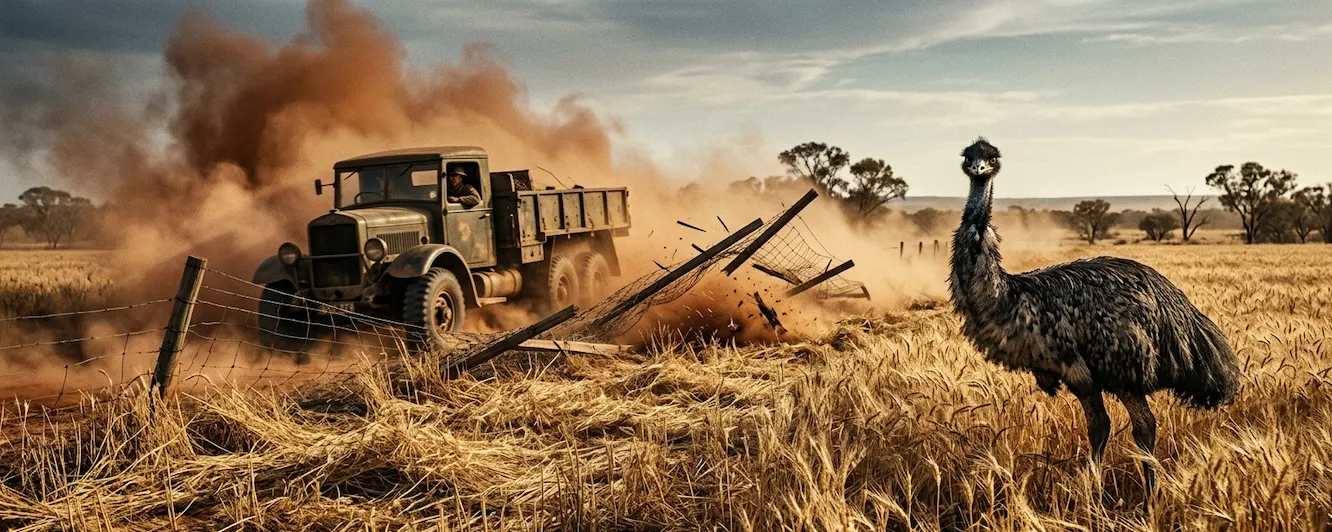
The emus, migrating inland after breeding season, found the freshly cultivated wheat fields irresistible. They flattened fences, devoured crops, and in doing so, quietly challenged human assumptions of control.
Enter Major G.P.W. Meredith, sent in with soldiers and two Lewis machine guns. On paper, it looked like an overwhelming display of military efficiency. Industrial-age weaponry against feathered herbivores. The logic felt precise, almost reassuring. Superior tools, disciplined execution, and a clearly defined objective.
Yet the Australian outback does not follow neat plans. It resists tidy equations. The Emu War quickly exposed a deeper truth. When brute force efficiency meets biological complexity, outcomes become unpredictable. Nature does not comply. It adapts, often with quiet defiance.
The real absurdity was not that humans chose to fight birds. It was that they expected the fight to be easy.
The General’s Delusion and the Trap of Efficiency
Military planning often rests on a deceptively simple belief. Better tools lead to better outcomes. In the case of the Emu War, this belief edged close to blind faith. The Lewis gun, capable of firing hundreds of rounds per minute, symbolised clear technological superiority. Against slow, ground-bound birds, it should have been decisive.
The initial plan was clean and methodical. Locate the emu flocks, position the guns, and remove the threat with neat operational efficiency. After all, efficiency sits at the heart of modern systems thinking.
But the first encounter exposed a flaw that no amount of firepower could fix. The emus simply refused to behave like targets.
They did not gather obligingly. They did not charge or retreat in tidy formations. Instead, they dispersed. Small groups peeled away in different directions, making it nearly impossible to focus fire. The Lewis guns chattered across the scrub. The soldiers fired. The emus evaporated into the acacia. And the bullets, costly and limited, delivered very little return.
This is where the Rigidity Trap becomes evident. When a system is optimised for a specific scenario, it becomes fragile outside it. The military had prepared for a conventional fight. What they faced was an unconventional, decentralised, and highly adaptive system.
The Darwinian Guerilla: Why Instinct Beats Intellect
What the soldiers faced next was not chaos, but a different kind of order. In the Emu War, the birds, despite having no formal command structure, displayed behaviour strikingly similar to guerrilla tactics.
Observers noticed a subtle but consistent pattern. Each flock seemed to have a lead bird. One emu stayed alert, scanning the horizon, while the others fed. At the first hint of danger, the big black-maned emu that stood 6 feet tall reacted, and the group dispersed almost instantly.
This was not intelligence in the human sense. It was something deeper. Evolutionary optimisation at work.

The birds moved with remarkable speed and unpredictability. They zig-zagged, shifted direction without warning, and used the terrain with quiet efficiency. The Lewis guns, built for straight-line engagements, struggled to keep up with such erratic motion.
At this point, the Emu War stopped being just a comedy of errors and became a lesson in decentralised systems. The emus did not rely on centralised control. They functioned as a network of autonomous units, each acting independently, yet moving in natural coordination.
The Ghost in the Machine Gun: When Systems Shatter
In a desperate push for mobility, the military mounted a Lewis gun on a truck, only for the Emu War to slip into near farce. The vehicle bounced wildly across rough terrain, making accurate aim nearly impossible. The chase ended abruptly with a collision into a boundary fence, before a single effective shot could be fired.

This episode captures the Illusion of Speed, the trap where frantic movement is mistaken for real strategic progress. The truck was fast, but useless. Its speed destroyed accuracy. In the same way, brute force efficiency often sacrifices the very adaptability needed to solve complex, moving problems.
Against a decentralised opponent, speed alone quickly turns ineffective.
The emus, by contrast, relied on distributed intelligence, a principle now central to modern systems thinking. No single point of failure. No dependence on central control.
The lesson from the Emu War is clear. Break problems into smaller, manageable parts. Keep things in motion. Adapt continuously. Avoid rigid systems that collapse under pressure.
The birds did not win by overpowering the soldiers. They won by staying fluid, elusive, and impossible to pin down.
When the Machine Jams: The Dam Ambush
If the early encounters were frustrating, the episode near the dam was outright humiliating. The setup appeared perfect. Nearly 1,000 emus gathered within range. This was the moment the military had been waiting for. A concentrated target. A clear line of fire. A textbook opportunity.
The gun was positioned. The soldiers prepared. The trigger was pulled.
And then, the machine gun jammed. The Lewis gun was a specialist tool designed for the mud of the Somme, not the heat of Australia.
In that instant, the illusion of control shattered. The emus, sensing danger, scattered in all directions. What should have been a decisive victory became another failure.
This incident highlights a critical concept. Technological Fragility. We often place immense faith in our tools. Technology, systems, routines, status, wealth. These become our primary means of navigating the world. We assume they will function when needed.
The emus, ironically, had no such dependencies. They were the system.
The Humiliating Silence of the Royal Artillery
After weeks of effort, thousands of rounds of ammunition, and very little to show, the campaign began to look less like a military operation and more like an unintended farce. Reports suggested that nearly 10,000 rounds had been fired, with only a small fraction leading to confirmed kills. The Emu War was proving stubbornly resistant to brute force efficiency.
Major Meredith, to his credit, did not hide behind excuses. Instead, he delivered a line that has since become legendary. He observed the birds’ impressive “bullet-carrying capacity.”
It was, perhaps unintentionally, a compliment. The emus were not invincible, but they were remarkably resilient. Even when struck, many kept moving, slipping into the scrub before collapsing out of sight.
In time, the military stepped back. A second attempt followed, with slightly better results, but the core outcome did not change. The Emu War ended not with triumph, but with a quiet, almost reluctant withdrawal.
And yet, from a broader perspective, the result is unmistakable.
The emus won. Not through aggression. Not through a calculated strategy, but through sheer persistence.
My Take: The Emu War shows that to win in corporate or personal life, we don’t have to be the most powerful. We have to be the most adaptable and persistent. Because when systems fail and plans collapse, those who stay fluid and keep moving quietly win.
The Emu Mindset: Conditioning for Survival
The Emu War offers a surprisingly sharp lesson in survival strategy. Like the emus, we need to build internal resilience into our systems and processes. A rigid mindset makes us predictable, and predictability makes us vulnerable. When others can read your next move, it becomes easier to corner you and strike at will.
Embrace the Zig-Zag
The shortest path between two points may look efficient, but it is not always the safest or most effective. In the Emu War, when under fire, the birds did not run in straight lines. They chose the zig-zag, and that choice kept them alive.
The zig-zag is a metaphor for choosing the unconventional path over the obvious one. It may take longer, but it often proves more resilient and sustainable.
A company facing intense price competition may avoid a direct fight and instead shift to a niche, high-value segment. Another may bypass traditional distribution and move directly to digital channels to stay ahead of larger, slower rivals.
Relinquish the Need for Total Control
When dealing with complex challenges, not everything needs to move in lockstep. In fact, a decentralised strategy with multiple points of control is often far more effective in uncertain conditions. In the Emu War, the birds instinctively split into smaller groups, each with its own leader, spreading risk and increasing survival.
This approach reduces dependency on a single point of failure and allows faster, local decision-making.
In organisations, instead of centralising every decision, high-performing teams empower smaller units to act independently within a clear framework. Similarly, startups often outperform larger firms by allowing teams to experiment, adapt quickly, and pivot without waiting for top-down approvals.
Surviving Your Own “Emu War”
In life, we all face our own version of the Emu War. The challenge is scattered, fast-moving, and hard to pin down. The more you try to control it in one sweep, the more it slips away.
Take someone dealing with financial mismanagement. You create a neat plan for expense control and restructuring, but distractions arrive from every direction, much like emus darting unpredictably across a field.
It starts quietly. A costly car on EMIs. An unplanned pair of shoes. A spontaneous party with friends. Small decisions, spread out, yet collectively disruptive.
To handle this, you need a plan that is flexible, decentralised, and built for real-world chaos. These principles can help:
1. Avoid Brut Force
Throwing everything at the problem may feel decisive, but it is rarely effective. It drains energy and motivation before real progress begins. In a scattered challenge like the Emu War, brute force fails because the problem exists in too many places at once.
2. Split the Problem
Do not chase the entire herd. Focus on smaller, manageable targets. In the Emu War, success would have required breaking the problem down, not attacking it all at once.
In this case, start with one anchor move. Restructure your EMIs first. Once stable, move to zero-spend weeks. Build momentum step by step.
3. Choose what Matters Most
In a dispersed battle like the Emu War, you cannot tackle everything together. The smarter approach is to identify the one factor that delivers the highest impact.
Is your financial strain driven by impulsive buying, lifestyle inflation, or gadget obsession? Pinpoint the biggest contributor and act there first. Focus creates leverage, and leverage drives results.
Conclusion: The Wisdom of the Flightless
What unfolded in the Campion district during the Emu War is a quiet yet powerful lesson in strategy, resilience, and survival.
The emus were flightless and, at first glance, easy targets. The opposition had everything: superior guns, ample ammunition, trained soldiers, and a commander seasoned in battle. On paper, it looked like a swift and certain victory.
And yet, they could not win the Emu War.
Why? Because they prepared for what they expected the enemy to do. The emus, with no playbook to follow, relied on instinct. They adapted, endured, and survived one bullet at a time. What looked like chaos was, in reality, pure resilience in motion.
There is another layer to this story. Outcomes are often shaped by what is at stake. For the forces, it was just another assignment. For the emus, it was survival. And survival sharpens behaviour in ways strategy alone cannot.
If you want to survive your own Emu War, reflect on where you are applying rigid, brute force thinking like Major Meredith. Then identify what truly matters, the stakes that define your survival and growth.
Because when survival is on the line, you do not just fight better.
You refuse to lose.
If you found this perspective useful, consider subscribing to my blog by sharing your email below. You will receive regular insights on strategy, leadership, and building sustainable systems.
Stay Connected: For short-form thoughts and business storytelling, follow me on X and Facebook for regular updates.
Beyond the Blog: If stories of power, ambition, and passion interest you, explore my books on Amazon. They examine the fine line between success and surrender, and the choices that define both.


Leave a Reply