

THE 50-WORD SUMMARY: Most leaders forecast by projecting the past forward. Strategic Backcasting does the opposite: it starts at a defined 2027 “Done State” and works backwards. By using Pre-mortems to identify failure points today, you can transform vague long-term visions into high-leverage 2026 actions. Don’t predict the future, engineer it through prospective hindsight.
It’s a humid July morning in Mumbai in 2027. With your daily dose of caffeine, you review the Q2 dashboard. Everything is in green. Half-yearly targets achieved. Profit margins 0.75% above budget. From your office window, the production floor appears efficient and composed. And then the realisation strikes.
30% of the workstations are empty. The AI-led digital transformation your team implemented has reduced manpower dependency more than projected. Your forecasting based on linear extrapolation of 2025 data was precise. Your strategic backcasting was absent.
You planned the technology rollout. You did not engineer the second-order consequences of its success. The margins improved, yet you are underwriting idle real estate and managing a culture unsettled by displaced capability. This is the paradox of the successful failure. A leader accurately predicts the future but fails to design it deliberately.
The Post-Mortem of a Success
You return from that 2027 thought bubble to February 2026. There is still time. The future is not fixed. It can be engineered. That is precisely what backcasting enables. Before we examine its strategic implications, let us clarify how it differs from forecasting.
Forecasting
Forecasting predicts future outcomes using historical data and current trends. It moves forward from the present and estimates what is likely to happen if existing patterns continue.
Backcasting
Backcasting begins with a clearly defined future goal and works backwards to determine the actions required today. It is not about probability. It is about intentional design and disciplined execution.
Forecasting vs Backcasting
The table below clearly captures the basic difference between the two:
| Aspect | Forecasting | Backcasting |
| Thinking Direction | Forward. From the present to predict what is likely to happen. | Backward. From a desired future to determine what must be done. |
| Starting Point | Begins with past data and current trends. | Begins with a clearly defined ‘Done State’ or vision. |
| Purpose | To estimate probable outcomes under existing conditions. | To design actions required to achieve a specific future outcome. |
THE DISTINCTION: Forecasting is an act of extrapolation; Backcasting is an act of architecture. If you are merely extrapolating, you are essentially driving 2026 while looking in the rearview mirror.

In 2026, the only credible way to secure 2027 is to live it in reverse. Strategic backcasting, powered by disciplined pre-mortem thinking, is the ultimate stress test of your business strategy, capital deployment, and execution roadmap.
The Philosophy of Prospective Hindsight
The human brain is wired for cause and effect. When an outcome unfolds, our internal processor instantly scans past data, reconstructs the sequence of events, and identifies what went wrong. This cognitive reflex is a strategic asset.
This is the foundation of pre-mortem analysis. Research on prospective hindsight shows that when teams assume a project has already failed, they identify 30% more risks than in conventional discussions. When we mentally place ourselves in a future outcome, whether failure or success, our risk identification capability sharpens.
This is precisely where backcasting becomes powerful. By imagining the future state first and working backwards, leaders uncover blind spots, operational bottlenecks, and hidden dependencies before they crystallise into losses. Backcasting is not speculation. It is structured foresight anchored in deliberate design.
Why Backcasting in 2026
2025 was a year of volatility. Most organisations operated in survival mode, conserving capital, protecting margins, and managing uncertainty. 2026 is a year of stabilisation. The turbulence is easing. Markets are recalibrating. Strategic clarity is returning.
2027 will separate operators from leaders. It will belong to organisations operating in dominance mode, those that align capital allocation, talent strategy, and technology integration with a clearly engineered future.
To win in 2027, the pivot must begin now.
You will have to design your growth instead of predicting it.
You will have to pre-empt disruption instead of reacting to it.
KEY TAKEAWAY: Backcasting, reinforced by disciplined pre-mortem thinking, helps you define today’s execution roadmap in alignment with your strategic vision, competitive advantage, and long-term value creation.
The Backcasting Framework
Effective backcasting is a disciplined loop that converts strategic vision into present-day action. It connects long-term ambition with operational execution and ensures that the future is engineered, not assumed.
The framework rests on three foundational steps:
- Define the Done State.
- Conduct the Pre-mortem.
- Map the Reverse Milestones.
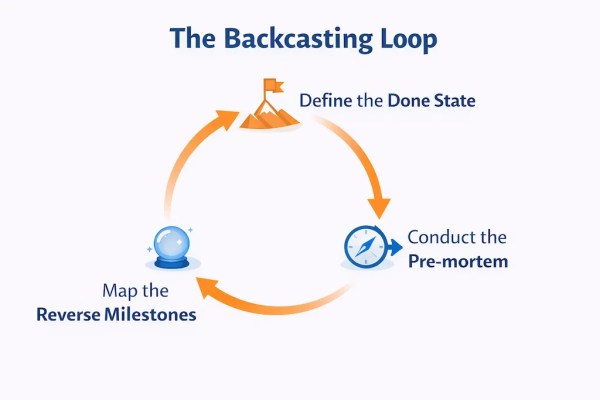
Together, these steps align risk management, capital allocation, and execution discipline with your intended future. In volatile markets, backcasting is not optional. It is a strategic necessity.
In the sections ahead, we will lift the hood and examine each step in detail, translating this framework from boardroom theory into operational reality.
The 2027 “Done State”: Defining the Finish Line
A clear finish line is essential for any meaningful pursuit of goals. The same principle applies to backcasting. A clearly defined future is the starting point of the backcasting loop. Without it, the remaining steps simply cannot function.
So, begin by writing your 2027 Victory Memo.
Sounds easy? It isn’t.
Most leaders analyse past data, observe trends, and project forward. A decade of 17% CAGR becomes the foundation of the 2027 plan. On 31st December 2027, you report 18.5% growth, exceeding your projections. The dashboards are green. The board is pleased.
But the market grew at 21%. Despite exceeding your targets, you lost market share. You delivered on forecasts, yet diluted competitive advantage. This is the classic case of success that quietly erodes position.
Key Metrix to Consider
Your 2027 Victory Memo is not about forecasting. It is about strategic vision. When defining your Done State, look beyond revenue projections and include:
- Market Share and Technology Leadership
- Reduction of Tech and Operational Debt
- Retention and Expansion of Your Talent Pool
These dimensions determine long-term dominance, not short-term optics.
REMEMBER: A well-defined finish line is the foundation of your backcasting strategy. Without clarity on where you must land, you cannot design the actions required today to secure your future.
The Pre-Mortem: Killing the Plan to Save the Vision
A pre-mortem analysis is an extreme-case examination of your defined Finish Line. Its purpose is simple. Before reality tests your strategy, you test it yourself. In the context of backcasting, the pre-mortem sharpens foresight and strengthens risk management.
It is a disciplined three-step process.
1. The Hypothetical Disaster
Imagine you have reached the finish line. It is 31 December 2027. Your most ambitious product launch has failed spectacularly. Or, equally disruptive, it has succeeded beyond expectation.
A pre-mortem is not restricted to negative outcomes. Success, too, can destabilise an organisation. For example, “Our AI platform became so successful that 50% of our workforce was underutilised.”
The objective is to surface uncomfortable scenarios before they become operational realities.
REMEMBER: Pre-Mortem should be conducted by a cross-functional team. If only the leadership team does it, you may miss the “ground-level” failure points that middle management sees daily.
2. The Failure Attribution Phase
Each stakeholder lists the reasons behind the assumed outcome and their probability of occurrence.
Consider both what worked and what failed.
Both internal factors and external forces must be examined. Internal variables include strategy, processes, leadership, and execution discipline. External drivers may include vendors, competition, regulatory shifts, market dynamics, and technology disruptions.
This stage strengthens risk identification and exposes hidden assumptions.
3. The Categorisation
Every identified reason is then classified. Was it a strategic flaw or an execution gap?
This distinction is critical. Strategic flaws demand recalibration of direction. Execution gaps require tightening of processes, governance, and accountability.
REMEMBER: The “reasons for failure” in 2027 become the design inputs for strategic backcasting. They transform into your 2026 safeguards, ensuring that today’s actions are aligned with tomorrow’s strategic vision and long-term goals.
Reverse Engineering: The 2026 Roadmap
Once the pre-mortem analysis is complete, the real work begins. Insights without action are intellectual comfort. Backcasting demands translation of foresight into execution.
Start from Q4 2027 and move backwards to Q1 2026. Redefine your quarterly and monthly milestones in reverse order. This approach ensures that every 2026 decision is anchored to your defined Done State, not to incremental habit.
Constraint Mapping
Today’s initiatives can become tomorrow’s constraints. Through backcasting, you must audit your current roadmap and identify actions that may obstruct your 2027 finish line. Classify them clearly:
- What must be deprioritised
- What requires directional correction
- What demands amplified focus
For example, if your 2027 Victory Memo prioritises technology leadership, but 2026 budgets continue to favour legacy product upgrades, that allocation becomes a structural drag. Similarly, if aggressive hiring continues while automation is scaling, workforce expansion may become an operational liability.
Constraint mapping ensures that your present actions do not sabotage your future ambition. It sharpens capital allocation, streamlines priorities, and removes strategic friction early.
The Critical Path
Not all actions carry equal weight. Some decisions trigger cascading impact across multiple objectives. These are your Critical Path levers, or what I call the “Lead Dominos.”
For example, investing early in a scalable AI architecture in 2026 may simultaneously improve customer experience, reduce operational cost, and strengthen competitive advantage by 2027. Similarly, restructuring leadership accountability may accelerate execution across product, sales, and operations.
Prioritising these high-leverage actions simplifies everything downstream. Address them now, and several 2027 challenges disappear before they emerge.
REMEMBER: Through disciplined backcasting, reverse engineering becomes a strategic advantage. It aligns today’s roadmap with tomorrow’s strategic vision, ensuring that your future is not left to momentum but shaped by deliberate design.
Operationalising the Vision: Turning Backcasting into Action
This is where strategy earns its credibility. Defining the 2027 vision is intellectual clarity. Operationalising it is a leadership discipline.
Once your revised roadmap is shaped through backcasting, it must cascade into daily execution. The real test is simple. Does your 2027 vision show up in Monday morning stand-up meetings in 2026? If not, it will stall at middle management and never reach the frontlines.
To translate strategic vision into operational momentum, focus on three imperatives:
1. Communicate with Precision
Clearly articulate the changes made to the 2026 roadmap. Highlight what has shifted, what has stopped, and what now takes priority. Ambiguity dilutes execution. Clarity accelerates it.
Strong communication ensures alignment across functions and strengthens execution discipline.
2. Show the Larger Picture
People commit to purpose, not just process. Connect roadmap changes to the organisation’s long-term growth, market relevance, and competitive advantage.
When teams understand how today’s actions secure tomorrow’s dominance, alignment becomes voluntary rather than enforced.
3. Explain the “Why” at an Individual Level
Every strategic shift triggers a personal question: “What is in it for me?” Address it directly. Explain how these decisions enhance capability, create opportunity, and strengthen long-term security.
When individuals see how backcasting protects both organisational success and personal growth, engagement deepens.
REMEMBER: Operationalising the vision is a commitment to ensure that backcasting moves from boardroom narrative to frontline behaviour.
How Netflix Used Backcasting to Win
In the early 2000s, Netflix was thriving as a DVD-by-mail business. Subscriptions were rising, logistics were efficient, and revenues were predictable. A conventional forecasting approach would have focused on expanding warehouses and optimising distribution.
Instead, Netflix defined a different ‘Done State.’ Leadership anticipated a world where physical media would become obsolete and on-demand digital streaming would dominate home entertainment. That Done State became their strategic anchor.
Backcasting from that vision, they reengineered their roadmap and began investing in streaming technology in 2007, well before broadband penetration and consumer behaviour fully supported it. They restructured licensing agreements, built digital infrastructure, and gradually repositioned their brand from mail-order convenience to streaming leadership.
At the time, the DVD model was still profitable. The shift was not reactive. It was intentional backcasting. When consumer behaviour eventually pivoted, and competitors scrambled to adapt, Netflix was already ahead of the curve.
MY TAKE: Netflix didn’t just ‘hope‘ streaming would work; they conducted a pre-mortem on the DVD-by-mail model. They saw the death of physical media as an inevitability and used backcasting to build the infrastructure needed to survive it.
Conclusion: The Power of a Fixed Finish Line
2027 is not a destination. It is the cumulative outcome of your 2026 decisions.
When you apply the backcasting loop, you define a precise Finish Line, conduct a rigorous pre-mortem analysis, and reverse-engineer a roadmap that aligns today’s execution with tomorrow’s strategic vision. But strategy delivers results only when it descends from presentation slides to Monday morning agendas. If your 2027 vision does not shape your 2026 stand-up meetings, it remains aspiration, not execution.
Pause and review your 2026 roadmap. Is it driven by linear forecasting, or by deliberate visioning anchored in backcasting? Are your priorities protecting short-term optics or strengthening long-term competitive advantage?
The right time to begin backcasting is now. Add “Define the 2027 Finish Line” to your next leadership agenda.
Because a well-defined future, acted upon today, is already half achieved.
If you found this perspective useful, consider subscribing to my blog by sharing your email below. You will receive regular insights on strategy, leadership, and building sustainable systems.
Stay Connected: For short-form thoughts and business storytelling, follow me on X and Facebook for regular updates.
Beyond the Blog: If stories of power, ambition, and passion interest you, explore my books on Amazon. They examine the fine line between success and surrender, and the choices that define both.
Leave a Reply