

50-WORD SUMMARY: Process pruning helps leaders remove legacy reporting, redundant approvals and unnecessary operational routines before the year begins. By reviewing workflows, testing changes through controlled pilots and measuring results, organisations can reduce operational drag, release employee capacity, protect essential controls and enter Q1 with simpler processes, sharper priorities and stronger execution.
Every year, during the monsoon season, a farmer walks through his mango orchard, examining branches that have grown in the wrong direction, crossed into one another or become weak and unproductive. He removes the unwanted growth, opens up the canopy and restores the tree’s shape. With adequate moisture and favourable growing conditions, the tree can develop fresh growth and prepare for the next flowering and fruiting cycle.
The timing and extent of mango pruning depend on the variety, region and local growing conditions. However, the underlying principle is universal: remove what obstructs healthy growth without damaging what produces the next crop.
Businesses need the same discipline.
Over time, organisations accumulate processes, reports, approval layers and administrative routines. Most were introduced with good intentions. Some addressed genuine problems. Others fulfilled regulatory requirements or supported a particular business need.
But circumstances change. The original problem disappears, while the process remains.
The result is operational drag. Work takes longer, decisions become slower, and employees spend more time maintaining the system than improving its output.
This is where process pruning becomes essential. Before setting new objectives for the coming year, you must examine what your organisation should stop doing.
Why Businesses Need Process Pruning
Organisations are generally good at adding things. Whenever someone identifies a problem, they introduce a new reporting requirement, another approval, an additional review meeting, or another performance dashboard.
Very few revisit these additions to ask whether they are still necessary.
Consider a sales organisation that introduced a daily performance report five years ago. At the time, regional managers needed visibility into sales activity. The report served a purpose.
Today, the organisation has a CRM platform providing real-time dashboards, automated alerts and detailed performance analytics. Yet the daily spreadsheet still circulates. Three employees spend two hours every morning compiling, checking and distributing information that already exists elsewhere.
Nobody questions it because it has become part of the routine.
This is legacy waste.
Effective pruning challenges this waste. It distinguishes between activities that aid business growth and the ones that merely consume resources.
The Hidden Cost of Operational Drag
The cost of wasteful processes is distributed across employee hours, delayed decisions, missed opportunities and avoidable administrative effort.
Three common examples illustrate the problem.
1. Redundant Reporting
Different departments prepare separate reports using the same underlying information. Teams reconcile conflicting numbers instead of acting on them. You pay several people to maintain multiple versions of the same truth.
2. Excessive Approvals
A routine customer refund requires four levels of authorisation. The customer waits, the frontline employee becomes frustrated, and managers spend time approving transactions that fall within an acceptable risk threshold.
3. Legacy Meetings
A weekly operational review continues despite the introduction of automated dashboards. Participants spend an hour reading out numbers everyone has already received. The meeting produces updates, not decisions.

Individually, these activities appear harmless. Collectively, they create a substantial productivity tax.
Pruning helps you recover this lost capacity. More importantly, it releases people and resources for activities that directly contribute to customer experience, revenue and profitability.
Three Tools to Identify What Needs Pruning
You should not depend entirely on intuition when identifying redundant processes. A structured assessment makes the exercise objective and reduces the likelihood of removing something important.
Here are three practical tools.
1. The Zero-Based Process Review
Instead of asking why a process exists, ask whether it deserves to exist today.
For every recurring report, approval, meeting or administrative activity, examine three questions:
- What business problem does it solve?
- Who uses its output?
- What would happen if we stopped doing it?
For example, if nobody can identify who reads a monthly operational report or what decision it supports, its continuation needs justification.
2. Value Stream Mapping
Consider a vehicle repair authorisation process.
A customer reports a breakdown. The assistance provider registers the request, checks coverage, contacts a service partner, obtains an estimate, seeks approval and finally dispatches assistance.
If the process takes four hours, mapping each activity may reveal that the actual work takes 45 minutes, while the remaining time is spent waiting for approvals, chasing updates and transferring information between teams.
Mapping makes these bottlenecks visible and provides a factual basis for pruning unnecessary steps.
3. The Pareto Analysis
Do a Pareto Analysis to identify processes consuming the most time, money or management attention.
For example, you may discover that 20% of approval categories account for 75% of the total processing delays.
Look at transaction volumes, turnaround times, rework rates, escalation frequency and employee effort. Rank activities by their operational impact and start with the top 3 instead of redesigning the whole process.
This ensures that pruning begins where the potential returns are highest.
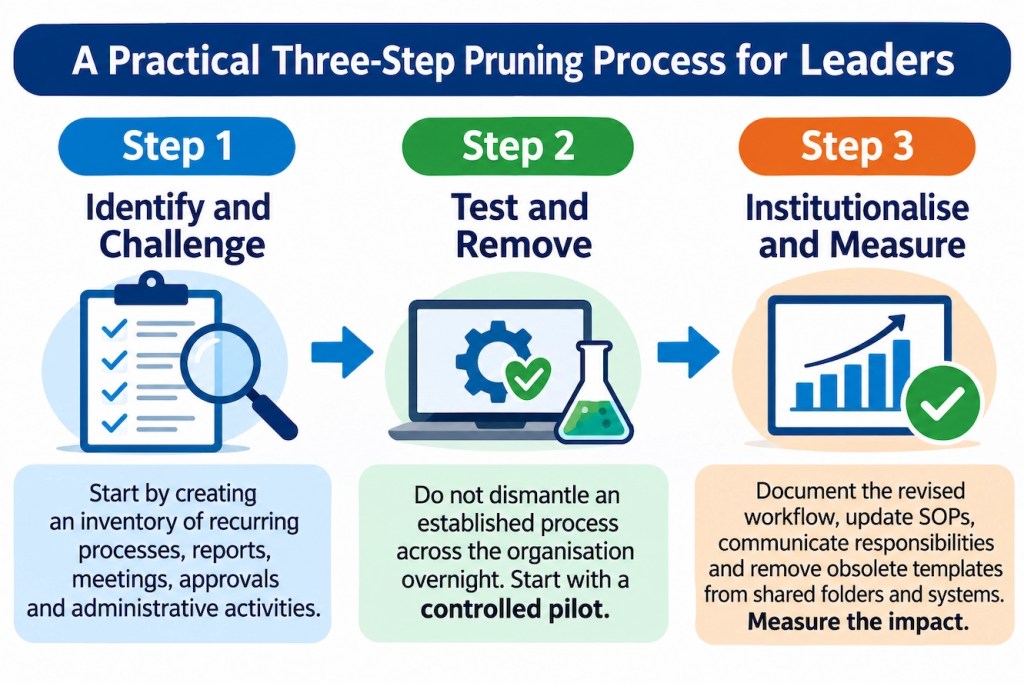
A Practical Three-Step Pruning Process for Leaders
Identifying waste is only half the job. Removing it without creating confusion, resistance, or operational disruption requires a disciplined approach.
A simple three-step framework can help.
Step 1: Identify and Challenge
Start by creating an inventory of recurring processes, reports, meetings, approvals and administrative activities.
Involve the people who perform these. Frontline employees often know where time is wasted better than senior managers reviewing dashboards.
Classify each activity into three categories:
- Retain: Essential for customer service, compliance, risk management or business continuity.
- Simplify: Necessary, but unnecessarily complicated or repetitive.
- Eliminate: Duplicated, obsolete or no longer connected to a meaningful business outcome.
A useful trick is to ask employees to identify one task they would eliminate if they were allowed to redesign their working day.
Step 2: Test and Remove
Do not dismantle an established process across the organisation overnight. Start with a controlled pilot.
Suppose you want to reduce the number of approvals required for routine expenses. Introduce a revised approval matrix for one region or department, with clearly defined financial limits and exception triggers.
Monitor turnaround time, error rates, compliance breaches and employee feedback.
If the results are positive, extend the change.
Step 3: Institutionalise and Measure
Every eliminated process must have an owner responsible for ensuring that it does not quietly return.
Document the revised workflow, update SOPs, communicate responsibilities and remove obsolete templates from shared folders and systems.
Measure the impact using a few practical indicators:
- Reduction in process turnaround time.
- Employee hours released.
- Reduction in approval steps.
- Lower reporting and administrative effort.
- Improvement in customer response and resolution times.
Pruning must produce measurable operational benefits, not merely a shorter process document.
Why December Is the Ideal Month
Timing matters in farming and business alike.
A farmer does not prune randomly. It must fit the tree’s growth cycle, local weather and upcoming flowering season. In many Indian mango-growing practices, post-harvest canopy management and carefully timed pre-flowering work help prepare the tree for the next cycle. The exact schedule varies by region and variety.
You should apply similar thinking.
December offers a natural opportunity for operational pruning because it sits at the intersection of two business cycles: the closing of the current year and the preparation for the next.
There are four practical reasons.
First, performance data is available. You can examine the year’s operational performance, identify recurring bottlenecks and distinguish genuine controls from outdated routines.
Second, budgets are being reviewed. Removing unnecessary reporting, manual administration and duplicated activities can release resources before the next year’s expenditure commitments are finalised.
Third, employees are preparing for new priorities. Eliminating low-value activities creates capacity for strategic projects, customer initiatives and improvement programmes.
Fourth, organisational changes are easier to communicate. A new year provides a natural reference point for revised SOPs, approval matrices, performance measures and accountability structures.
The biggest advantage is that Q1 begins with a cleaner operating environment. Teams do not have to learn new priorities while continuing to carry every old obligation.
Pruning should be used for planned changes, not indiscriminate cuts. Critical operations, statutory requirements and customer commitments must remain protected.
Three Dos and Three Don’ts of Process Pruning
Even a well-intentioned exercise can fail if leaders approach it as a cost-cutting campaign rather than an operational improvement initiative.
Three Dos
1. Involve the people doing the work. Employees closest to a process understand its practical challenges. Their participation improves diagnosis and creates ownership.
2. Use evidence. Measure delays, transaction volumes, employee effort and error rates before making changes. Establish a baseline so that improvements can be demonstrated.
3. Protect essential controls. Review compliance, financial exposure, customer impact and operational risks. Simplification must not create a new vulnerability.
Three Don’ts
1. Don’t confuse pruning with indiscriminate cost-cutting. Removing a necessary quality check may reduce processing time today but increase customer complaints and rework tomorrow.
2. Don’t make changes without communication. Employees should understand what is changing, why it is changing and what their revised responsibilities will be.
3. Don’t allow old habits to return. If obsolete templates, reports and approval routes remain accessible, people will eventually start using them again. Close the loop by updating systems, SOPs and governance mechanisms.

Make Room for Better Growth
Sometimes, progress begins by removing what is no longer useful.
The mango farmer understands that a healthy tree needs space, light and the right conditions to produce a good crop. You must recognise the same principle. Legacy reports, unnecessary approvals and redundant routines consume organisational capacity that could be directed towards customers, innovation and growth.
Make process pruning an annual discipline, not an occasional response to declining performance.
Before finalising your Q1 objectives, ask your team one simple question:
What should we stop doing next year to become better at what really matters?
Enjoyed this perspective? Drop your email below, subscribe to my blog and receive regular insights on strategy, leadership, and sustainable systems.
Follow along: Catch short-form thoughts and business storytelling on X and Facebook.
Read the books: Find my work on Amazon covering power, ambition, and the choices that shape success.


Leave a Reply