
THE 50-WORD SUMMARY: Efficiency initiatives often fail because optimising a process lowers its cost, unintentionally triggering a massive surge in demand. This counterintuitive phenomenon, the Jevons Paradox, explains why making resources friction-free rarely creates a surplus. Instead, without strict operational governance, businesses simply scale up consumption, driving aggregate resource waste higher than before.
We love to see efficiency as the ultimate cure for corporate waste. The logic seems obvious. Optimise a system, use fewer resources, and waste less. Yet in practice, improved efficiency sometimes creates a subtle, but dangerous form of resource waste.
When a process becomes cheaper, faster, and friction-free, the barriers to using it fall dramatically. What follows is rarely a stockpile of saved resources. Instead, people and organisations consume more of the newly efficient resource.
The result is a surge in demand that can drive total waste, resource consumption, and operational strain even higher than before. Consider Sarah, a professional whose experience with a modern transport system perfectly mirrors this hidden operational trap.
Sarah’s Dilemma: A Story of Found Time
When the municipal transit authority announced a new high-speed rail line connecting a growing suburb to the central business district, Sarah, a business consultant, saw an unexpected opportunity. The upgrade promised to cut her commute by 30%.
Sarah calculated that saving forty minutes per trip would give her nearly six hours of extra personal time each week. Encouraged by this newfound efficiency, she purchased a larger home further down the line, confident that the rapid train would offset the additional distance. The first few weeks felt like a masterclass in personal productivity. Travel became effortless. The new rail line removed much of the time and stress that had previously limited her movements.
Lower Costs Create Higher Consumption
Because travelling into the city was now quick and reliable, when a lucrative client on the opposite side of the urban core approached Sarah, she accepted immediately. Previously, the distance would have made the contract impractical, but the high-speed rail made the journey feel insignificant. Soon, another client followed, then another networking event, and then another opportunity.
Within six months, Sarah’s calendar was transformed. The ease of travel had expanded her appetite for movement. Because the unit cost of commuting, measured in time and stress, had fallen, her consumption of travel soared. She was no longer saving six hours a week. Instead, she was spending 20% more total time on trains than before the efficient line opened. The surplus had vanished into an expanded schedule.
This phenomenon undermines resource management, cost reduction, and operational efficiency initiatives every day. When a process becomes more efficient, people rarely bank the savings and stop. Instead, they reinvest the surplus, expand their ambitions, and consume more of the resource than they did before the optimisation took place.
When Reducing Waste Creates More Waste
William Stanley Jevons (1835 to 1882), an English economist, logician, and philosopher who helped shape modern economic thinking, was the first to identify this counterintuitive phenomenon. Jevons observed that advances in steam engine technology made coal use far more efficient. Common sense suggested that Britain would therefore consume less coal.
The opposite happened.
As steam engines became cheaper and more economical to operate, businesses adopted them at scale. Coal-powered machinery spread across industries, and total coal consumption surged rather than declined. Jevons famously wrote in his 1865 book, The Coal Question:
“It is a confusion of ideas to suppose that the economical use of fuel is equivalent to diminished consumption. The very contrary is the truth.”
This observation became known as the Jevons Paradox, explaining why improving the efficiency of a resource can sometimes increase overall consumption rather than reduce it.
The Mechanics of the Corporate Rebound
The way the Jevons Paradox unfolds in modern business operations is surprisingly straightforward:
Efficiency → Lower Unit Cost → Lower Prices → Higher Demand
As products and services become cheaper to produce and easier to access, demand elasticity often drives usage up faster than the efficiency gains themselves. What begins as an effort to reduce waste can end up increasing overall resource consumption. Beyond a critical threshold, rising demand absorbs those gains and creates an entirely new layer of operational waste.
The Rebound Effect vs Backfire
Returning to Sarah’s example, we can see two distinct operational phases that dictate how efficiency gains are lost:
- The Rebound Effect: This occurs when some of the efficiency gains are lost, but the overall outcome remains positive. In Sarah’s world, this would be like losing just one hour of her saved six to grab coffee or schedule an extra minor appointment.
- Backfire: This is the true operational threat. It happens when consumption rises well beyond the original baseline. Sarah experienced total backfire, where her travel time actually exceeded what she spent commuting before the new rail line opened. The efficiency gains disappeared entirely and were replaced by higher net consumption.

Case Study: The Digital Mirage of Cloud Efficiency
The digital landscape is particularly vulnerable to backfire because it removes physical friction.
A mid-sized e-commerce company decided to migrate from legacy on-premises servers to a modern cloud architecture. The business case looked compelling. By adopting microservices, auto-scaling, and on-demand infrastructure, the engineering team projected a 40% reduction in server waste and a significant improvement in operational efficiency.
On paper, the numbers were flawless, but the reality told a different story.
Why the Efficiency Gains Evaporated
Once the migration was complete, creating a new testing environment became almost instantaneous. What previously required approvals, procurement, and manual setup could now be done with a few clicks.
As the cost and effort of provisioning resources fell, developers began launching hundreds of parallel experiments, temporary databases, and test environments. Many of these environments remained active long after they had served their purpose. Some ran throughout the weekends; others were forgotten entirely. The organisation had removed the friction from resource consumption, but it had not strengthened governance.
Digital efficiency removed physical barriers, and the Jevons Paradox quietly entered the picture. Without those barriers, human behaviour shifted towards maximum consumption, creating new forms of waste. The result was predictable. Although the company’s code became significantly more efficient, its monthly cloud bill increased by 15%.
The Core Operational Insight: The biggest source of waste is often not inefficient technology, but the additional consumption that efficient technology encourages. Unless efficiency is paired with governance, accountability, and usage controls, lower costs quickly translate into higher resource consumption.
Operational Efficiency Changes the Entire Supply Chain
One of the biggest mistakes organisations make during efficiency improvement initiatives is treating them as localised projects rather than enterprise-wide transformations. The departments suffering most from bottlenecks, delays, or high costs are usually the first to drive change. While the intention is good, focusing on a single function often creates a dangerous illusion of success.
The Local Optimisation Trap
Improving one department in isolation rarely reduces overall waste. More often, it shifts the burden elsewhere in the value chain.
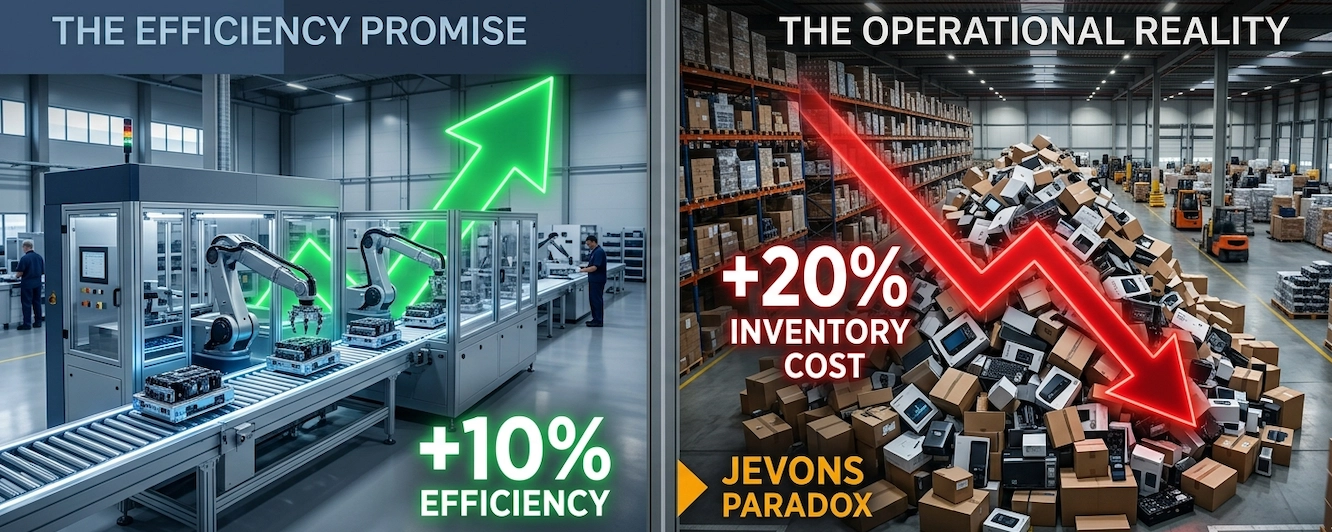
Consider a manufacturing company that improves production efficiency by 20%. More units are produced using the same resources, reducing the cost per unit. But the story does not end there. The logistics team must now process and distribute 20% more shipments. Warehousing must accommodate higher inventory flows. Procurement must source additional materials.
If these surrounding functions fail to keep pace, the gains quickly unravel. Production lines continue running, warehouses overflow, inventory carrying costs rise, and a new form of operational waste emerges. Efficiency gains in one department have simply created inefficiencies elsewhere.
The Elasticity of Business Demand
The same pattern appears in workforce management. When operations become more efficient, leadership teams rarely respond by reducing workloads. Instead, they raise expectations.
If customer acquisition requires 10% less effort, the goal is seldom to work 10% less. The new target is often 10% more customers, faster growth, and greater market share. This creates additional pressure on people, systems, and resources. Teams work harder, workloads expand, and the risk of burnout, turnover, and hidden waste increases. Efficiency without end-to-end capacity planning merely moves waste to the next constraint.
Strategies for Genuine Waste Reduction
If you want lasting waste reduction, you must look beyond simple efficiency improvements. A sustainable improvement journey requires a holistic approach supported by strong governance, resource controls, and enterprise-wide visibility. Leaders must deploy targeted operational frameworks to capture efficiency gains without falling into the Jevons Paradox trap.

1. Adopt a Cap-and-Reinvest Model
One of the simplest ways to prevent efficiency gains from being consumed by rising demand is to establish a firm resource ceiling before launching an initiative.
For example, suppose a manufacturing plant reduces its electricity consumption by 15% through equipment upgrades. Instead of allowing departments to spend those budgetary savings elsewhere, leadership can lock in the reduced energy budget and formally redirect the financial savings towards automation, capacity expansion, or strategic capital investments. This converts short-term efficiency gains into long-term business value.
2. Introduce Artificial Friction
Efficiency often removes the natural barriers that limit consumption. Smart governance should replace those barriers with deliberate, automated controls.
In the cloud computing example, many organisations now configure environments to shut down automatically after a predefined period of inactivity. Developers can still access resources when required, but forgotten servers cannot continue consuming computing power indefinitely. Similarly, spending limits, approval workflows, and capacity thresholds are essential for preventing hidden waste from accumulating behind the scenes.
3. Measure the Entire Lifecycle
Many organisations measure efficiency at a transaction level rather than across the entire value chain. A factory may celebrate producing 25% more units per hour, but if those products remain unsold and occupy warehouse space for months, total resource waste has actually increased.
Operational research suggests that inventory carrying costs alone can range between 20% and 30% of inventory value annually. This is why organisations must evaluate efficiency across procurement, production, logistics, storage, sales, and disposal rather than focusing on a single activity. True waste reduction is achieved only when the organisation consumes fewer resources overall.
The Efficiency Trap: Are You Saving or Simply Consuming More?
The Jevons Paradox reminds us that efficiency and waste reduction are not the same thing. Making a resource cheaper, faster, or easier to use often increases demand, which can erase the very gains we worked so hard to achieve. True operational excellence comes from managing total resource consumption, not just improving individual processes.
Before celebrating your next productivity breakthrough, ask a tougher question: has overall waste actually fallen?
Audit your recent efficiency initiatives and track their organisation-wide impact. You may discover that your greatest opportunity for savings lies not in working faster, but in consuming less.
If you found this perspective useful, consider subscribing to my blog by sharing your email below. You will receive regular insights on strategy, leadership, and building sustainable systems.
Stay Connected: For short-form thoughts and business storytelling, follow me on X and Facebook for regular updates.
Beyond the Blog: If stories of power, ambition, and passion interest you, explore my books on Amazon. They examine the fine line between success and surrender, and the choices that define both.


Leave a Reply