

THE 50-WORD SUMMARY: Success often masks stagnation. When “yes” becomes a reflex, we trade personal growth for external validation. This article explores the psychology of over-commitment from the Validation Trap to Competence Penalties and provides a practical audit framework to reclaim your time, prioritise deep work, and transition from hollow achievement to meaningful growth.
It is the last day of the quarter. You sit in your corner office, reviewing the numbers on your performance dashboard. Once again, you have exceeded every commitment you made. Targets met. Expectations surpassed. You are seen as dependable, consistent, and indispensable. This has become routine.
Then a calendar alert appears. It is a reminder from HR about a leadership programme titled Achieving Mental Peace Through Smart Delegation. You have postponed it for three months. Each time, the reason has been the same: work commitments. Ironically, mental peace is exactly what you feel deprived of right now.
Does this sound familiar?
If yes, then this article has been written especially for you.
The Perfect Quarter Mirage
In professional life, commitment is celebrated. Saying yes is rewarded. Reliability is praised. Over time, however, this habit quietly turns into over-commitment. We begin to say yes, without evaluating cost, capacity, or consequence. What looks like success on the surface slowly becomes hollow. Performance stays high, but personal growth, clarity, and balance erode.
The Success Gap
This brings us to a fundamental question: what is success, really? How do we measure it?
Is it defined by external applause, or by what genuinely matters to us?
A recent workplace study found that nearly 60% of senior-level women executives frequently experience burnout, a figure higher than their male counterparts in similar roles. The data reveals a clear pattern: rising responsibility and relentless obligations often travel alongside emotional exhaustion.
This is the paradox of modern success. We are winning and losing at the same time. Winning by society’s benchmarks, while quietly losing by our own.
So why do capable, driven people fall into this trap?
The answer is deceptively simple. When commitment becomes automatic, saying yes turns into a reflex rather than a choice. Success built on the inability to say no is not growth. It is a high-interest loan taken against your future self. The returns look impressive today, but the cost is paid later in lost energy, stalled personal growth, and a deeply hollow success.
The Anatomy of Over-Commitment
So why do we repeatedly fall prey to over-commitment and say yes when every instinct tells us to say no?
Because this behaviour is deeply human. Blindly saying yes is not a character flaw; it is driven by powerful psychological needs that quietly shape our decisions.
The Validation Trap
As social beings, we seek acceptance and validation. Saying yes feels easy while saying no feels risky, even isolating. Over time, this turns commitment into a reflex rather than a conscious choice. Each yes raises expectations. The more reliable you appear, the more work flows your way, until you are carrying tasks and responsibilities that were never meant to be yours.
This slowly evolves into the hero complex. Your yeses are driven by the need to be indispensable. You volunteer before being asked, reschedule personal priorities, and work late to deliver perfection. Often, the work goes unnoticed, but the commitment stays. What looks admirable from the outside quietly becomes an empty achievement.
The Competence Penalty
Consider this. When a critical and complex task needs to be done, who gets the assignment? The most capable person, not the one who is disengaged. The logic is as clear as the difference between cheese and chalk.
This is where an obligation quietly turns into a liability. The unspoken “reward” for good work is more work. One successful delivery is quickly followed by another, often more demanding assignment. While this increases visibility, it rarely supports personal growth.
As you move from task to task, there is little space to pause, recharge, or reflect. Self-assessment disappears. Long-term personal commitment to learning, balance, and direction gets postponed indefinitely.
Fear of the Void (FOMO)
The inability to say no is also fuelled by the fear of missing out. Declining an opportunity feels risky.
- What if this becomes a career-defining project?
- What if saying no means being overlooked next time?
- What if stepping back leaves nothing meaningful to work on?
These questions reinforce blind commitment. They create anxiety around absence and silence, pushing us to accept work we neither need nor want. The result is a growing list of unwanted commitments, driven not by purpose but by fear.
The Slow Descent
The effects of over-commitment rarely announce themselves loudly. They creep in. Unwanted tasks slowly fill your calendar, drain your energy, and leave you successful on paper but unfulfilled in reality. This descent usually unfolds in three phases.
Phase 1: The Adrenaline Rush
It begins with a win. You exceed targets, deliver complex work, and earn public praise. Confidence rises. Visibility follows. Soon, every critical task comes your way. You are consulted, trusted, and seen as indispensable because your commitment is unconditional. Saying yes feels rewarding, and the trap remains invisible.
Then the cost appears. Over-commitment starts with small sacrifices: missed workouts, cold dinners, late-night emails. You call it temporary. Gradually, learning stops, training is skipped, and curiosity fades. Your world shrinks to the next task. Commitment quietly shifts from growth to survival.
Phase 2: The Breaking Point
One day, the realisation hits. You have not read a book in the last two years. You have not learned a new skill. You cannot remember the last meaningful conversation you had.
You are cut off from your professional circle. The last email from your mentor has been sitting unanswered for three weeks. You are busy, yet strangely stagnant.
This is where blind commitment starts feeling heavy.
Phase 3: The Crash
Finally, you find yourself sitting at your desk, staring at a blank monitor.
Despite all the movement, all the activity, you are exactly where you were three years ago. Except now, the cost is visible. Friends have drifted away. You are on blood pressure medication. Your diabetes is borderline. You have not spoken to your partner in three days.
This is the endgame of unchecked commitment.
Pro Tip: Saying yes blindly does not lead to growth. It leads to over-commitment and a version of success that looks impressive from the outside but feels unmistakably hollow on the inside.
The Opportunity Cost
Deep Work vs Shallow Work
Growth requires long, uninterrupted tranches of focused deep work. However, when your calendar is packed with deliverables, commitment shifts from thinking deeply to merely finishing tasks. Over time, deep work gives way to shallow work.
You start doing the bare minimum required to tick the box and move on. Quantity overtakes quality. Presentations begin to look the same. Solutions rely on the same familiar frameworks and strategies. There is little room for innovation, experimentation, or fresh ideas. Blind commitment keeps you busy, but it slowly erodes creative depth.
The Skill Plateau
Working in an assembly-line mode takes quite a toll on your skills and creativity. It is like Ford producing every Model T in black. Efficient, predictable, and limiting.
You are always “doing,” but you are no longer “evolving.” There is no time to learn a new skill, groom a subordinate, or contribute meaningfully to a cross-functional team. Your commitment becomes narrowly operational.
Your world shrinks to your product, your department, and your team. In the process, you sacrifice learning new technologies, studying competitors, or understanding market evolution. Over time, over-commitment locks you into competence without growth.
The “Mile Wide, Inch Deep” Problem
The combined effect of shallow work and stalled skill development creates a dangerous outcome. You become a journalist of tasks.
You perform well within the boundaries of your role and department, but you lose sight of the bigger picture: mastering your craft. Your commitment is spread wide but lacks depth.
When a new variable enters the equation, or a familiar problem appears in a slightly different form, you struggle. Without depth, adaptability disappears. This is how relentless commitment produces activity without mastery, and success without substance.
Redefining Your Commitment
Next, I lay out strategies to help you review and redefine your commitments. I also introduce a practical framework to guide your decisions on when to say “yes” and when to say “no,” along with honest advice on handling the inevitable discomfort and consequences that come with saying no.
The Commitment Audit
The first step in any improvement plan is a clear audit of the current state. I recommend conducting this audit once every month. List all your commitments for the coming month. Do not filter or justify them. Once listed, categorise each item into one of the three types below.
1. Obligations
Commitments you take on to repay IOUs or to oblige someone, often with the expectation of future leverage or goodwill. A few examples could be:
- Taking on a colleague’s report because they helped you earlier
- Supporting a project to “stay in good books”
Obligations feel safe, but they quietly accumulate. Left unchecked, they become a major source of over-commitment.
2. Validations
Commitments driven by the need to maintain visibility, relevance, or social standing. They help protect your image, not necessarily your growth. Like:
- Accepting high-visibility work that offers limited learning
- Taking on tasks to avoid being perceived as uncooperative
Validation sustains reputation in the short term but often leads to success without substance.
3. Growth
Commitments that directly expand your capability, perspective, or long-term value. These comprise tasks like:
- Learning a new skill or technology aligned with future goals
- Participating in cross-functional work that broadens business understanding
These commitments are uncomfortable but compounding.
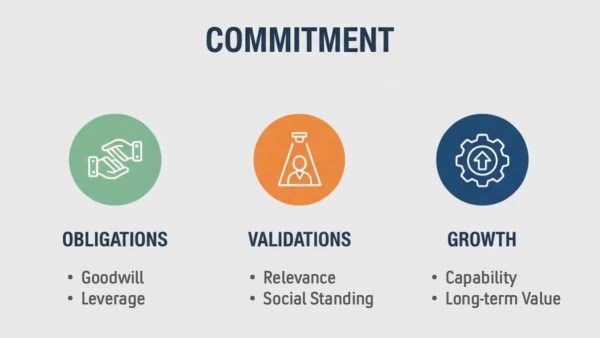
Pro Tip: The strategy to overcome these commitments is to rebalance them. Obligations should be limited and time-bound. Validations should be chosen selectively, not reflexively. Growth must be protected and scheduled first, not fitted in last.
The “Hell Yes or No” Rule
The next step is to become deliberate about taking on new commitments. The “Hell Yes or No” Rule is a simple filter that helps you decide when to say yes and when to say no.
The “Hell Yes or No” Rule: If an opportunity, request, or task does not trigger a strong and enthusiastic “Hell Yes,” the default answer should be “No.”
A hesitant yes is rarely neutral. It consumes time, attention, and energy while delivering limited value. Over time, these half-hearted commitments accumulate and create the illusion of success through busyness, not progress.
In practice, this rule separates commitments taken out of habit, fear, or the need for validation from those that genuinely align with your goals and growth. A true “Hell Yes” signals relevance, learning, and meaningful impact. Anything else quietly drains capacity and pulls you deeper into over-commitment.
Navigating the Guilt
Even when logic tells us that saying no is the right decision, it rarely feels comfortable. Guilt is one of the most common side effects of redefining commitment.
Years of conditioning make us equate saying no with letting people down. As you begin to correct over-commitment, this internal resistance is natural.
- Reconnect with the Reason Behind the No: You are protecting your energy, your focus, and your most important commitments. This is not selfishness. It is strategic clarity.
- Release the Burden of Universal Approval: You are not responsible for meeting everyone’s expectations. Accepting every request makes you overextended. Choosing carefully only makes you human.
- Trust the Repetition Curve: Guilt fades with practice. Each time you say no with intent, it becomes easier. Over time, intentional commitment replaces reflexive agreement, and saying no begins to feel normal.
When you say ‘YES’ to others, make sure you are not saying ‘NO’ to yourself. – Paulo Coelho
The Power of the Meaningful “No”
There was a time when I said yes too easily. As a freelance consultant, I took on assignments driven by FOMO, not fit. Most added little value and quietly ate into what truly mattered: my blogging and writing. Once I started saying no, the pace slowed. Focus returned. The work became fewer, but the growth became real. That is the difference between blind commitment and intentional commitment.
If you want to step out of over-commitment, start here:
- Audit your commitments for the coming month without justification or defence.
- Identify two growth commitments and make them your top priority. Schedule them first.
- Identify one validation and one obligation commitment, and consciously say no to them.
Saying no is not about doing less. It is about choosing better. When commitment becomes deliberate, success becomes sustainable.
If you enjoyed this perspective on operational strategy, subscribe to my blog below for weekly insights on building a business that runs itself.
Stay Connected: For short-form thoughts and business storytelling, follow me on X and Facebook for regular updates.
Beyond the Blog: If stories of power, ambition, and passion interest you, explore my books on Amazon. They examine the fine line between success and surrender, and the choices that define both.
Leave a Reply