

Hedy Lamarr is often remembered for her captivating presence on the silver screen, but few know of her remarkable contributions beyond Hollywood. Her inventive mind challenged conventions and quietly laid the groundwork for technologies we now use every day.
This hidden chapter of her life reveals how brilliance can emerge from the most unexpected places.
We live in a world where Bluetooth and Wi-Fi connect our lives seamlessly. Have you ever stopped to wonder how these technologies manage to work without interference despite the countless devices around us? Well, they use a very simple but effective technology for this.
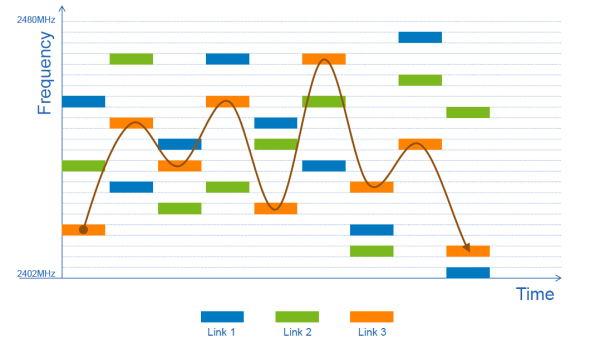
Each technology is assigned a frequency spectrum for communication. For example, Bluetooth operates in the 2.4 GHz ISM (Industrial, Scientific, and Medical) band. 2.4 GHz spectrum is divided into 79 channels (in most regions), each 1 MHz wide. Devices “hop” between these channels up to 1,600 times per second in a pseudo-random sequence. Both transmitter and receiver use the same hopping sequence for seamless communication.
Commonly known as ‘Frequency Hopping Technology’, it is a versatile and robust communication method. This technology is used in military, consumer, and industrial domains for secure and interference-free communications. The development of this technology is credited to the film actress Hedy Lamarr. She is the star of this story.
A Star is Born
Hedy Lamarr was born Hedwig Eva Maria Kiesler on November 9, 1914, in Vienna, Austria. Her father, Emil Kiesler, was a banker with a deep interest in technology. He often explained machines to his young daughter. This sparked her fascination with how things worked and this exposure to technology later played a crucial role in her scientific achievements.
Her mother, Gertrud, was a talented concert pianist who nurtured Hedy’s artistic side. Hedy grew up in Vienna’s vibrant cultural and intellectual environment. She was exposed to the arts and sciences early on. This duality would define her life. Discovered at 16 by Austrian director Max Reinhardt, she embarked on a promising acting career.

Early Life and Acting Career
Hedy quickly found success, landing roles in German and Czech films. Her beauty and talent were undeniable and soon Hedy became a rising star in European cinema. Hedy’s breakthrough role came in the controversial 1933 film Ecstasy. A romantic drama filmed in three languages (German, Czech, and French). The film gained international acclaim, winning the Best Director award at the 1934 Venice Film Festival for Rogoz Machatý.
Hedy married Austrian arms dealer Friedrich Mandl in 1933. Mandl’s company enabled Hedy to learn about weapons technology, while attending his business meetings and absorbing the technical discussions around her. Mandl, though, was a controlling and possessive husband and attempted to stifle her acting career.

In 1937, Hedy escaped from her unhappy marriage, fleeing to Paris and then to London. In London, she met Louis B. Mayer, head of MGM Studios, who offered her a Hollywood contract. She accepted and changed her name to Hedy Lamarr, starting a new chapter in her life.
Lamarr quickly became one of Hollywood’s biggest stars during its Golden Age. She starred in films like Algiers (1938), Boom Town (1940), Ziegfeld Girl (1941), and Samson and Delilah (1949). She received acclaim for her beauty. Many called her “The most beautiful face in Hollywood”.
Passion for Science and Technology
Behind the glamour, yet, Hedy was a woman deeply fascinated by science. In her downtime, Hedy tinkered with inventions in her home lab, from improved traffic lights to dissolvable soft drink tablets. She famously quipped, “Any girl can be glamorous. All you have to do is stand still. You just need to look stupid.” This also underscored Hedy’s disdain for being typecast by her looks alone.
During World War II, Hedy became increasingly concerned with the war. Disturbed by reports of German U-boats targeting Allied ships, Hedy was determined to contribute to the war effort. She met George Antheil, an avant-garde composer and fellow inventor, at a Hollywood party. Both bonded over their shared interest in technology. This partnership would lead to one of the most important innovations of the 20th century.

Invention of Frequency Hopping Technology
In World War II, radio-controlled torpedoes were a critical weapon in naval warfare. Nonetheless, they were susceptible to jamming by the enemy. Hedy Lamarr and George Antheil developed a frequency-hopping system. A revolutionary concept to secure radio communications. They merged Hedy’s understanding of weapons systems with George’s skill in player piano mechanisms to build it.
The concept was inspired by player pianos, which used perforated rolls to control the notes played. The system had the transmitter and receiver hop between frequencies. They followed a predetermined synchronised pattern. This made it nearly impossible for enemies to detect or jam the signal. Hedy and George received a patent for their invention, U.S. Patent No. 2,292,387, on August 11, 1942.
The Legacy of Frequency Hopping Technology
The impact of Hedy Lamarr and George Antheil’s invention was huge. The principles of frequency hopping are fundamental to secure wireless communication, enabling devices to connect seamlessly without interference.
While the U.S. Navy initially dismissed the idea, believing it to be too complex to implement. They revisited it during the Cuban Missile Crisis in the 1960s. It became a critical part of military communication systems.
It also became the precursor to technologies like Bluetooth, Wi-Fi, and GPS. Today, this technology is essential for everything from mobile phones to satellite communications. It protects sensitive information. It also enables the seamless connectivity we rely on today.
Recognition and Rediscovery
Despite her groundbreaking contribution, Hedy Lamarr got little recognition during her lifetime. The patent had long expired before its commercial applications became evident. However, the tide turned in the 1990s. Hedy and George were awarded the Electronic Frontier Foundation (EFF) Pioneer Award in 1997. Hedy Lamarr became the first woman to get the BULBIE Gnass Spirit of Achievement Award, also known as the “Oscars of Inventing.”
“Hope & curiosity about the future seemed better than guarantees. The unknown was always so attractive to me, and still is.”
Hedy Lamarr
Today, Hedy Lamarr’s story is a source of inspiration. Hedy was inducted into the National Inventors Hall of Fame in 2014, celebrating her as a Hollywood legend. She is also a pioneer in technology. Her life has been immortalised in books, films, and the acclaimed documentary Bombshell: The Hedy Lamarr Story (2017).
A Timeless Role Model
Hedy Lamarr’s life is a testament to the power of curiosity and determination. She shattered stereotypes, proving that beauty and brilliance can coexist. Her legacy continues to inspire women in STEM fields. It encourages them to break boundaries and make their mark on the world.
So, the next time you connect to Bluetooth or Wi-Fi, take a moment to remember Hedy Lamarr. The woman whose inventive spirit shaped the connected world we enjoy today.
I am sure you found this story interesting.
Please subscribe to my blog by filling in your details below:
My blog has countless such articles and stories to guide you and quench your thirst for knowledge.
You can also follow me on X and Facebook to read more such stories and posts.
You can also watch a video on this topic on my YouTube channel:
PS: Copilot and ChatGPT have been used to create parts of this post.
Leave a Reply