

Our needs drive our pursuit of happiness and keeps us going. We dedicate our entire existence to finding the sources of our joy. Whether it’s mastering biking for the first time, gaining admission to a prestigious school, landing a job at our dream company, marrying our childhood love, purchasing our first car or home, or cradling our newborn, every milestone enhances our happiness.
Along this journey, we achieve numerous milestones while accumulating assets and accolades, some of which are essential and others not so much. Significant sacrifices often accompany this journey, impacting our relationships, health, and mental well-being.
Eventually, we find ourselves pondering: is it all worth it? Do we truly need everything we’ve gathered, or have we been chasing our wants while neglecting some vital needs?
In this article, I will explore the distinction between needs and wants and offer tips on how to achieve a balance between the two, enabling us to lead a more fulfilling life.
We begin by clarifying the concepts of needs and wants.
Needs:
These are the essential items required for survival. These are primarily encompassing of:
- Physiological: Food, water, clothing and sexual fulfilment.
- Security: Housing and a reliable income.
- Social: Love and friendship
All these play a vital role in our emotional and psychological health.
Wants:
Wants are the desirable extras that we believe enhance our lives. Although they boost our self-esteem and ego, these are not critical for survival. Wants typically include items associated with recognition, like status, power, and money. These provide temporary satisfaction only.
“Man is a wanting animal – as soon as one of his needs is satisfied, another appears in its place. This process is unending. It continues from birth to death.”
Douglas McGregor
Both needs and wants are integral to human nature. Often, we struggle to distinguish between them, leading to confusion where we equate wants with needs. Failing to meet wants confused as needs results in frustration and unhappiness. Thus, recognising the distinction between the two and achieving a harmonious balance is essential for finding contentment in life.
In 1943, psychologist Abraham Maslow proposed a ‘Hierarchy of Needs’ model. In this model, he classified human needs into five types.
- Physiological Needs: Food, Shelter, Sleep, Heat, Sex.
- Security Needs: Job Security, Health, Protection.
- Social Relationships: Family, Friends, Intimacy, Trust, Acceptance, Love.
- Recognition: Status, Power, Money.
- Self Actualisation: Individuality, Realising Personal Potential, Faith.
Balancing Needs and Wants
Finding a balance between needs and wants leads to a fulfilling life. By prioritising our needs, we ensure our fundamental requirements for health and stability are met. This approach enables us to pursue our wants without compromising our well-being. Achieving this balance allows us to experience both stability and enjoyment.
Here are some tips to help achieve this balance:
1. Identify Needs and Wants
As a self-assessment exercise, we can use the graphic below to categorise our needs and wants to understand where we currently stand.
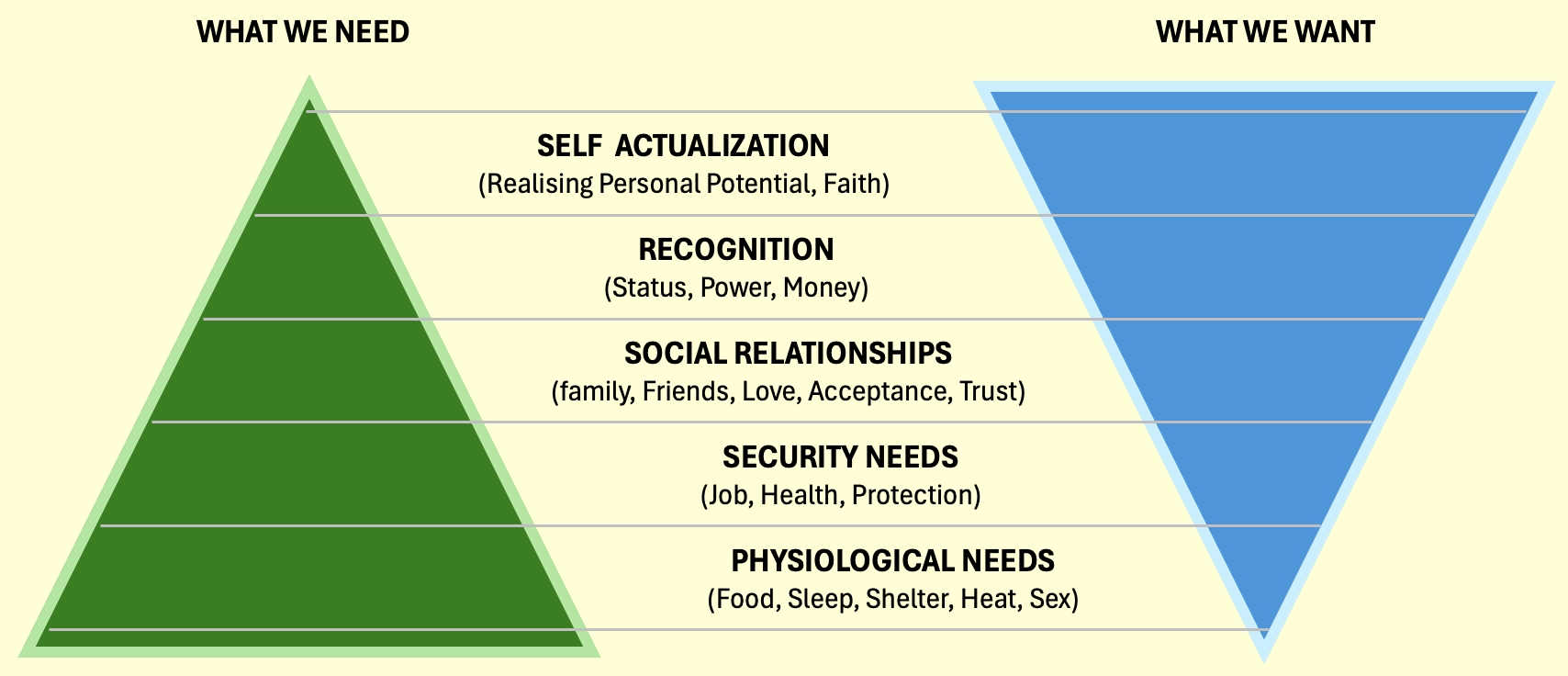
This exercise helps us make a clear distinction between our needs and wants. This will help us cut down our efforts towards our wants and focus more on our needs.
2. Less is More
A minimalistic lifestyle helps us focus on what truly matters and eliminate excess. The point to remember is that the wants give only temporary pleasure. Take the example of buying a very expensive car. While the acquisition will give us satisfaction in the short term, paying for its insurance, fuel, and maintenance will keep causing stress during the entire ownership period of the vehicle.
3. Financial Planning
Financial planning helps in balancing needs and wants. Making a detailed budget ensures that we consume our financial resources consciously. We can prioritise our expenditure, giving the essentials the first priority. This approach ensures that whenever we are spending on our wants, it is always within our means. This also prevents financial distress at a later date.
4. Be Thankful
There is an old saying, “Be grateful for the things and people you have in your life. Someone else is praying for the things you take for granted.”. These are very powerful words. Often, we are so worried about things we don’t have that we forget to appreciate what we have.
Focusing on what we already have, allows us to appreciate the fulfilment of our needs and reduces the possibility of chasing unnecessary wants. It also makes us realise that we own enough things to lead a happy and fulfilling life. Thankful people, experience higher life satisfaction.
5. Non-Material Fulfilment
Our relationships with our family and friends, personal growth and happy life experiences create lasting happiness. These are non-materialistic sources of fulfilment.
Instead of focusing on acquiring more, we should invest our time and efforts in activities that nurture our emotional and psychological well-being. Spending time with loved ones, engaging in hobbies, and personal development through learning and self-reflection are a few such activities. These fulfil our deeper emotional and psychological needs and contribute to a sense of purpose.
Some Real-World Examples
Elon Musk

Musk lives a relatively frugal lifestyle despite his wealth. He has been known to sleep on friends’ couches and live in a modest prefab house near SpaceX’s headquarters. Musk’s focus is on fulfilling his needs, such as advancing space travel and sustainable energy.
Tom Shadyac

The director of popular comedies like “Ace Ventura” and “The Nutty Professor,” Shadyac experienced a shift in perspective after a serious biking accident. He realised that his pursuit of material wealth had not brought him true happiness. Shadyac sold his mansion, moved into a mobile home, and focused on living a simpler, more meaningful life.
Marie Kondo

The author of “The Life-Changing Magic of Tidying Up” advocates for decluttering and simplifying one’s life. Kondo’s philosophy encourages people to keep only items that “spark joy,” helping them prioritise their needs and let go of excessive wants. This approach has resonated with many individuals seeking happiness through minimalism and intentional living.
Conclusion
Happiness lies not in having everything we desire but in understanding the distinction between our needs and wants. Striking a balance between these allows us to live purposefully, with mindfulness and gratitude. Embracing a minimalistic lifestyle, engaging in financial planning, practising thankfulness, investing in experiences rather than possessions, and prioritising what truly matters help us escape the unending chase for more, leading to lasting happiness found in life’s simplest yet most essential aspects.
I am sure you found this article interesting and useful.
Please subscribe to my blog by filling in your details below:
My blog has countless such articles and stories to guide you and quench your thirst for knowledge.
You can also follow me on X and Facebook to read more such stories and posts.
You can also watch a video on this topic on my YouTube channel:
PS: Copilot and ChatGPT have been used to create parts of this post.
Leave a Reply