
THE 50-WORD SUMMARY: The 1904 Olympic marathon was a chaotic disaster defined by resilience and absurdity. From a postman taking a nap to a winner fuelled by rat poison, this race exposes the dangers of toxic leadership and bad data. It serves as a powerful metaphor for personal development and adaptability.
Exactly 122 years ago, the world witnessed a disaster. Today, we can use it as a blueprint for our own resilience.
The year was 1904. The world was still discovering aeroplanes, telephones were a luxury, and the Olympic Games were struggling to prove they were more than a travelling carnival. St. Louis, Missouri, hosted the Olympics as part of the grand World’s Fair, and the organisers wanted to showcase endurance, human resilience, and American toughness to the world.
Instead, they accidentally delivered one of the most bizarre sporting disasters in history.
A Recipe for Disaster in St. Louis
The 1904 Olympic Marathon was supposed to celebrate discipline, grit, and human determination. What unfolded instead was a masterclass in confusion, dehydration, cheating, dust storms, hallucinations, and survival.
The Marathon stretched across 24.85 miles of rough country roads outside St. Louis. The conditions were brutal. Temperatures climbed above 32°C, humidity wrapped itself around the runners like a wet blanket, and the roads were coated with loose limestone dust that exploded into choking clouds every time a vehicle passed.
Yet the greatest threat was not the heat; it was the management philosophy behind the race.

James Edward Sullivan, the chief organiser, believed the Marathon should serve as an experiment in what he called “purposeful dehydration.” In modern business language, this would qualify as catastrophic leadership wrapped in misplaced confidence.
So he provided only two water stations for the entire race.
Just two. For nearly twenty-five unforgiving miles under a punishing Missouri sun.
Modern Marathon runners would likely refuse to start under such conditions. Corporate risk managers would shut the event down before the first shoe touched the ground.
And yet, the runners stepped forward anyway.
Meet the Cast of Misfits
If the course itself sounded dangerous, the marathon runners looked even more improbable.
One of the most unforgettable figures was Félix “Andarín” Carvajal, a cheerful Cuban postman with endless energy, very little preparation, and absolutely no concern for conventional race strategy.
Carvajal had travelled from Cuba chasing Olympic glory. Unfortunately, while passing through New Orleans, he lost nearly all his money in a gambling game. With his finances in ruins, he begged rides on trains, hitchhiked when possible, and walked long stretches simply to reach St. Louis.
He appeared at the starting line wearing a long-sleeved woollen shirt, heavy trousers, and ordinary street shoes. Moments before the race began, fellow athletes took pity on him. One runner produced a pair of scissors and cut his trousers at the knees, creating improvised running shorts minutes before the starter pistol fired.
Nearby stood American runner Thomas Hicks, a disciplined and highly respected long-distance athlete. Unlike Carvajal, Hicks arrived with preparation, structure, and a serious support system. What nobody realised was that his team had also prepared a performance-enhancement strategy that belonged more in a chemistry laboratory than a sporting event.

Then there was Fred Lorz, a bricklayer from New York with an easy smile and a mischievous streak. He joked with spectators, looked relaxed, and carried himself with the confidence of a man who believed he understood the assignment.
At 3 pm, the marathon starter pistol fired.
And within minutes, the entire operation started collapsing under the weight of poor planning and brutal conditions.
Chaos on the Road
The Dust Lung
The first major disaster arrived in the form of traffic.
Unlike modern Marathons with sealed roads, controlled routes, and carefully managed operations, the 1904 Olympic Marathon unfolded in the middle of ordinary public movement. Horse wagons rattled across the course. Official cars sped past exhausted runners. Spectators wandered dangerously close to the athletes, turning the race into a logistical nightmare.
Every passing vehicle kicked up enormous clouds of limestone dust.
The runners coughed, choked, and struggled to breathe. Dust coated their faces, filled their lungs, and clung to sweat-soaked bodies like cement.
One athlete, William Garcia of California, suffered particularly badly. The dust tore through his throat and damaged the lining of his stomach. He collapsed unconscious beside the road and was rushed to the hospital in critical condition.
The Rotten Apples
Meanwhile, Andarín Carvajal appeared to be operating under an entirely different business model.
The cheerful Cuban chatted with spectators, joked with bystanders, and waved at crowds as he ran. His relaxed mindset and ability to improvise helped him survive conditions that were breaking stronger and more disciplined athletes.
Somewhere along the route, Carvajal spotted an apple orchard beside the road. Unable to resist temptation, he climbed over and helped himself to several apples.
There was only one problem: the apples were rotten.
Within minutes, the Cuban runner developed severe stomach cramps. The combination of spoiled fruit, heat exhaustion, dehydration, and physical strain hit him like a hostile takeover.
Carvajal lay down under a tree and fell asleep, right in the middle of the Marathon.

After waking up, he simply stood, stretched himself, and resumed running.
And perhaps that is the real lesson hidden inside this absurd race. Effort matters, but in any long Marathon, adaptability, composure under pressure, and the ability to recover quickly from unexpected setbacks matter even more.
The Race Becomes a Nightmare
As the hours dragged on, the Marathon stopped resembling a sporting event and began looking like a slow-motion operational collapse.
Around mile nine, the New York bricklayer, Fred Lorz, collapsed with severe cramps. Unable to continue, he climbed into a car alongside his manager. Under normal circumstances, that should have ended his Marathon immediately.
Instead, the vehicle continued travelling along the race route for roughly eleven miles before it broke down near the stadium. A refreshed Lorz, after his unofficial mobility upgrade, casually stepped out and began jogging towards the finish line as though nothing unusual had happened.
Applauding the Wrong Winner
Thousands cheered wildly and celebrated as they believed it was a heroic performance against impossible odds. Fred Lorz crossed the line smiling confidently while spectators hailed him as the Olympic Marathon champion.
He even posed for photographs beside Alice Roosevelt, daughter of President Theodore Roosevelt. For a brief moment, Fred Lorz became America’s newest sporting icon. Then reality arrived with the subtlety of a boardroom audit.
Witnesses informed officials that the supposed winner had spent a large portion of the Marathon travelling comfortably by automobile. He was immediately disqualified. The roaring celebration inside the stadium quickly transformed into public embarrassment.
But the greatest drama of the day had not yet arrived.
The Walking Laboratory Experiment
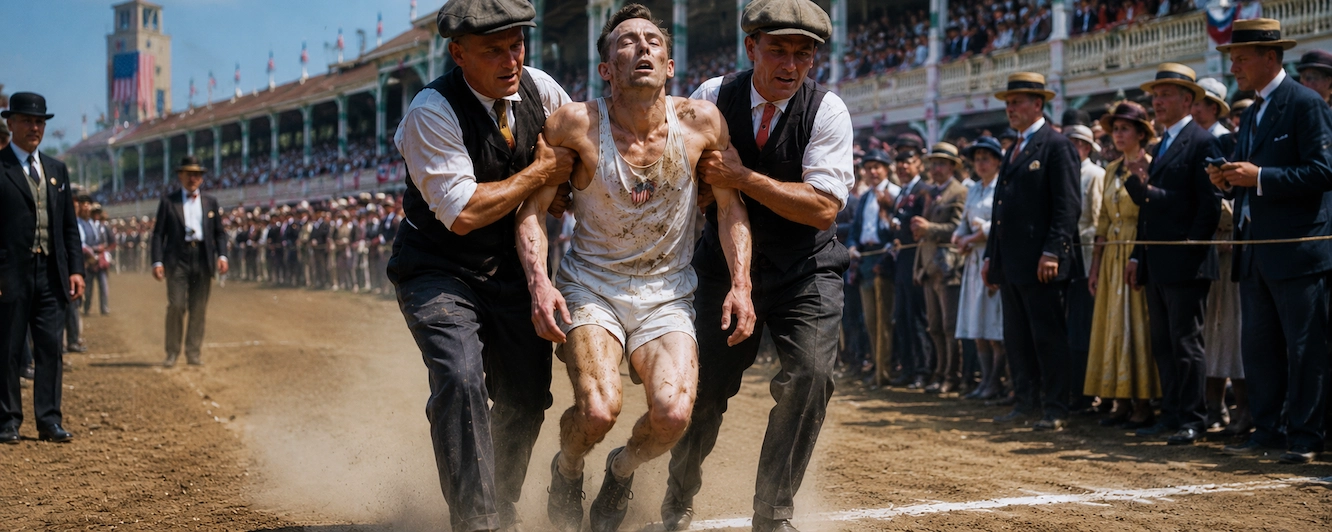
Far behind the chaos surrounding Fred Lorz, Thomas Hicks was running a very different marathon. His trainers, desperate to keep him operational, repeatedly fed Hicks small doses of strychnine mixed with egg whites and brandy.
Strychnine was commonly used at the time to kill rats, but in tiny quantities, strychnine acts as a stimulant.
The chemical mixture briefly boosted Hicks’s energy, but it also pushed his body towards complete collapse. His skin turned pale. His eyes became glassy. Exhaustion and dehydration triggered severe hallucinations.
His feet dragged across the ground while handlers supported him under both arms. When Hicks finally entered the stadium, he no longer resembled a runner competing in an Olympic Marathon. He looked like a ghost trying to complete a final assignment.
Finally, after nearly three and a half punishing hours, Thomas Hicks crossed the line. Or more accurately, he was guided across it.
Moments later, he collapsed completely.
Doctors spent more than an hour trying to revive him. Later reports stated he had lost nearly eight pounds during the race, most of it through extreme dehydration.
Yet officially, Thomas Hicks became the Olympic Marathon champion.
Although the James Sullivans’s circus had left town, the wreckage remained for us to study
Mastery Amidst the Madness: Lessons from the Marathon
The 1904 Olympic Marathon remains one of the strangest events in sporting history because it perfectly captured an era where competition was chaotic, poorly managed, and dangerously unregulated.
That is also the reality of most meaningful journeys in business, leadership, and life itself.
The road towards ambitious goals is rarely smooth or properly hydrated. More often, it is dusty, exhausting, and filled with unexpected crises, poor leadership decisions, collapsing systems, and bad advice disguised as expertise.
Plans fail. Pressure exposes weaknesses. Shortcuts tempt exhausted people. Public applause often celebrates the wrong winners before reality catches up.
In the end, survival rarely belongs only to the strongest or the fastest.
It belongs to those with enough adaptability, mental resilience, and composure to keep moving when the entire operation begins collapsing around them.
Building Environmental Resilience
The environment around us is often filled with the equivalent of limestone dust, clouding our judgment and visibility. Endless noise, information overload, office politics, toxic pressure, and constant distraction slowly enter the system like invisible pollutants.
If we do not build filters, the dust eventually reaches our lungs and decision-making ability.
The heat and humidity of pressure will always exist. Every meaningful Marathon comes with exhaustion, uncertainty, and periods of emotional dehydration.
The smartest performers are not the ones who sprint blindly through chaos. They are the ones who know when to pause strategically, conserve energy, and locate alternate sources of shade, clarity, and recovery before burnout arrives.
The Danger of Bad Data
Thomas Hicks was not only battling exhaustion. He was running on poison disguised as performance support. Modern lives operate similarly.
When individuals and organisations entangle themselves in the Expert Trap, they begin hallucinating false outcomes. That poison may come in the form of outdated advice, toxic productivity culture, unchecked prejudice, fear-driven leadership, vanity metrics, or the pressure to appear successful at any cost.
In the short term, such stimulants may generate movement, but they rarely lead to sustainable success.
A difficult Marathon demands clarity, not artificial acceleration. That means learning to challenge the “James Sullivans” in our lives: the voices, systems, and leadership models that glorify suffering while ignoring long-term damage.
Resilience Over Perfection
Perhaps the most unforgettable figure in this story was not the chemically assisted winner. It was the exhausted Cuban postman who ate rotten apples, took a nap under a tree, woke up, and simply continued running.
There is something deeply human about that.
A resilient, adaptable postman navigating chaos with humour and persistence is far more inspiring than a collapsing champion surviving on stimulants and illusion.
Because in any meaningful Marathon, perfection rarely wins.
Adaptability does.
Remember, the road will never be clean. The systems will never be perfect. The crises will never stop arriving. But those who learn to recover, adapt, and keep moving are usually the ones who reach the finish line with their humanity intact.
The Real Marathon Begins After the Starting Line
The 1904 Olympic Marathon was far more than a bizarre sporting event. It was a brutal reminder that the road towards meaningful goals is rarely clean, predictable, or properly managed. Most journeys are filled with dust, confusion, poor leadership, bad data, exhaustion, and unexpected crises that appear without warning.
Yet history rarely remembers the people who had perfect conditions.
It remembers those who adapted.
The runners who survived that chaotic Marathon did not succeed because the system supported them. They survived because they adjusted, improvised, recovered, and kept moving despite the dysfunction around them.
That lesson matters even more today.
In business, leadership, and life, we are all running through our own versions of the St. Louis Marathon. Somewhere around us, there is always a “James Sullivan” glorifying burnout, rewarding suffering, or pushing dangerous ideas disguised as wisdom.
The question is simple.
Which James Sullivan are you going to challenge today?
If you found this perspective useful, consider subscribing to my blog by sharing your email below. You will receive regular insights on strategy, leadership, and building sustainable systems.
Stay Connected: For short-form thoughts and business storytelling, follow me on X and Facebook for regular updates.
Beyond the Blog: If stories of power, ambition, and passion interest you, explore my books on Amazon. They examine the fine line between success and surrender, and the choices that define both.


Leave a Reply