
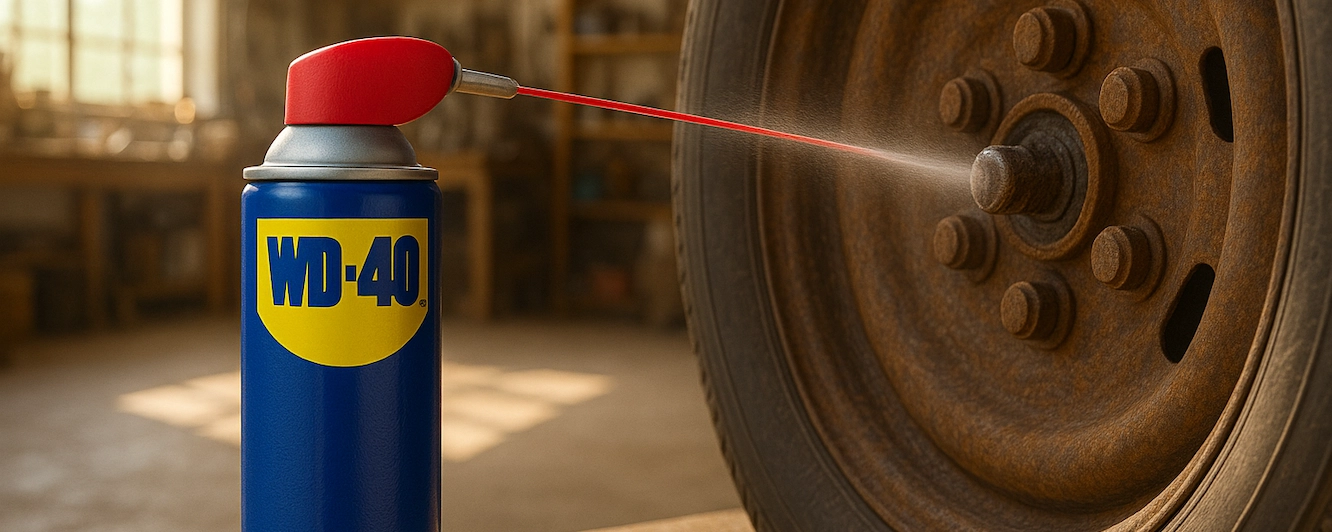
Squeaky doors and chairs turn quiet moments into irritating ones. The sharp creak every time we move or open a door is a constant annoyance, to say the least. Until WD-40 steps in and silences it in a jiffy.
The first time someone picked up a can of WD-40, they probably didn’t expect this magic. But that familiar blue-and-yellow can has since become a quiet hero in garages, kitchens, studios, and workshops around the world.
From squeaky hinges to rusted bolts, WD-40 is the go-to solution for everyday mechanical problems.
But what exactly is it? Where did it come from? And how did it become a global icon?
Today, we explore the story of WD-40, the signature blue can with the red nozzle that makes a big difference.
WD-40: Toolbox in a Can
WD-40 stands for ‘Water Displacement, 40th formula’, because it took 40 attempts to get it just right. Originally developed to repel moisture from metal surfaces, it was a breakthrough for aerospace engineers battling rust and corrosion on sensitive equipment.
Unlike thick greases or sticky oils, WD-40 is a light, penetrating liquid. It seeps into tight crevices and leaves a thin film that resists moisture, reduces friction, and shields metal from wear. Its clean application and versatility make it useful far beyond its original purpose.
It was never sold as a miracle product, but people began treating it like one. It cleaned grime, freed jammed bolts, silenced squeaky hinges, protected tools, and kept moisture out of hard-to-reach places.
Its usage spread rapidly. Mechanics relied on it to loosen stubborn parts. Homeowners sprayed it on noisy doors and stuck locks. Cyclists used it on chains. Gardeners cleaned and maintained their tools with it. Even electronics technicians trusted it to drive out moisture without damaging circuits.
WD-40 became the go-to solution for everyday problems. A true toolbox in a can, always ready when something sticks, squeaks, rusts or refuses to budge.
Life Before WD-40
Imagine a time when rust had the upper hand and squeaky door hinges were simply ignored. Mechanics had to mix their own concoction. DIYers turned to petroleum jelly or machine grease. People used whatever they could find. Machine oil, candle wax, and even animal fat, to protect or loosen metal parts.
These quick fixes offered only short-term relief. They were messy, attracted dust and grime, and wore off too soon. In factories, machines broke down from unchecked corrosion. At home, creaky chairs and rusted locks were just part of daily life.
There was no single, dependable solution. Only trial, error and frustration, until WD-40 arrived and changed everything.
The Men Behind the Can
Iver Norman Lawson was a mechanical engineer working in a small lab of Rocket Chemical Company in San Diego in the early 1950s. Lawson and his team were working to solve a specific problem for Convair, an aerospace manufacturer building missiles for the US military.
Convair needed something that could protect the outer skin of the ‘Atlas missile’ from rust and corrosion caused by salty ocean air. Lawson’s team’s task was to find a water displacement formula that worked. It took them 39 failed attempts. But on try number 40 was a resounding success.
Like all stories, the story of WD-40 also had a twist. Lawson never patented his formula, and over time, credit shifted to Norman B Larsen, the president of the company, who brought it to market. History’s record is a little fuzzy, but Lawson’s brilliance lives on in every spray.

From Missiles to Toolboxes
WD-40 was specifically created to protect the outer shell of the Atlas missile from rust and moisture. But before long, engineers and factory workers started sneaking cans home. They discovered it worked wonders on household tools, appliances, car parts and anything that moved, jammed, or squeaked.
That’s when Rocket Chemical Company had a eureka moment. WD-40 wasn’t just useful in aerospace or industry; it had a place in everyday life. Norman Larsen quickly saw the consumer potential. In 1958, they began selling it in aerosol cans to the general public.
The response was immediate. Demand surged. Larsen and his team sold cases out of garages, trunks, and small stalls. People didn’t need to be convinced. They tried it once, saw it work, and told others. Word spread, and so did the product.
By the early 1960s, the company rebranded itself as The WD-40 Company, focusing entirely on its breakout product. Sales skyrocketed. By 1993, WD-40 had earned a place in 80% of American homes. Today, it’s used in over 176 countries and remains a go-to solution for repairs, maintenance, and everyday fixes, offering a product for every need.


The Secret Formula
What gives WD-40 its all-around usefulness? The truth is, it’s a secret.
Ask the company for the formula, and you’ll get a polite smile, but no details. The recipe has never been patented, which is rare for a product so successful. But that’s exactly the point. By keeping it a trade secret, WD-40 avoids ever having to reveal its ingredients to the world.
It’s said that only one person knows the full formula, and the original recipe is safely locked away in a vault in San Diego.
What we do know is this: WD-40 is made from a blend of hydrocarbons, light lubricating oils, corrosion inhibitors, and water-displacing agents. The aerosol version also includes carbon dioxide as a propellant to help it spray smoothly. Despite the myths, it doesn’t contain fish oil or kerosene.
Its real power lies in the perfect balance of ingredients. That’s what allows it to seep into tight spots, push out moisture, reduce friction, and shield metal from rust. It is safe for metal, glass and most plastics; however, it is not recommended for skin, food surfaces and certain rubber seals.
The Success Mantra
WD-40 earned its place through quiet, consistent performance and the power of word of mouth.
Someone fixed a rusted bike. A teacher wiped crayons off a wall. A mechanic freed a jammed car lock. These everyday victories spread from one person to another. People began writing in, sharing stories of how WD-40 solved problems they didn’t know had solutions. The company listened, compiling thousands of unusual but clever uses, from cleaning tools to repelling insects.
The secret lies in simplicity and versatility. It can handle dozens of tasks. Lubricating, cleaning, protecting, freeing stuck parts, and preventing rust. The design is simple. The iconic blue-and-yellow can, topped with a red straw, became a fixture in homes and workshops alike.
What also helped was its availability. WD-40 could be found everywhere. Hardware stores, supermarkets, online, and even gas stations. It wasn’t just a product; it was a solution within reach.
People didn’t need to be convinced. They tried it, trusted it, and told others. That’s how WD-40 quietly became one of the most loved and reliable tools in the world.
Why WD-40 Stands Out
Many products lubricate or clean metal surfaces, but WD-40 is in a league of its own. What makes WD-40 different?
- Multi-functionality: Apart from lubrication, it also loosens, cleans, protects, and preserves.
- Non-greasy residue: It doesn’t leave behind a thick, sticky film.
- Easy application: The aerosol can, with its familiar red straw, reaches tight spots perfectly.
- Durability: The protective coating lasts.
WD-40 is also non-conductive. It can therefore also be used around electrical components without risk. That’s why it’s often used on spark plugs, battery terminals, and circuit boards.
Unexpected and Quirky Uses
WD-40 is famous not just for what it was designed to do, but also for the creative ways people use it. Some of these uses are genuinely helpful; others are just plain amusing.
Here are some delightful and strange use cases:
- Removing chewing gum from hair, shoes, and carpets
- Unsticking LEGO bricks locked together by enthusiastic kids
- Freeing a python trapped under a school bus (yes, really)
- Cleaning piano keys to restore that ivory shine
- Deterring wasps from building nests in window frames
- Waterproofing boots before a winter hike
- Creating art textures by misting canvas surfaces
- Loosening tight rings from fingers
- Cleaning dog mess from sneakers without a trace
There are also some myths, like using WD-40 to treat arthritis or attract fish. While these are just someone’s figments of imagination, for cleaning, lubrication and household fixes, it is brilliant.
“You only need two tools in life: WD-40 and duct tape. If it doesn’t move and should, use the WD-40. If it shouldn’t move and does, use the duct tape.”
Anonymous
A Global Icon in the Blue Can
WD-40 was born from aerospace challenges, but it quickly found its way into homes, garages, and toolkits. What began as a rust-prevention formula for missiles became a universal solution for life’s stubborn problems.
From silencing squeaky hinges to loosening jammed bolts, WD-40 has earned its place through results. Created after 40 attempts by a small team with a big idea, it embodies persistence, practical thinking, and everyday usefulness. People trust it because it delivers: simply, effectively, and without fuss.
Each spray carries decades of performance and stories from those who used it. It may not look flashy, but its impact is undeniable. WD-40 is the tool we reach for without thinking. The quiet helper that’s been solving problems for over 70 years.
I am positive that you found this article informative and useful!
Please subscribe to my blog by filling in your details below:
My blog has countless such articles and stories to guide you and quench your thirst for knowledge.
You can also follow me on X and Facebook to read more such stories and posts.
PS: ChatGPT and/or Copilot have been used to create parts of this post.
Leave a Reply