
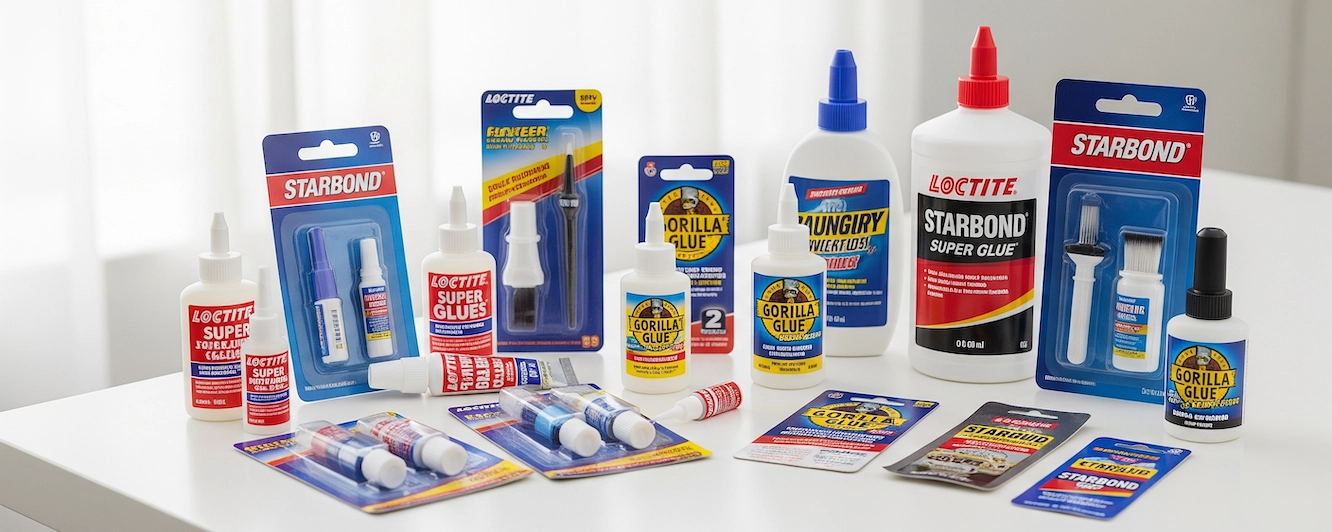
Super Glue is a household hero masquerading as a small tube of liquid adhesive. It has become so ingrained in our lives that its importance is often overlooked. If you’ve ever accidentally glued your fingers together while fixing a broken object, or rescued a broken sandal minutes before stepping out, then congratulations, you’ve experienced the magic of Super Glue.
A broken vase, a broken family heirloom or even a falling apart science project. Behind every quick fix lies a captivating history filled with serendipity, innovation, and sheer ingenuity. A tale of accidental genius, wartime science, marketing misfires, and a lot of people yelling, “Oh no, I think I glued my eye shut.”!
Let us embark on this journey to explore the history, impact, and legacy of Super Glue. An invention that quite literally holds the world together.
Dr Harry Coover
Super Glue owes its existence to Dr Harry Coover, a brilliant chemist born in Newark, Delaware, in 1917. From an early age, Coover displayed a knack for experimentation, often tinkering with household items in ways that probably gave his parents heart palpitations. His curiosity and academic brilliance led him to Cornell University, where he earned his PhD in chemistry.

In 1940s, fresh out of the University, Dr Coover joined Eastman Kodak, a company better known for photography than adhesives. His early career saw him diving into the world of polymers, with a focus on creating materials for lenses and photographic films that could withstand extreme conditions.
But fate had other plans. Little did young Harry knew that his legacy would be shaped by an accidental discovery that initially seemed like a colossal failure.
The Super Glue Accident
In 1942, amidst the chaos of World War II, Coover and his team were tasked with developing clear plastic gun sights for the military. Their mission was to create materials that were durable, transparent, and resistant to harsh environments. Among the many experiments conducted, one involved a chemical compound known as cyanoacrylate.
The result? A disaster for the gun sights, but a sticky situation for Coover. The substance adhered to everything. Lab equipment, hands, tables and notebooks. Nothing was safe. To say cyanoacrylate was sticky would be an understatement. It was outrageously, impossibly sticky.
As a matter of fact, it was ‘too sticky’ to be of any use for the intended purpose. Frustrated by its lack of practicality, Coover shelved the compound, dismissing it as a failed experiment.
The Reencounter with Super Glue
The year 1951: Coover was supervising a new project at Eastman Kodak. His team was developing heat-resistant polymers for jet canopies. And as fate would have it, cyanoacrylates showed up at the party again.
This time, one of Coover’s colleagues, Fred Joyner, made a clumsy but world-changing mistake. While testing the refractive index of the compound between two glass prisms, he accidentally glued them together, permanently. No heat, no pressure, just air and time. That was the Eureka moment.
The thing they’d once dismissed as an annoyance was actually a miracle adhesive. And like all great discoveries, it was stumbled upon by someone trying to do something completely unrelated.
This time, instead of discarding it, Coover recognised the potential of cyanoacrylate as a revolutionary adhesive. The ‘failure’ of 1942 had become a serendipitous success.
The ‘Super’ in Super Glue
What makes Super Glue, so super? For starters, it bonds almost instantly to virtually anything including your skin. Just apply a drop and boom, permanent bond.
Unlike traditional adhesives, which require heat, pressure, or lengthy drying times, cyanoacrylate bonded instantly when exposed to moisture. In chemical terms, Super Glue polymerised in the presence of water, forming strong chains that held things together like an obsessive ex who won’t let go.
As the team experimented further, they realised the adhesive’s potential went far beyond household repairs. Its strength and versatility made it suitable for industrial, medical, and even military applications. Coover and his team knew they had something extraordinary on their hands, literally.
Super Glue Goes to the Market
Coover, now far less annoyed and a lot more excited, pitched the idea to Kodak. In 1958, Eastman Kodak introduced Super Glue to the market under the brand name ‘Eastman #910’. Now the next challenge was, “How to convince people to buy a product so effective that it bordered on terrifying?”.

As you can imagine, ‘Eastman #910’ didn’t exactly fly off the shelves. People thought it was engine oil or some kind of sci-fi serum. Enter the marketing team, which wisely rebranded it to something snappier: Super Glue.
The new name stuck, literally and figuratively. Kodak launched dramatic advertising campaigns showing a man hanging from a steel beam with just a drop of Super Glue holding his helmet. Another memorable stunt involved lifting a car using nothing but a few drops of the Super Glue.
Were these tricks slightly terrifying? Yes. Did they work? Absolutely. These eye-catching displays captivated the public’s imagination and cemented Super Glue’s reputation as a product that could defy physics.
Early adopters included hobbyists, repair professionals, and anyone who appreciated a quick and reliable fix. Of course, mishaps were inevitable. Stories of accidental glue-related disasters began circulating, from fingers permanently bonded together to entire objects glued in the wrong place.
Yet, these anecdotes only added to Super Glue’s mystique, proving its incredible power.
The Rise of Super Glue
Once the public caught on, Super Glue became the unsung hero of home repair. It fixed vases, kids’ toys, broken heels, leaky pipes, and the hearts of sentimental spouses everywhere. Soon, it was being used in forensic science, medical applications, industrial engineering, and even space travel. Model builders and car mechanics hoarded it like treasure. DIY dads started feeling like chemical engineers. Super Glue was everywhere.
One of the adhesive’s most remarkable achievements was its adoption by NASA. During the Apollo space missions, cyanoacrylate adhesives were used to secure equipment and components in the harsh environment of outer space. If Super Glue was good enough for the moon, it was good enough for Earth.
Super Glue’s success wasn’t confined to the United States. As word spread, the adhesive became a global sensation, embraced by consumers and industries alike. Its versatility made it indispensable in countless applications, from repairing household items to assembling complex machinery.
In Japan, for example, Super Glue became a staple in traditional craftsmanship, enabling artisans to create intricate designs with precision and strength.
Inspiring Future Adhesives
Super Glue didn’t just stop at fixing broken items, it inspired a wave of innovation in adhesive technology. Researchers built upon Coover’s discovery to develop specialised variants of cyanoacrylate adhesives, tailored for specific needs.
Medical-grade adhesives emerged, revolutionising surgical procedures by allowing doctors to close wounds without sutures. Industrial-grade variants provided solutions for construction, automotive manufacturing, and electronics assembly.
Today, the adhesive market is a multi-billion-dollar industry, with Super Glue serving as the pioneer that paved the way for countless innovations. From waterproof glues to temperature-resistant formulas, the legacy of Super Glue continues to stick around, pun intended.
Super Glue: Some Anecdotes
1. The Immortal Rear View Mirror
A man in Ohio once used Super Glue to reattach his car’s rearview mirror. When it fell off again, he glued it back. And again. And again. Twenty-seven times. He wrote to Super Glue Corp, calling it ‘the love-hate relationship that keeps me on the road’.
2. The Emergency Stitch
In Vietnam, medics used Super Glue to close open wounds and stop bleeding, giving them time to transport injured soldiers. Later, this led to FDA-approved medical versions for surgical use. Talk about battlefield-tested!
3. The Broken Award
At an awards ceremony in the 1980s, a celebrity dropped and shattered their trophy just before stepping on stage. A crew member fixed it in 30 seconds flat with Super Glue. The show went on. The trophy never knew it was broken.
4. The Sticky Parrot
In one (probably exaggerated) tale, a pet owner used Super Glue to fix a broken perch in their parrot’s cage. The parrot, curious as ever, landed on the perch too soon and was stuck there for three hours, shrieking in agony. The bond between the human and bird? Also damaged, possibly forever.
5. Super Glue Mends A Heart
In 1985, a Florida man survived a life-threatening injury when a doctor used cyanoacrylate to seal a wound in his heart. The quick-thinking medical team turned to the adhesive as a last resort, and it worked.
The Legacy of Super Glue
From an unwanted chemical nuisance to a global staple, Super Glue is the ultimate comeback story. Its discovery was accidental, its rise unconventional, but its impact is undeniable. It holds together our broken gadgets, our DIY dreams, and occasionally, our dignity.
Dr Harry Coover became a legend in the adhesive world. He earned the National Medal of Technology and Innovation in 2010 from President Obama and was affectionately known as the man who ‘invented the stuff that sticks’.
Today, Super Glue stands as a testament to serendipity, science, and the simple idea that sometimes, the best inventions are the ones we try to throw away. And as long as people continue dropping things, breaking stuff, or glueing their fingers together by accident, the legacy of Super Glue will live on.
I am positive that you found this story informative and useful!
Please subscribe to my blog by filling in your details below:
My blog has countless such articles and stories to guide you and quench your thirst for knowledge.
You can also follow me on X and Facebook to read more such stories and posts.
PS: Copilot and ChatGPT have been used to create parts of this post.
Leave a Reply