

50-Word Summary: Process drift occurs when undocumented shortcuts gradually replace standard operating procedures, creating hidden risks that can trigger serious operational failures. Discover why quick fixes become habitual, how tribal knowledge weakens business continuity, and how leaders can regain control through the STOP framework, the 24-72-7 rule, and disciplined process improvement.
A business process rarely fails overnight. More often, it slowly drifts away from its original design until nobody can distinguish between the official procedure and the shortcuts used to keep work moving.
The process drift begins with seemingly harmless shortcuts that gain acceptance through repetition and eventually create a gap between how a business should operate and how it actually operates. By the time that gap becomes visible, the consequences can be expensive.
The Drift: When the Manual Stops Matching Reality
Consider a service operations manager responsible for a nationwide roadside assistance network.
One morning, several service requests get stuck between the call centre and the dispatch system. Vehicles are waiting for assistance, customers are calling repeatedly, and escalation tickets are piling up.
The manager opens the standard operating procedure (SOP) manual. It says the dispatch system automatically assigns an available service provider. However, the team stopped relying on this function months ago because it occasionally assigned jobs to occupied partners.
Someone introduced manual allocation. Another employee created a spreadsheet to track pending assignments. Later, a team leader added WhatsApp confirmations because the spreadsheet was not updated consistently.
Each change solved an immediate problem. None was incorporated into the official procedure, thus starting the process drift.
After spending several hours navigating three unofficial systems, an outdated manual, and conflicting explanations from experienced employees, the manager discovers that a recent system update has disrupted a field used by the unofficial allocation tracker. The tracker no longer reconciles dispatched jobs correctly, leaving requests stranded.
By then, the operation has lost multiple man-hours, customer escalations have accumulated, and confidence in the service has suffered.
Why Quick Fixes Become the Default
Why do capable professionals repeatedly choose shortcuts when they know proper solutions are better?
Because emergencies change priorities. When customers are waiting, deadlines are slipping, and senior management wants answers, restoring service takes precedence over protecting the process.
Several factors encourage this behaviour.
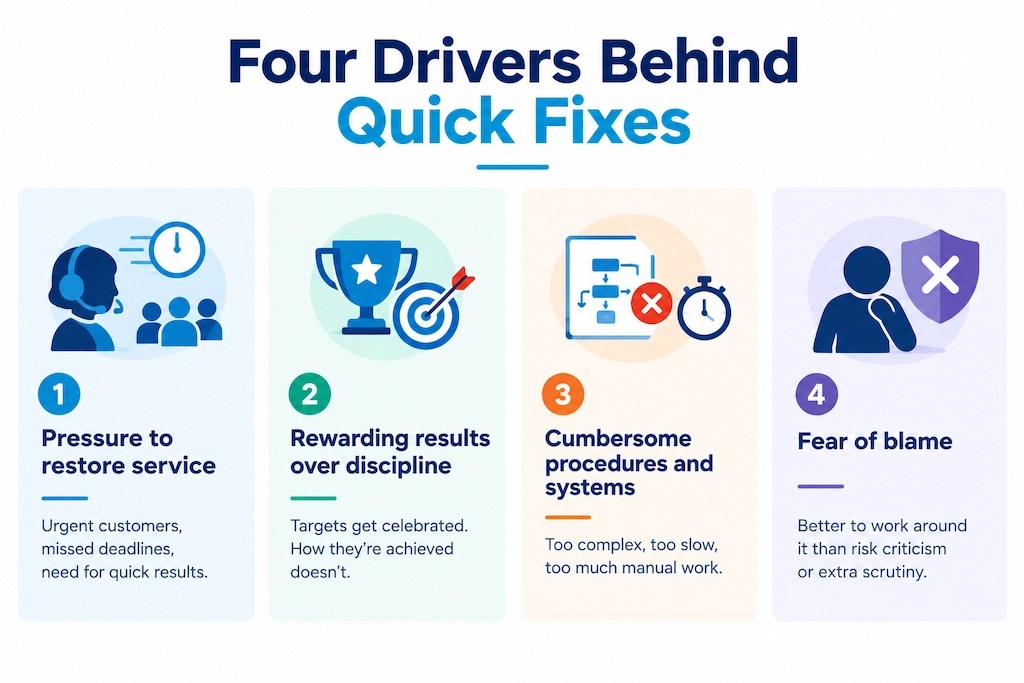
Pressure to Restore Service
When a service centre receives hundreds of calls during a system outage, nobody wants to spend 30 minutes documenting a workaround while customers remain unanswered.
A supervisor creates a shared spreadsheet, allocates calls manually, and clears the immediate backlog. The result is positive, but the long-term consequences receive little attention.
Rewarding Results over Discipline
Organisations often reward teams for meeting targets without examining how those targets were achieved.
If a manager clears a backlog by bypassing an approval step, the achievement is celebrated, but the control that was bypassed is never discussed.
Cumbersome Procedures
Sometimes the official process is genuinely impractical. A team needs three approvals to replace a faulty component, while the customer expects immediate service.
Employees create an informal approval route because the formal one takes too long. Repeated often enough, the workaround becomes standard practice and creates fertile ground for process drift.
Fear of Blame
Employees hesitate to report a broken process because they expect criticism, additional paperwork or an investigation into their performance. They quietly work around the problem instead.
The leadership lesson: drift thrives when urgency is high, procedures are cumbersome, and accountability focuses on immediate output rather than sustainable performance.
How Shortcuts Corrupt Procedures and Cause Process Drift
An SOP captures an organisation’s shared understanding of how work should be performed, which controls matter, and how exceptions should be handled.
Process drift weakens that shared understanding. The documented procedure becomes progressively less accurate, while operational knowledge migrates into people’s heads, personal notes, spreadsheets and informal conversations.
The Manual becomes Unreliable
Imagine that a finance team follows a three-step vendor payment process. Then came an urgent payment that was approved through an additional email verification because the bank’s system was temporarily unavailable.
Months later, employees treat the extra email verification as mandatory, even though the original issue has disappeared. A new employee follows the official SOP, misses the unofficial step, and has the payment returned.
The organisation now has two competing procedures: one documented and another practised. Nobody knows which steps are essential controls, and which are redundant habits, no longer needed.
Tribal Knowledge Dependency
Tribal knowledge is the undocumented information held by particular employees and shared informally.
Consider a vehicle service operation where one experienced dispatcher knows how to correct a system field when automated allocation fails. The SOP does not mention it, so new employees depend on that dispatcher to resolve exceptions.
When the dispatcher takes leave or resigns, jobs stall.
The employee has unintentionally become an unofficial control point. The operation appears competent, but its performance depends on knowledge the organisation does not formally own.
A Real Warning: Knight Capital’s Trading Failure
On 1 August 2012, Knight Capital Group, a major US trading firm, suffered a catastrophic technology failure after deploying new trading software.
An earlier software function had been left dormant on some servers. During the upgrade, the new deployment failed to overwrite this legacy code consistently, inadvertently reactivating it. This hidden inconsistency disrupted trading operations and exposed the dangers of process drift.
The malfunction generated unintended trades and caused losses of approximately US$440 million in around 45 minutes. It demonstrates how an upgrade can expose hidden dependencies created by legacy workarounds, turning an apparently routine change into a catastrophic failure.
In complex operations, what people believe the system is doing is not necessarily what the system is doing. When operational knowledge exists only in informal practices, management cannot reliably assess risks, reproduce solutions or ensure that critical controls remain effective.
The STOP Framework for Urgent Problems
Avoiding process drift does not mean forcing employees to follow a manual blindly while customers wait. It means giving them a disciplined way to resolve urgent problems without creating uncontrolled risks.
Leaders can use the STOP framework.
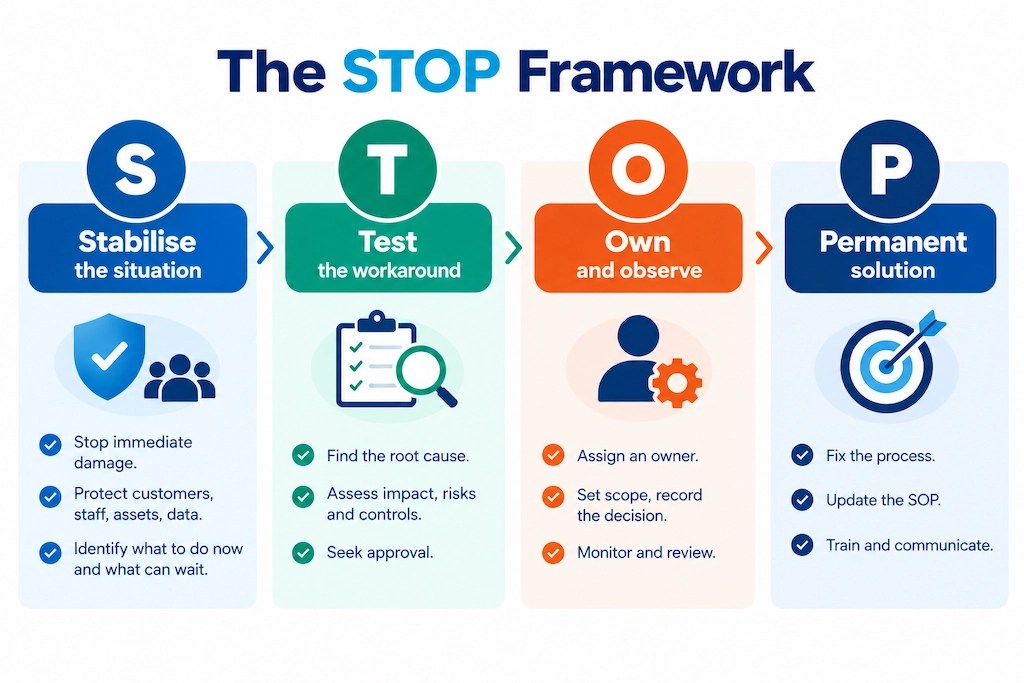
S: Stabilise the Situation
Stop the immediate damage. Protect customers, employees, assets, data and service continuity. Identify what must happen immediately and what can safely wait.
During a roadside assistance system outage, for example, activate an approved manual dispatch process and prioritise customers facing safety risks.
T: Test the Workaround
Understand the root cause as far as time permits. Assess the proposed workaround’s impact, reversibility, customer consequences, financial exposure and control implications.
Before assigning jobs manually, confirm that customer verification and duplicate-job controls can still operate safely. Seek appropriate approval rather than assuming urgency removes accountability.
O: Own and Observe the Exception
Assign a named owner, define the workaround’s scope, record the decision and set a review or expiry time.
The owner should monitor performance, identify unintended consequences and ensure that the exception does not continue indefinitely.
P: Permanent Solution and Prevention
Restore the standard process or formally revise it after review. Update the SOP, communicate the changes, train affected employees and test that the original problem does not recur.
STOP works because it combines empowerment with governance. Employees can act quickly, while management retains visibility and control.
However, certain boundaries must remain firm. Safety requirements, legal obligations, privacy protections and critical financial controls cannot be casually bypassed because a situation is urgent.
Leaders should define in advance which decisions frontline employees can make independently, which require escalation, and which controls must never be overridden.
Are Quick Fixes Always Avoidable? No.
Some situations demand immediate action, and waiting for a perfect solution can cause greater harm. The objective is not to eliminate quick fixes. It is to prevent process drift.
Consider a hospital’s emergency power supply. If the primary system fails, the team must activate the backup supply immediately. There is no time to redesign the electrical infrastructure or convene a committee to approve a long-term solution.
The immediate priority is patient safety and continuity of essential services. Once the situation is stable, engineers can investigate the failure, repair the primary system, test the backup arrangements and improve preventive maintenance.
The temporary intervention is necessary. Leaving the underlying weakness unresolved is not.
The distinction lies in intent, control and follow-through.
A responsible quick fix has a clear purpose, a defined scope, an accountable owner and a route back to normal operations. An irresponsible one becomes an unofficial operating procedure without review.
Process drift begins when the exception outlives the emergency, and nobody takes responsibility for restoring control.
Avoid Process Drift: Turn Quick Fixes into Permanent Solutions
Every workaround contains useful information about the system. It may reveal weaknesses in technology, training, decision-making, resource allocation or process design.
Leaders need a simple method to convert that information into lasting improvement.
The 24-72-7 rule
Use this as a practical management guideline for non-critical operational exceptions, adjusting the timelines to suit the organisation’s risk profile.
Within 24 hours: Record. Capture the problem, workaround, reason, risks and responsible owner. Do not rely on memory or informal conversations.
Within 72 hours: Review. The process owner and relevant stakeholders should decide whether to retire the workaround, retain it temporarily under formal controls, or incorporate it into a revised procedure.
Within 7 days: Resolve. Implement the permanent correction where feasible. If more time is needed, assign an owner, agree a deadline and introduce interim controls.

Maintain a workaround register
A simple spreadsheet can capture the information needed to control process drift.
| Field | What to record |
| Problem | What failed and where? |
| Workaround | What temporary action was taken? |
| Risk | What could go wrong? |
| Owner | Who is accountable? |
| Review date | When must the exception be reconsidered? |
| Permanent fix | What will prevent recurrence? |
| Status | Open, under review or closed |
Review the register during weekly operations meetings. Look for recurring workarounds, ageing exceptions and dependencies on particular employees.
If the same workaround appears repeatedly, investigate the underlying weakness rather than treating each occurrence as an isolated incident.
Measure what matters
Traditional dashboards track calls answered, jobs completed, turnaround times and customer satisfaction. These indicators matter, but they may not reveal process drift.
Add a few leading indicators:
- Number of active, undocumented workarounds.
- Percentage of exceptions reviewed on time.
- Recurrence rate of previously resolved incidents.
- Number of SOPs overdue for review.
- Operational failures linked to undocumented dependencies.
These measures help leaders identify weaknesses before they cause major failures.
They also support financial prudence. Repeated workarounds consume management attention, duplicate effort, increase rework and expose the business to avoidable losses. Correcting the underlying cause is often cheaper than repeatedly managing its symptoms.
Fix the System, Not Just the Symptom
Process drift rarely announces itself. It grows through small compromises that appear sensible in isolation but gradually weaken operational discipline.
A shortcut saves ten minutes today. An undocumented adjustment becomes tomorrow’s standard practice. Months later, a seemingly minor failure exposes the gap between the official procedure and the way the business actually works.
The answer is not more paperwork or rigid compliance. It is disciplined flexibility: empower people to respond to emergencies, control exceptions, capture operational knowledge and convert temporary fixes into permanent improvements.
Start this week. Ask your team to identify three workarounds they use because the official process does not work as intended. Record them, assess their risks and assign owners to resolve the underlying problems.
You may discover that the biggest operational risk in your business is not a broken system. It is a system everyone believes is working because they have learnt how to work around it.
Do not wait for a crisis to expose the gap. Find the drift before it finds you.
Enjoyed this perspective? Drop your email below, subscribe to my blog and receive regular insights on strategy, leadership, and sustainable systems.
Follow along: Catch short-form thoughts and business storytelling on X and Facebook.
Read the books: Find my work on Amazon covering power, ambition, and the choices that shape success.


Leave a Reply