
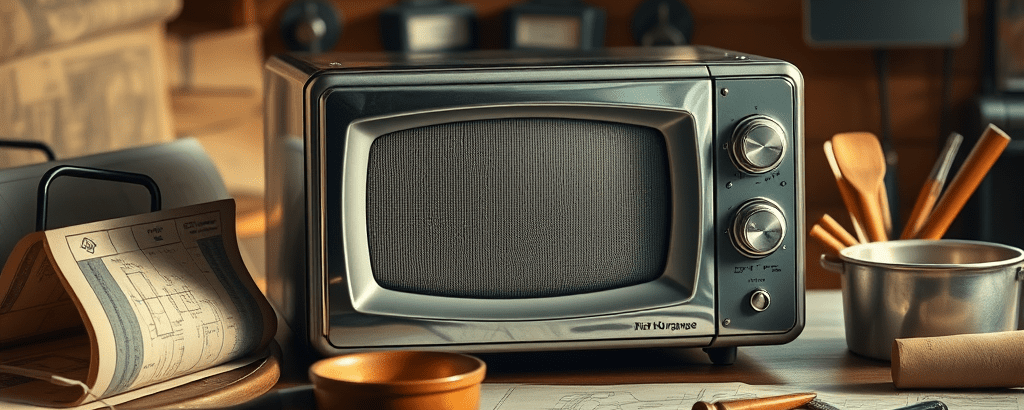
The microwave oven is one of the most transformative inventions in our kitchens, embodying speed, convenience, and energy efficiency. For millions around the globe, it has revolutionised food preparation, enabling quick cooking, reheating, and defrosting with a simple touch of a button. Its compact size and user-friendly features have turned it into a household staple, particularly favoured by busy families and working professionals. With over 1 billion units in use worldwide, the microwave is undoubtedly the most sought-after kitchen appliance today.
But how did it all begin? The magic of microwave ovens is rooted in a fascinating discovery made by Percy Spencer while he was testing radar technology for the U.S. Navy during World War II. As he explored the workings of these advanced systems, he stumbled upon a remarkable phenomenon: Microwave Heating. This innovative cooking method is now widely used not just for preparing food but also for applications like sterilisation, drying materials, and curing substances.
Early Life
Born on July 19, 1894, in Howland, Maine, Percy LeBaron Spencer faced a challenging start in life. His father passed away when he was just an infant, and shortly after, his mother abandoned him. Raised by his impoverished aunt and uncle, Percy was forced to leave school after the fifth grade. At the tender age of 12, he found work at a local spool mill to support himself.
Despite the odds stacked against him, Percy’s innate curiosity and natural talent for understanding complex systems began to shine. At 18, he joined the U.S. Navy, where his passion for radio technology flourished. Spencer’s self-taught expertise and hands-on experience quickly earned him a reputation as a brilliant engineer. After the war, he joined Raytheon, a major defence contractor, where his contributions to radar technology continued.
Microwave Heating
In 1945, while working on radar magnetrons (devices responsible for generating microwave radiation), Percy Spencer made an astonishing discovery. As he stood in front of an active radar set, he felt a peculiar sensation: a candy bar in his pocket had melted. Intrigued, he began a series of experiments, placing popcorn kernels near the magnetron, which promptly popped intently!
Seizing the moment, Spencer tested his hypothesis further by placing an egg near the magnetron. To his astonishment, the egg heated rapidly and exploded! With these experiments, he uncovered the power of microwaves in heating food quickly. This revelation inspired him to create a metal box to contain the microwaves, marking the birth of the first microwave oven. In 1947, Raytheon patented Spencer’s groundbreaking invention.
The Radarange
The Radarange, the first microwave oven, made its debut in 1947. It was an imposing machine. Standing nearly six feet tall and weighing over 700 pounds, it was primarily aimed at restaurants and large food services that could benefit from its speed in cooking.
However, the early Radarange faced significant hurdles. Its size and steep price tag, ranging from $3,000 to $5,000, kept it out of reach for most consumers. Coupled with scepticism about safety and practicality, widespread adoption of the microwave oven was slow.
The Modern Microwave Oven
A revolution unfolded in the 1960s, driven by technological advancements and efforts to miniaturise the appliance. The Amana Corporation, a division of Raytheon, introduced the countertop microwave oven in 1967, priced around $495. This more compact and affordable version captured the attention of consumers, making microwave cooking accessible to the everyday household.
As technology continued to evolve, prices plummeted, and the microwave oven became a common sight in kitchens across the United States and worldwide. By the late 1970s, it had fundamentally changed the culinary landscape, enabling families to prepare meals in an efficient and effortless manner.
Beyond Just Cooking
Today, the microwave oven is not just a cooking appliance; it stands as an indispensable part of life for millions. Its energy-efficient methods reduce overall energy consumption and have less environmental impact than traditional cooking. Beyond reheating leftovers or popping popcorn, microwave technology enhances productivity in various sectors for drying materials, curing adhesives, and sterilising medical equipment.
From Percy Spencer’s remarkable journey from a challenging childhood to becoming the father of microwave technology, the microwave oven has changed how we interact with food. It continues to evolve, finding new applications and helping us navigate the bustling pace of modern life, proving that sometimes, innovation truly is just a moment away.
I am sure you found this story interesting.
Please subscribe to my blog by filling in your details below:
My blog has countless such articles and stories to guide you and quench your thirst for knowledge.
You can also follow me on X and Facebook to read more such stories and posts.
You can also watch a video on this topic on my YouTube channel:
PS: Copilot and ChatGPT have been used to create parts of this post.
Leave a Reply