

Influencing others is the skill that makes things happen without raising our voice or imposing our will.
Imagine this: you are leading a team on a crucial project. A key team member is struggling to meet a deadline, and their lack of progress is holding everyone back. You could demand they work late and threaten consequences for failure. While this might achieve a temporary result, it could also breed resentment and hurt team morale.
Instead, consider influencing them. You might sit down, understand their challenges, offer support, and help break the task into smaller, manageable steps. By doing this, not only are you getting the job done, but you are also building trust, empowering your colleague, and fostering a collaborative environment.
This is the essence of influencing: guiding people to willingly take action because they see the value in it themselves. In this article, I take a deep dive into various aspects of influencing and share a few strategies to master it.
Need to Influence Others
In both our personal and professional lives, influence is the currency of progress. It is how we navigate complex relationships, drive change, and achieve our goals. At work, influencing helps us align teams, advance initiatives, and foster collaboration without constant supervision. In personal life, it allows us to build trust, strengthen bonds, and encourage positive behaviour. Without influence, even the best ideas can remain unexecuted.
Consider a manager who micromanages. They may get compliance, but rarely inspire innovation. Contrast this with a leader who excels at influencing their team. Team members feel empowered, engagement rises, and productivity improves. Influencing is the key to achieving goals while maintaining healthy relationships.
It matters in personal life, too. It helps us strengthen connections with family and friends. It allows us to persuade a partner to try a new restaurant, encourage our children to complete their chores, or guide a friend toward seeking help for a problem.
“If you are given a chance to be a role model, I think you should always take it because you can influence a person’s life in a positive light, and that’s what I want to do. That’s what it’s all about.”
Tiger Woods
Influence vs Coercion
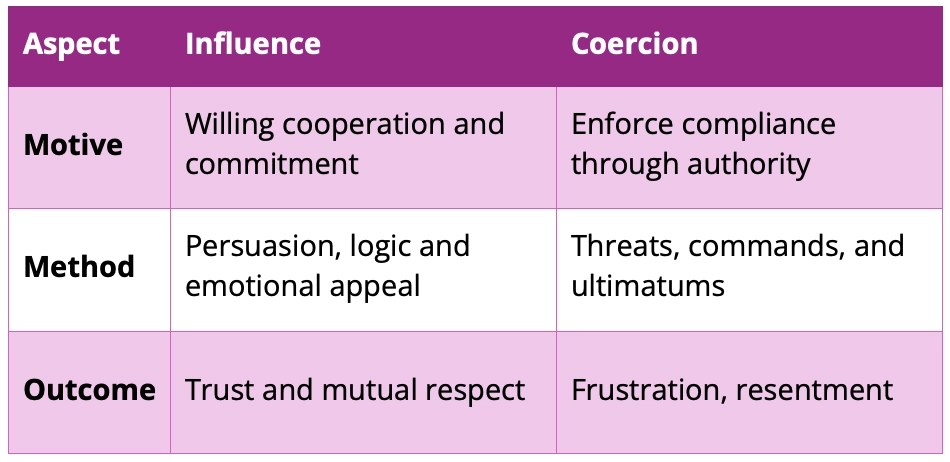
It is easy to confuse influence with coercion, but both are fundamentally different.
Coercion is about forcing someone to do things against their will. Think of a manager who says, “If you don’t complete this report by Friday, don’t bother coming in on Monday.” This is a command backed by a threat. While it produces immediate results, the effect is often temporary. Employees or peers may comply out of fear or obligation, not commitment.
Now contrast this with explaining to your child how a tidy space can make it easier to find things, and involving them in organising ideas often leads to cooperation. Influence achieves compliance with understanding, while coercion only achieves obedience. It’s about convincing someone that a particular course of action is in their best interest.
What is Influence and What is Not
A colleague asks you for your opinion on a presentation. You don’t just tell them what to do. You might also ask, “Have you considered including more data on the customer feedback? I think it would really strengthen your argument about the product’s value.” This is you influencing them to a better outcome.
What is not influence?
- Ordering without explanation: “Just do it this way.”
- Using position of power: “As your manager, I need you to…”
- Evoking guilt: “I can’t believe you won’t help me with this after everything I’ve done for you.”
When Influence Borders on Manipulation
The line between influencing and manipulation can be blurry. While Influence is ethical and transparent, manipulation is deceptive and self-serving. It is designed to get what we want at the expense of someone else.
- Ethical: A sales representative highlighting the product’s features, benefits, and how it can solve the customer’s problems
- Manipulative: A sales representative pressuring a customer into buying a product by creating a sense of false urgency (“This is the last one in stock!”) or by making misleading claims about the product’s performance.
Evils of Manipulation
Manipulation erodes trust, damages relationships, and creates toxic environments. At the workplace, manipulation leads to disengagement and resentment. In personal life, manipulation can break bonds and lead to long-term emotional damage.
Manipulation can take many forms:
- Guilt-tripping: “After all I’ve sacrificed for you, you won’t even call me?”
- Gaslighting: “You’re just being too sensitive”
- Playing the victim: “I’m so overwhelmed with work, I guess I’ll just have to stay up all night to finish this report on my own.”
- Flattery to deceive: “You’re the only person I know who could handle this. Can you help me move?”
The short-term gains from manipulation are never worth the long-term cost. People who are repeatedly manipulated eventually learn to avoid or distrust the person who is using these tactics.
Strategies to Influence Ethically
1. Focus on Building Trust
People are far more likely to be receptive if they believe we have their best interests at heart. We should take a genuine interest in others. Ask about their lives, their hobbies, and their challenges. Be a good listener and remember what people tell us.
We celebrate their successes and offer support during their failures. When a colleague says, “I’m really stressed about this upcoming presentation,” we don’t just ignore it. We acknowledge their stress and offer to help.
2. Master Active Listening
To influence someone effectively, we must first understand their perspective, concerns, and motivations. This isn’t just about hearing their words; it’s about listening to understand. When someone is speaking, we must pay attention to their non-verbal cues.
We should also ask clarifying questions like, “So, what I’m hearing is that you’re concerned about the budget for this project. Is that right?” This shows we are paying attention and helps us frame our response in a way that resonates with their concerns.
“To listen well is as powerful a means of communication and influence as to talk well.”
John Marshall
3. Appeal to Shared Goals and Values
People are more likely to be persuaded if they believe a particular action aligns with their own goals or values. Ethical influence is about finding that common ground.
Before we try to convince someone of something, we should think about what they care about. Are they motivated by career growth, financial stability, or making a positive impact? We can then frame our proposal in a way that shows how it benefits them personally or helps them achieve their goals.
4. Using Logic and Evidence
While emotional appeals can be part of the influence process, they should be grounded in facts and data. We mustn’t only rely on hyperbole or dramatic language. We should back up our claims with concrete evidence.
A project manager, trying to convince her team to adopt a new project management tool, may create a detailed side-by-side comparison of the new tool’s features versus the old one, and a clear breakdown of the time savings the team could expect. The team, seeing the clear data and logical case, would easily be convinced.
5. Giving an “Out”
Ethical influence respects the other person’s autonomy. We should never make someone feel like they have no choice. The ultimate decision must be theirs.
We should present our case, explain the benefits, and then give the person time and space to think about it. Using phrases like “No pressure, just think about it,” or “I’ll leave this with you to consider.” It is a good strategy.
6. Be Authentic and Vulnerable
People are more likely to trust us and be open to our influence if they feel we are being our genuine selves. We don’t need to pretend to be an expert on everything. It’s okay to admit when we don’t know something.
We should share our own experiences and struggles with the object under consideration. For example, if we are trying to get our team to be more collaborative, we can share, “I’ve personally found it hard to ask for help sometimes, but I’ve realised that’s where some of our best ideas come from.”
“I believe one of the best things about managing people is that we can influence lives in a positive way. That’s basically what a manager is about. When I can do that, I am very happy.”
Arsene Wenger
Things to Avoid While Trying to Influence Others
Even ethical influencers must be careful to avoid pitfalls:
- Don’t flout your position: Effective leaders use their skills, not their authority.
- Don’t overpromise: This is a surefire way to destroy trust. If we say we’ll provide support, we must ensure that we follow through.
- Don’t talk down: We should treat everyone with respect, regardless of their position or experience level. A condescending tone will immediately shut down any chance of positive outcome.
- Be open: Influence is a two-way process. We must be willing to be influenced ourselves.
- Avoid negativity: We should focus on what we can gain, not what we will lose. “Let’s try this new process to increase our efficiency” is more compelling than “We need to fix our current process because it’s so inefficient.”
Recommended Reading
1. Influence: The Psychology of Persuasion by Robert B Cialdini
Explores the science behind why people say “yes.” The book is packed with real-world examples, making it both practical and eye-opening for anyone looking to ethically master the art of persuasion in business and personal life.
2. How to Win Friends and Influence People by Dale Carnegie
First published in 1936, it offers practical principles for winning trust, handling people with tact, and inspiring cooperation. With real-life anecdotes and simple strategies, the book remains a go-to guide for building lasting connections in both personal and professional life.
3. The Art of Woo by G Richard Shell
A practical guide to mastering the subtle art of winning others over. It breaks down influencing into a systematic process, blending psychology, strategy, and storytelling to build genuine persuasion skills. Through case studies, the book shows how to ethically gain support for your ideas in business, leadership, and everyday life.
Conclusion
Influencing is a powerful tool that, when used ethically, can transform both work and personal relationships. Unlike coercion or manipulation, influencing creates genuine commitment, builds trust, and inspires collaboration. It is rooted in empathy, authenticity, and shared goals, making it far more sustainable than fear or pressure.
In today’s interconnected world, the ability to influence without manipulation is not just a leadership trait but a sign of emotional intelligence. Whether you are guiding a team through challenges, negotiating an important deal, or nurturing bonds with family and friends, ethical influencing opens doors that force and coercion never can.
Start practising the art of influencing today. Lead with empathy, act with integrity, and watch how your impact grows naturally.
I am positive that you found this article interesting and useful!
Please subscribe to my blog by filling in your details below:
My blog has countless such articles and stories to guide you and quench your thirst for knowledge.
If you enjoy videos, you can watch interesting thoughts and stories on my YouTube channel.
You can also follow me on X and Facebook to read more such stories and posts.
PS: Gemini and/or ChatGPT have been used to create parts of this post.
Leave a Reply