
Ingenuity is the power to optimise resources, solve problems, and navigate crises when all seems lost. In boardrooms, on battlefields, and even in space, ingenuity marks the line between failure and survival. Few stories capture this truth better than the Apollo 13 mission of 1970, immortalised by the words: “Houston, we’ve had a problem here.”
The oxygen tank crisis aboard Apollo 13 transformed a routine lunar mission into one of history’s most dramatic rescue operations. Stranded nearly 330,000 kilometres from Earth, with a crippled spacecraft, dwindling oxygen, and failing electrical systems, the astronauts faced the unthinkable.
Yet it was ingenuity, of the NASA engineers on the ground and the crew in space, that pulled the mission back from the edge of tragedy. What followed was not merely the story of a space crisis, but a timeless lesson in how human ingenuity can turn impossible odds into extraordinary victories.
Apollo 13 Mission
The Apollo programme was NASA’s crown jewel in the 1960s and 70s. Its goal was to land humans on the Moon and return them safely to Earth. By 1970, two successful lunar landings, Apollo 11 in July 1969 and Apollo 12 in November 1969, had cemented America’s dominance in the space race. Apollo 13, launched on 11 April 1970, was meant to be the third successful Moon landing.
Apollo 13’s mission objectives were to explore the Fra Mauro highlands, a region of the Moon, believed to be of volcanic origin. The astronauts were to conduct a series of geological experiments, collect rock samples, and set up scientific instruments on the lunar surface. Beyond exploration, Apollo 13 also aimed to refine procedures for future missions.
In short, it was a stepping stone for even more complex lunar operations. But destiny had other plans. Instead of a scientific triumph, Apollo 13 would be remembered as a powerful demonstration of ingenuity under crisis.
Build-Up to Launch
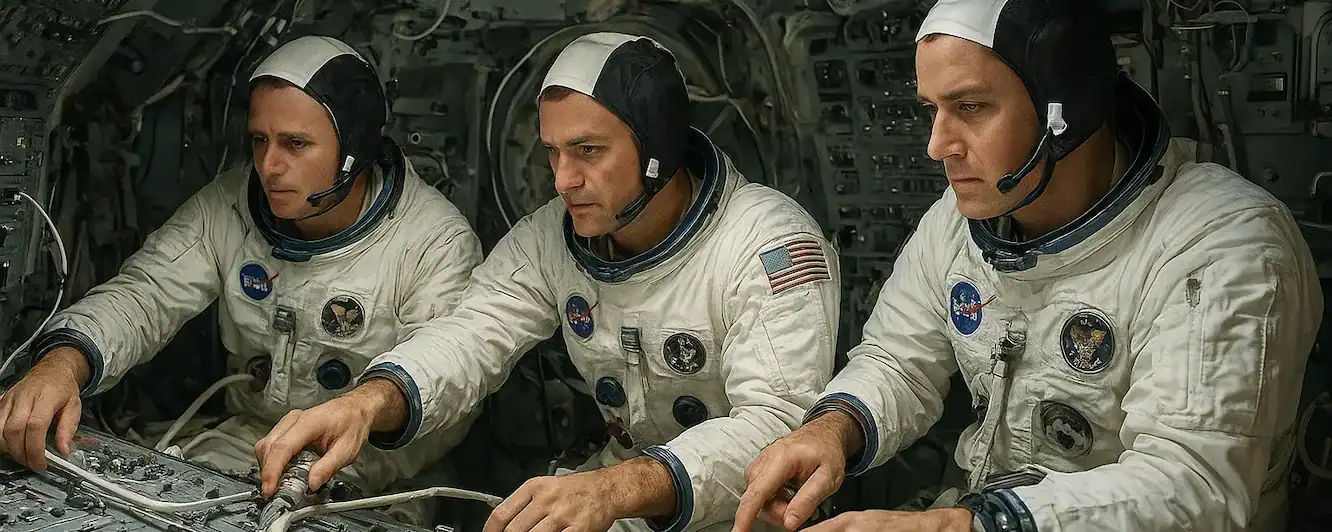
The Apollo 13 crew embodied the finest blend of training, skill, and ingenuity. Jim Lovell, a seasoned veteran of Gemini and Apollo 8, commanded the mission. Jack Swigert, the command module pilot, joined the crew only days before launch, stepping in after Ken Mattingly was sidelined due to possible exposure to German measles. Fred Haise, the lunar module pilot, was preparing to make his first steps on the Moon alongside Lovell.


The mission was designed as an 11-day round trip, with a planned lunar landing on April 15, 1970. The world followed with anticipation, expecting another flawless milestone in humanity’s cosmic journey. Behind this bold ambition lay months of disciplined preparation. The astronauts honed their responses in simulators, drilled emergency procedures, and mastered the spacecraft’s intricate systems.
The spacecraft itself was a marvel of engineering ingenuity, divided into three components: the Command Module Odyssey, the crew’s main living quarters; the Service Module, carrying fuel, oxygen, and power; and the Lunar Module Aquarius, purpose-built for landing on the Moon.
A Perfect Start
On April 11, 1970, crowds gathered at the Kennedy Space Centre in Florida to witness the spectacle. The Saturn V rocket, a towering marvel of engineering, stood poised on its launchpad, a symbol of years of scientific ingenuity and human ambition. The mood was one of quiet confidence, as though another successful journey to the Moon was all but assured.
When the countdown reached zero, the Saturn V’s engines thundered to life, shaking the ground and painting the sky with fire. The rocket rose with flawless precision, stage after stage separating as it climbed into Earth orbit before propelling itself on a trans-lunar course. Apollo 13 was on its way.
In the days that followed, the crew carried out routine tasks, shared light-hearted banter, and even broadcast live television updates for audiences back home. Mission Control in Houston reported no anomalies, and all signs pointed to another milestone in lunar exploration. Yet, concealed within the Service Module, a hidden flaw waited silently, preparing to turn routine into crisis.
Houston, We’ve Had a Problem Here
On the evening of 13 April 1970, about 56 hours into the flight, the crew were asked to stir the cryogenic oxygen tanks, a routine step meant to prevent stratification. At 9:08 PM, US Central Time, Jack Swigert flipped the switch. A sudden bang shook the spacecraft.
A faulty thermostatic switch had overheated a wire inside one of the tanks. The spark it created ignited Teflon insulation in the oxygen-rich environment, triggering a rapid pressure surge. The explosion ripped open the side of the Service Module, destroying one oxygen tank and fatally damaging the other. Warning lights flashed, alarms blared, and oxygen levels plunged.
Swigert’s voice broke the tension with calm urgency: “Okay, Houston, we’ve had a problem here.” Moments later, Jim Lovell confirmed, “Houston, we’ve had a problem. We’ve had a Main B Bus undervolt.”
The truth quickly became clear. Oxygen Tank 2 had exploded, crippling the Service Module. Oxygen, vital not only for breathing but also for generating electricity, was now venting into space. The Command Module Odyssey, built to sustain the crew only during re-entry, could no longer keep them alive.
The Moon landing was instantly abandoned. Apollo 13 had become a mission of survival.
Root Cause of the Problem
Investigations later revealed that the oxygen tank disaster was the result of a cruel combination of pre-existing flaws and unforeseen circumstances. The tank had originally been installed on Apollo 10 but was removed for modifications. During its removal, it was accidentally dropped, yet it passed testing and was cleared for use.
Later, during a ground test before Apollo 13’s launch, the tank was filled with liquid oxygen but could not be emptied due to a faulty valve. To resolve this, engineers decided to boil off the oxygen using the tank’s internal heaters. However, the heaters were exposed to higher voltages than they were designed for. 65 volts instead of 28, because a ground support power source was used instead of the spacecraft’s own.
This damaged the thermostatic switches, which were meant to shut off the heaters if temperatures rose too high. On April 13, these compromised switches failed, causing the tank to overheat and explode.
What began as a minor equipment oversight had escalated into a life-threatening crisis in the vacuum of space. A stark reminder of how fragile human ingenuity can be in the harsh realities of space exploration.
Battle for Survival
Back on Earth, a team of brilliant and dedicated minds sprang into action, embodying ingenuity at its finest. At the heart of the effort was Mission Control in Houston, led by Flight Director Gene Kranz, whose calm leadership became legendary, captured in his iconic words: “Failure is not an option.”

Kranz’s team of flight controllers, engineers, designers, and specialists at the Manned Spacecraft Centre (now Johnson Space Centre) faced an extraordinary challenge: bring the crew home safely using only the limited resources at hand. The crippled Command Module and the Lunar Module, never intended to serve as a lifeboat for such a long journey, now had to sustain life for hundreds of thousands of kilometres. The stakes were astronomical, and the world watched with bated breath.
Around the clock, the team ran simulations, brainstormed solutions, and maintained constant communication with the crew. The astronauts, in turn, displayed immense discipline and courage, meticulously following instructions, managing scarce resources, and maintaining composure under extreme stress.
It was not just the brilliance of a few individuals, but the collective ingenuity of thousands of minds, both in space and on the ground, that turned the tide.
Journey Back to Earth
With the Command Module damaged, the astronauts were forced to rely on the Lunar Module Aquarius as a lifeboat. Designed to support two men on the Moon for just two days, it now had to sustain three men for nearly four days.
Engineers improvised relentlessly. They devised ways to conserve power, ration water, and recycle oxygen. One of the most remarkable displays of ingenuity came with the carbon dioxide filter problem. The Lunar Module’s round filters did not fit the Command Module’s square slots, and without a solution, the crew risked suffocation.
Using plastic bags, cardboard, tape, and sheer creativity, engineers designed a makeshift adapter. Following their instructions aboard the spacecraft, the astronauts constructed the device, buying precious time and saving their lives.
Trajectory corrections posed another challenge. With limited fuel, the crew had to execute precise burns to re-enter Earth’s atmosphere. Even navigation required ingenuity, relying on manual sightings of Earth and the Moon while computer systems were powered down to conserve energy.
Against all odds, on 17 April 1970, Apollo 13 splashed down safely in the Pacific Ocean. Ingenuity had turned near-certain disaster into a triumph of human problem-solving.
Lessons Learnt
The Apollo 13 crisis is a universal lesson in problem-solving under pressure. The difference between disaster and survival often came down to ingenuity of the engineers and the crew. If resourcefulness had failed even once, the world might have witnessed a tragedy in space. Instead, ingenuity saved the day. Five key lessons stand out:
1. Ingenuity Turns Limitations into Solutions
The crew and engineers worked with what they had: duct tape, plastic bags, and cardboard. These were hardly the tools you expect to save a multi-million-dollar space mission. But without this mindset, the carbon dioxide scrubbers would have failed, and the astronauts would have suffocated.
Instead of lamenting limitations, they innovated within constraints. This mindset is invaluable in every crisis, whether in business or life.
2. Ingenuity Thrives on Teamwork
No single person saved Apollo 13. It was the synergy between astronauts, flight directors, and engineers that created miracles. Had NASA relied on one mind or one department, solutions would have taken too long to emerge.
It was teamwork that ensured quick fixes, constant support, and a steady stream of ideas. Ingenuity is amplified when diverse minds collaborate.
3. Ingenuity Demands Calm Under Pressure
Panic paralyses; composure empowers. Lovell, Swigert, Haise, and Kranz all displayed calmness, which created the space for creative thinking. If panic had taken over, small mistakes would have compounded into catastrophic failures.
Calmness kept the mission alive, giving ingenuity the breathing room it needed to thrive. Ingenuity flourishes in calm, disciplined environments.
4. Ingenuity Requires Adaptability
Apollo 13’s mission changed overnight, from lunar landing to survival. If the astronauts had clung to the original plan, they would never have made it home.
Success came because both astronauts and NASA adapted instantly, rewriting procedures on the fly. Ingenuity is the art of shifting gears without losing momentum, of turning setbacks into stepping stones.
5. Ingenuity is About Resilience and Hope
Against life-threatening odds, no one gave up. At several points, the situation looked hopeless: dwindling oxygen, freezing conditions, uncertain re-entry. If despair had taken over, decisions would have been clouded, and the mission lost.
Instead, resilience became the anchor, keeping both the crew and mission control motivated. Ingenuity is not just technical problem-solving; it is the spirit of refusing to accept defeat. It is resilience turned into action.
Ingenuity: The Key to Survival
In a crisis, when plans collapse and the future looks uncertain, ingenuity is the only saviour. The story of Apollo 13 is a testament to human resilience, intellectual skill, and the creative spirit. It shows that even when all seems lost, a clever idea, a resourceful mind, and a collaborative team can turn the tide.
The Apollo 13 crew did not land on the Moon, but they achieved something far greater: they showcased the extraordinary power of human ingenuity. Their journey home, against overwhelming odds, stands as an enduring monument to the fact that with creativity, determination, and unwavering resolve, no challenge is insurmountable.
This lesson extends beyond space. Whether navigating life’s daily obstacles or tackling complex professional challenges, Apollo 13 reminds us that outcomes are shaped not just by resources or circumstances, but by the ingenuity we bring to the problem. Its legacy is not measured by what was lost, but by what was saved through the sheer force of human creativity.
I am positive that you found this post interesting and useful!
Please subscribe to my blog by filling in your details below:
My blog has countless such articles and stories to guide you and quench your thirst for knowledge.
If you enjoy videos, you can watch interesting thoughts and stories on my YouTube channel.
You can also follow me on X and Facebook to read more such stories and posts.
PS: Gemini and/or ChatGPT have been used to create parts of this post.
Leave a Reply