
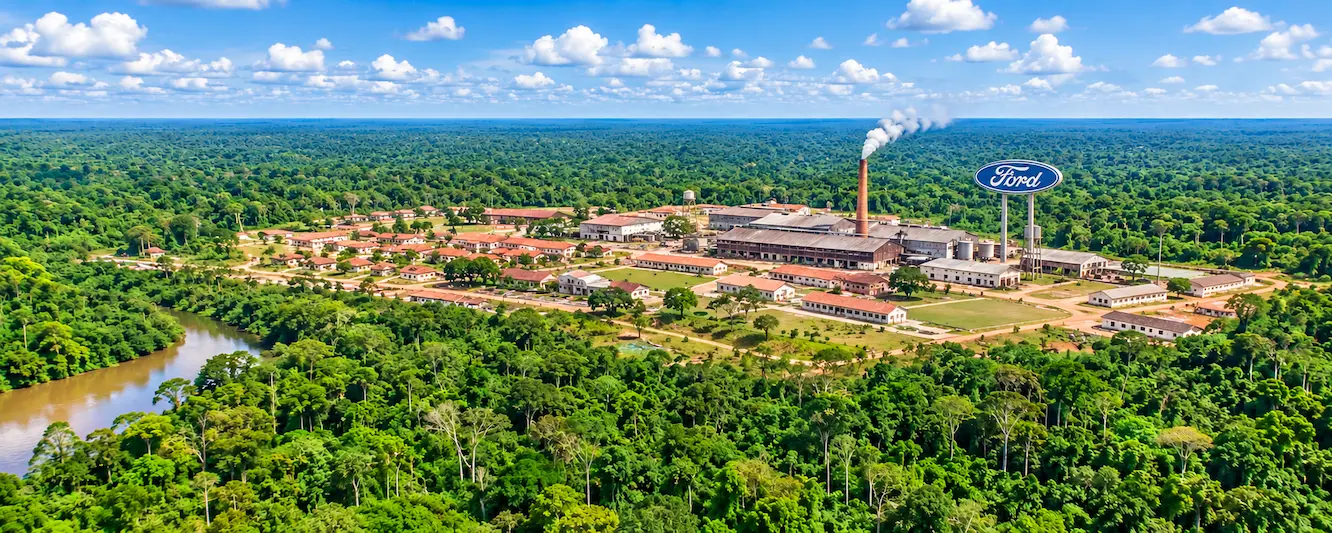
50-WORD SUMMARY: Fordlandia stands as a powerful lesson in corporate hubris. Henry Ford attempted to transplant his successful industrial model into the Amazon, overlooking local realities, agricultural complexity and cultural differences. The venture failed, demonstrating why business expansion requires local knowledge, operational readiness, financial discipline and the humility to adapt before committing resources.
In 1928, Henry Ford decided to build an American-style industrial town in the middle of the Amazon rainforest. He had the money, machinery, ambition and confidence to make it happen.
But there was just one problem. He had no clue about the jungle.
Fordlandia, his ambitious venture, became one of the most fascinating business failures in industrial history. A spectacular demonstration of what happens when corporate hubris gets ahead of operational reality.
Henry Ford: The Man Who Changed the World
Henry Ford was no ordinary businessman. He fundamentally changed how the world manufactured and consumed products.
He transformed automobile manufacturing by introducing the moving assembly line in 1913. The time required to assemble a Model T fell dramatically, making it affordable to millions of ordinary Americans. As the Model T dominated the American automobile market, Ford became a symbol of industrial progress.
However, success can create a dangerous blind spot. The methods that make someone successful can become a source of hubris when applied without questioning their relevance to a different environment.
Henry Ford was about to discover this the expensive way.
Ford Wanted to Build His Own Rubber Empire
Rubber was an essential raw material for Ford’s automobile business. Tyres, hoses, belts, seals and numerous other components depended on a reliable supply.
British-controlled plantations in Southeast Asia, particularly Malaya and Ceylon, were the key sources of natural rubber. This created a strategic vulnerability for American manufacturers. Ford wanted greater control over a critical input, reduced dependence on overseas suppliers and protection against price fluctuations.
His solution was vertical integration.
If Ford could grow his own rubber, he could potentially secure supply, control costs, and strengthen his manufacturing empire.
The Amazon forests in Brazil appeared to offer the perfect answer. Its climate seemed suitable, land was available, and the region had a long history of rubber extraction. Ford subsequently secured a concession of approximately 2.5 million acres along the Tapajós River.
The vision was enormous. The plantation would eventually produce enough rubber to supply millions of automobile tyres annually.
Fordlandia: America in the Amazon
Ford wanted to create a complete industrial community in the Amazon. Fordlandia had electricity, running water, a hospital, schools, housing, shops, recreational facilities and modern infrastructure. It even had a golf course.
Workers were offered high wages, housing, medical care and other benefits. On paper, this looked like an excellent employment proposition for the local population.
But Ford had another ambition. He wanted to introduce what he considered a better way of living. The plantation became an experiment in exporting American industrial culture.
Employees were expected to follow fixed working hours, eat American-style food, maintain gardens, participate in organised recreational activities and observe strict behavioural rules.
The company had imported its buildings, machinery and management practices. Unfortunately, it had also imported its assumptions.
This was the first major manifestation of corporate hubris: believing that a successful operating model could simply be transplanted into an entirely different society.
When the Jungle Refused to Follow the Assembly Line
An automobile assembly line operates in a relatively controlled environment. Inputs can be standardised, processes repeated and outputs measured with considerable predictability.
Rubber cultivation in the Amazon was an entirely different proposition.
The rubber tree, Hevea brasiliensis, grows naturally in tropical conditions. However, commercial cultivation requires careful management of soil, spacing, drainage, pests and diseases.
Ford’s plantation managers lacked sufficient specialist agricultural knowledge. Many were experienced factory personnel rather than horticultural experts.
The land presented immediate challenges. Heavy rainfall, unsuitable terrain, drainage problems and seasonal conditions complicated cultivation.
Then came the biggest enemy: South American leaf blight.
In natural rainforest conditions, rubber trees grow relatively dispersed. On plantations, they are cultivated much closer together. This concentration creates favourable conditions for diseases to spread rapidly.
The fungus devastated the plantation.

The trees that were supposed to generate a dependable supply of rubber became an expensive agricultural liability.
The company had underestimated the biology of its most important raw material. The hubris of assuming that industrial discipline could overcome ecological realities had proved expensive.
The Human Cost of Corporate Hubris
Agricultural problems were serious, but management failures were equally damaging.
Ford’s managers expected Brazilian workers to adopt the routines and lifestyle of American factory employees.
However, the Amazonian climate made conventional factory-style working hours uncomfortable. Local workers preferred working during cooler periods, often early in the morning and later in the evening.
The cafeteria became another flashpoint. Workers were expected to adopt unfamiliar self-service arrangements and American-style food. In 1930, a major riot broke out, with workers damaging the cafeteria and other facilities.
This was leadership hubris in action.
Management assumed that better infrastructure and higher wages would automatically produce acceptance of its operating model. But it had failed to understand what its workforce actually valued.
The Second Attempt and the Final Retreat
By the early 1930s, the scale of the problems was becoming impossible to ignore.
Fordlandia was not producing the commercial returns originally anticipated. In 1934, the company began shifting its rubber cultivation efforts towards another location, Belterra, closer to Santarém.
The new plantation benefited from better terrain and a more considered agricultural approach. Specialists were brought in, and cultivation methods were improved. However, then came another twist in the story.
The Second World War accelerated the development and adoption of synthetic rubber. The strategic value of establishing an expensive natural rubber plantation was diminishing.
Henry Ford’s grandson, Henry Ford II, eventually took control of the company. In 1945, Ford’s Brazilian holdings were sold back to the Brazilian government.
The Business Lesson: Vision Is Not a Substitute for Validation
Fordlandia teaches us an important distinction between ambition and execution.
Ambition defines what an organisation wants to achieve. Execution determines whether it can achieve it under actual operating conditions.
The problem begins when leaders become emotionally attached to their vision and stop questioning its underlying assumptions. This is where hubris enters decision-making.
Consider a company that has successfully operated a logistics business in Mumbai. Encouraged by its success, the leadership decides to expand into a remote North-Eastern market.
The business plan assumes similar delivery costs, supplier availability, infrastructure and customer behaviour.
But local road conditions, weather patterns, logistics networks and customer preferences are entirely different.
The company may have a brilliant strategy, sufficient capital and an experienced management team. Yet, without local validation, its expansion could quickly become a financial drain.
The mistake is not expanding. It is assuming that past success guarantees future success.
Leaders must challenge their own hubris before the market does it for them.
Five Areas Leaders Must Validate Before Taking the Plunge

Before committing capital or resources, leaders must look beyond the business opportunity and validate five critical dimensions.
1. Financial Viability: Follow the Economics, Not the Excitement
A promising business case can conceal weak economics. Ford underestimated the investment required to establish plantations, infrastructure and settlements.
Evaluate the total cost of ownership, unit economics, break-even volumes, working capital and downside exposure. Prepare three financial scenarios: optimistic, realistic and adverse. If the project survives only the optimistic scenario, it is not investment-ready.
Financial discipline is the first defence against investment hubris.
2. Operational Readiness: Understand the Ground Before Breaking It
A boardroom strategy must survive contact with operational reality. Fordlandia lacked the agricultural expertise required to manage its core production activity.
Validate local supplier availability, infrastructure, utilities, logistics, skilled manpower, technology compatibility and maintenance support. Conduct a ground-level operational audit. Visit the location, meet suppliers, speak to potential employees and test assumptions.
A feasibility report is not a substitute for actual feasibility.
3. Cultural and Social Compatibility: People Matter
Fordlandia demonstrated that high wages and employee benefits cannot compensate for cultural insensitivity.
Understand local working practices, social customs, language, community expectations and employee aspirations. A standardised shift system that works in one country may fail elsewhere because of transport constraints or established labour practices.
Build local leadership into the project. Distinguish between essential operating standards and practices that need local adaptation.
Listen before imposing. Understand before changing.
4. Political and Regulatory Environment: Know the Rules of the Game
Securing land or government approval does not guarantee a sustainable business.
Assess land rights, licences, environmental regulations, taxation, labour laws, political stability and policy continuity. Map the key stakeholders, including government agencies, local authorities, community representatives, suppliers and employees.
A commercially attractive project can become unviable when political and regulatory dependencies are overlooked. Ignoring them is another form of corporate hubris.
5. Management Capability: Put the Right Expertise in the Right Place
Ford’s factory-trained managers were expected to oversee a complex agricultural operation. The mismatch was fundamental.
Before entering a new business or geography, ask:
- Do we have the required domain expertise?
- Does the leadership team understand local conditions?
- Are decision-making responsibilities clearly defined?
- Can we attract and retain the right talent?
- Are local experts empowered to challenge headquarters?
Bring in people who understand what the leadership team does not.
“The strongest leaders are not those who know everything, but those who recognise what they need to learn.”
The Pre-Launch Risk Assessment Checklist
Before approving a new project, expansion or business venture, use this quick assessment.

Score each area from 1 to 5, where 1 represents inadequate preparation, and 5 represents strong validation.
Any score of 1 or 2 should trigger further investigation. Do not allow a high overall score to conceal a critical weakness in an individual area.
Most importantly, appoint someone independent of the project team to challenge the business case. The person approving the investment should not be the only person validating its assumptions.
Three Leadership Habits to Keep Corporate Hubris in Check
While a checklist is useful, disciplined leadership behaviour is what prevents expensive mistakes.
1. Practise the pre-mortem
Before launching, imagine that the project has failed two years later. Ask the team to identify the five most likely reasons.
This simple exercise encourages people to discuss uncomfortable possibilities before money and reputations become involved. It helps expose hubris before it becomes an expensive commitment.
2. Run a controlled pilot
Instead of committing the entire investment immediately, test the business model on a smaller scale.
A pilot exposes operational weaknesses, customer resistance and cost assumptions without putting the entire organisation at risk.
3. Establish decision gates
Define measurable milestones for continuing, modifying or stopping the project.
Do not allow sunk costs, executive pride or public commitments to dictate future investment.

The ability to stop a failing initiative is as important as the ability to start a promising one. It requires leaders to put business outcomes ahead of personal hubris.
These practices replace leadership hubris with evidence-based decision-making.
Conclusion: The Jungle Always Has the Final Say
Fordlandia shows that even extraordinary business leaders can make costly mistakes when they assume their success formula is universally applicable.
Corporate hubris often begins with a simple assumption:
“If we have succeeded here, we can succeed anywhere.”
But every market has its own rules. Every operation has its own constraints. Every community has its own expectations.
The smartest leaders do not merely ask whether an idea is brilliant. They ask whether it is viable, executable and sustainable in the environment where it must operate.
Because sometimes, the biggest business risk is not the competition, the economy or the market.
It is the leader who believes there is nothing left to learn.
Enjoyed this perspective? Drop your email below, subscribe to my blog and receive regular insights on strategy, leadership, and sustainable systems.
Follow along: Catch short-form thoughts and business storytelling on X and Facebook.
Read the books: Find my work on Amazon covering power, ambition, and the choices that shape success.


Leave a Reply