
There is a certain magic in a hot cup of chai. We know the feeling well. We might be half-asleep in the morning, tired after a long drive, or drained by a never-ending workday, and suddenly someone says, “Let’s have chai.” Just the sound of that word lifts our mood a little.
Then comes the first sip of that sweet, milky, spiced brew, the quintessential Indian chai. It hits our system like a warm handshake, telling our brain to wake up and start again. It feels like an instant reset button, a two-minute holiday our mind and body have been craving all day. Emails feel manageable, traffic sounds softer, and a dull afternoon turns into a productive evening.
This is the magic of chai, our national drink, our daily ritual, our reliable energy booster. It is amazing how chai has become the go-to source of energy for millions of Indians at any hour. But here is the surprising truth. A few centuries ago, most Indians had never even heard of chai. It was as unfamiliar to this land as a cold, artisanal Matcha Latte is today.
So how did chai travel from being an unknown entity to becoming India’s everyday energy boost? The journey of how this foreign leaf became India’s favourite daily companion is a story filled with adventure, politics, competition, and clever colonial strategy. And it began thousands of miles away, in the misty mountains of a distant land.
Misty Origins: Tea and the Chinese Monks
The story of Tea does not begin in a grand British parlour. It begins in the quiet, spiritual world of ancient China.
Legend says tea was discovered around 2737 BCE by Emperor Shen Nong, the Divine Farmer. One day, while he was boiling water under a tree, a few leaves from the Camellia sinensis plant drifted into his pot. Enticed by the distinct aroma, he tasted the warm infusion and found it refreshing and energising. That simple accident gave birth to the first cha, the ancestor of our beloved chai.
For centuries, tea stayed within China, treasured and protected. Buddhist monks held it in especially high regard. They believed the gentle caffeine lift helped them stay awake and focused during long hours of meditation. Tea was medicine, ceremony, and spiritual support. Not the everyday, sugary cup of chai we know today.
These leaves became precious, almost sacred. Chinese emperors controlled every secret of tea cultivation, turning it into a powerful monopoly that kept the rest of the world guessing.
Spreading the Leaves: From China to the World
Once tea earned prestige in China, it began its long journey across borders. The global spread of tea truly started with the famous Silk Road. Though known mainly for silk, these ancient trade caravans also carried valuable tea bricks towards the West. Tea first reached Persia, where the word chai originated, simply meaning “tea”. From there, it travelled into Central Asia and Russia.
By the 1600s, European merchants were sailing into Asia in search of spices, silk, porcelain, and soon, tea. Europe’s first major taste of tea came through the Dutch East India Company, which brought it home from its Asian trading posts.
At first, Europeans were unsure. Tea was rare, expensive, and treated as a novelty for the wealthy. But its exotic flavour and almost addictive charm soon changed that. Europeans didn’t just enjoy tea; they fell in love with it.
And in Britain, tea found its strongest admirers. It was here that tea became more than a drink. It grew into a passion, a ritual, and eventually a force powerful enough to shape the future of chai in India.
British Fascination: Tea, Tax, and Tastes
The rise of tea in Britain is often credited to Catherine of Braganza, the Portuguese wife of King Charles II. She brought along her elegant tea-drinking habit, a custom already popular in Portugal because of its early trade with China. Almost overnight, tea became the fashionable drink of the English royal court. What began as a royal ritual soon set the stage for the global journey that would one day shape India’s love for chai.
By the 18th century, tea was ubiquitous in Britain, although it was heavily taxed. It inspired the famous tradition of afternoon tea, turning a simple beverage into a social event. Tea even helped steer the working classes away from stronger alcoholic drinks, offering a safe, warm, and mildly stimulating alternative that quietly boosted productivity during long Victorian workdays.
But Britain’s growing addiction to this Chinese leaf came with a serious problem: a massive trade imbalance. The British were sending enormous amounts of silver to China to pay for tea, and China wanted nothing else in return. This constant outflow of wealth was impossible to sustain.
The Crown needed a solution, urgently. And in their search for answers, British eyes turned towards the vast, fertile lands of India, a subcontinent they were rapidly colonising. That decision would ultimately shape the future of tea and give birth to the chai we know today.
Colonisation of India: Power, Politics and Commerce
The British did not come to India looking for tea or chai. They arrived as traders, but trade soon opened the door to politics. Politics opened the door to control. And control, over time, opened the door to full colonisation.
By the early 1800s, the British East India Company was behaving less like a business and more like a government. It controlled territories, collected taxes, built armies, and shaped entire economies to suit its commercial goals. India had become the centrepiece of British power.
It was during this period of absolute control that the British faced their biggest challenge: their growing dependence on tea. Britain was obsessed with tea, while China controlled the global supply. This monopoly was draining British wealth, and they knew it could not continue.
So, the British asked a simple but game-changing question:
Why not grow tea in India?
That single idea, born out of power, politics, and desperation, changed the future of India and eventually gave rise to the chai we drink today.
The Great Indian Tea Experiment
The British decision to grow tea in India was a clever geopolitical move, born out of urgency and made possible by India’s rich natural resources and its troubled political reality. What began as an experiment would eventually shape the chai we drink today.
The hilly landscapes of Assam, the Himalayan foothills of Darjeeling, and the cool heights of the Nilgiris offered ideal conditions for tea: high altitude, heavy rainfall, and well-drained, acidic soil. These regions were perfectly suited for the Camellia sinensis plant to flourish.
Then came a discovery that changed everything. The British found a native, large-leaf tea plant, Camellia sinensis var. assamica, growing in the jungles of Assam. This removed their dependence on smuggled Chinese seeds and gave them a powerful advantage. India, they realised, could become the Empire’s tea powerhouse.
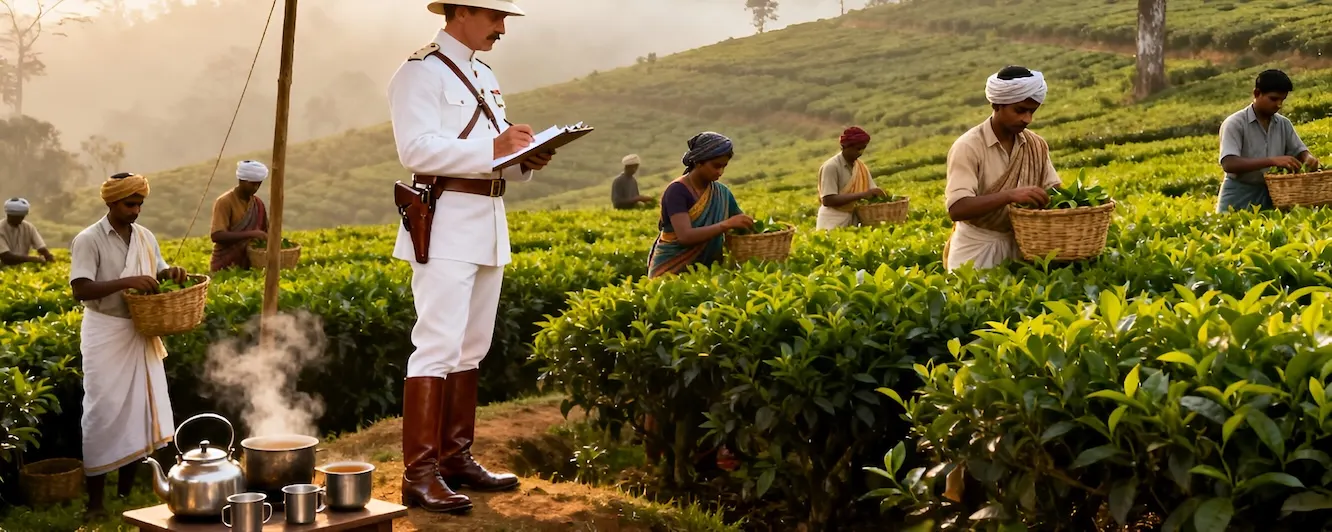
India also provided a vast supply of cheap labour, often pushed or coerced into working on the new plantations under harsh and unforgiving conditions. This kept production costs extremely low.
The British built a massive and efficient system for growing and exporting tea. Railways, ports, and plantations worked together like clockwork, sending Indian tea straight to Britain and across the Empire. It became a profitable, self-sustaining business, one that fed British demand and set the stage for the rise of Indian chai.
In 1839, the Assam Tea Company was formed, marking the official birth of India’s tea industry.
A New Line of Revenue
Tea plantations soon spread across three major regions of India, each creating flavours that would later shape the chai we drink today.
- Assam: Known for its strong, dark, malty brew, perfect for bold breakfast blends.
- Darjeeling: Famous for its delicate, muscatel notes and often called the “Champagne of Teas.”
- Nilgiris: Loved for its bright, aromatic leaves, widely used in blended teas.
These plantations grew rapidly. Tea production became industrial in scale, leading to innovations like the CTC (Crush, Tear, Curl) process. This method created small, granular tea leaves that brewed fast and strong. The exact base that gives modern Indian chai its colour, punch, and character.
Tea was no longer just a comforting drink. It had become a powerful economic engine for the British Empire. Indian tea began to dominate the global market, finally breaking China’s centuries-old hold over the trade. The revenue from tea exports was massive, helping fund other colonial ventures and strengthening the Crown’s treasury.
Without realising it, India had become the world’s largest tea producer. A title it proudly carried for many years. And in the background of this booming industry, the foundation for India’s future love affair with chai was quietly being built.
From Tea to Chai
Before tea arrived, Indians drank a variety of herbal infusions. The most common was kadha: a medicinal mix of herbs, spices, and roots. Our traditional diets had no habit of drinking a pure leaf infusion like tea. Chai, as we know it today, did not exist.
Interestingly, the British never planned to sell tea to Indians. India was simply the producer; Britain was the consumer. But soon, the British tea planters faced an unexpected problem. After processing premium leaves for export, huge piles of low-quality, broken tea, the “dust” and “fannings” began to accumulate. These leftovers had little value in the global market.
To get rid of this surplus and build a domestic market, the British-owned Indian Tea Association (ITA) launched a massive marketing campaign in the early 20th century. Their goal was simple: turn India into a reliable consumer base for their lower-grade tea. The early foundation of what would later become India’s love for chai.
The ITA’s strategy was clever and calculated. They introduced free tea breaks in factories and mills, and most famously, at railway stations. India’s expanding railway network became the perfect distribution channel. Vendors, often supplied with free kettles, cups, and tea leaves, served small cups of the cheap brew to millions of workers and travellers every day.
This was the beginning of a quiet revolution. Tea was entering Indian hands, and soon, Indians would transform it into the rich, sweet, spiced chai we consider our own.
The Birth of Masala Chai
Slowly, Indians began experimenting with tea leaves. But plain tea tasted too bitter and sharp. It didn’t suit our palate. So we did what we always do best. We Indianised it and turned it into chai.
- We boiled the tea leaves hard, a technique that worked perfectly for the low-grade CTC dust.
- We added generous amounts of milk and sugar to soften the bitterness.
- And most importantly, we mixed in the familiar spices of our old kadha. Ginger, cardamom, cloves, cinnamon, and black pepper.
This powerful blend gave birth to Masala Chai, the sweet, spiced, milky brew that comforts the soul and wakes up the body. It offered both stimulation and warmth, making it instantly popular among the working class. It was no longer “English tea”. It was our chai. Born from a colonial leftover, yet transformed into a national passion.
From railway platforms, the chai stall or the tapri began to spread across the country. Soon, it became a daily meeting point, a social equaliser, and the ultimate energy boost for everyone, from CEOs in corner offices to rickshaw pullers on busy streets.
The Economy of Chai
Today, the tables have truly turned. The colonial history remains a sombre chapter, but the tea industry is now largely Indian-owned, and most of what we grow is consumed right here at home as chai.
India is still one of the world’s biggest tea producers, often second only to China. Assam, Darjeeling, and Nilgiri teas are admired across the globe. At the same time, India is the world’s largest tea consumer. We drink an astonishing volume of tea, and nearly all of it becomes the chai that fuels our daily lives.
India continues to be a major exporter too, especially of premium varieties like Darjeeling and high-quality Assam orthodox teas. These prized leaves bring in valuable foreign exchange and play an important role in the Indian economy. Key export destinations include Russia, Iran, the UAE, the UK, Europe, and the USA.
For millions of Indians, the day begins and often ends with a cup of chai. It is the drink of hospitality, the spark for conversation, the remedy for stress, and the one pause in a busy day that no one negotiates. The chai economy, from vast plantations to the countless chaiwallahs on streets, stations, and markets, supports millions of livelihoods across the country.
Once a colonial product, is now an Indian lifeline.
Refreshing or Addictive
Our modern love affair with chai is charming, but it comes with a few gentle warnings. What we adore as masala chai is often a mix of caffeine, milk, and sugar, a comforting blend, yet not always the healthiest one.
- The Positives: The caffeine in tea is a natural energy booster that sharpens focus and reduces tiredness. Spices like ginger and cardamom are rich in antioxidants and help fight inflammation. A warm cup of traditional chai also creates social bonding and emotional comfort, both of which are essential for mental well-being.
- The Negatives: In India, the real issue is rarely the tea leaf. It is everything we add to it. The heavy use of sugar and full-fat milk can turn a simple, healthy infusion into a calorie-dense drink.
Drinking milky, sugary chai several times a day plays a quiet but significant role in rising rates of diabetes and metabolic problems across the country. When compared to plain black tea or a light kadha, our beloved masala chai can be far more harmful because of the extra sweeteners and fats.
For many of us, chai has become more than a habit; it has grown into a mild, comforting addiction.
Enjoying the Heritage with Caution
The story of chai in India is the story of an imported cash crop, a colonial strategy to break China’s monopoly, and a clever plan to clear surplus tea. Yet it is equally a story of resilience, adaptation, and cultural pride. Indians took a foreign leaf and turned it into something deeply our own, blending it with local spices and weaving it into the rhythm of daily life.
Today, every cup of Indian chai carries an echo of this remarkable journey. What began as a colonial experiment has become a drink we have completely reclaimed. So the next time you hold that small glass or steel cup for your daily energy boost, pause for a moment. Enjoy the aroma, feel the warmth, and remember the long journey these leaves travelled before becoming chai.
And while you celebrate this powerful heritage, keep one gentle reminder in mind: love your chai, but perhaps with a little less sugar.
I am positive that you found this article interesting and useful. Please subscribe to my blog by filling in your details below:
My blog has countless such articles and stories to guide you and quench your thirst for knowledge.
If you enjoy stories woven with power, passion, and desire, explore my books on Amazon. My stories unravel the fine line between success and surrender, reminding us that in a world ruled by strategy, love remains the ultimate game changer.
If you enjoy videos, you can watch interesting thoughts and stories on my YouTube channel. You can also follow me on X and Facebook to read more such stories and posts.
PS: Gemini and/or ChatGPT have been used to create parts of this post.
Leave a Reply