

50-WORD SUMMARY: Meeting fatigue is rarely a diary problem; it is an operating-model problem. This guide shows leaders how to build high-documentation, high-autonomy asynchronous workflows, replace routine calls with written briefs, decision logs and shared dashboards, clarify decision rights, and use a practical meeting audit to reclaim ten hours of focused work each week reliably.
At 7:15 pm on a damp Tuesday evening, Julian sat alone in his corner office, staring at a lukewarm mug of black coffee and mourning the loss of his daily autonomy.
His calendar was a solid wall of colour blocks: 9:00 am project alignment, 10:00 am cross-functional sync, 11:30 am status check, 2:00 pm steering committee, followed by a stream of “quick huddles”. He had spent nine consecutive hours talking, listening, negotiating and nodding. Yet none of his strategic priorities for the quarter had moved.
Julian was a senior director at a fast-growing fintech firm, but he felt less like a strategic leader and more like an air traffic controller directing flights that never landed. His engineers, product designers and marketing leads faced the same problem. Back-to-back meetings left them with scraps of 15 minutes between calls to complete meaningful work. Collaboration had become a performance of availability.
The issue was not talent or commitment. It was a lack of structural autonomy.
Decisions were held hostage by real-time discussion. Minor updates required a call. Cross-functional dependencies required an “alignment workshop”. Nobody felt able to move without first finding a slot in someone else’s calendar. The organisation was operating on a low-autonomy system that valued immediate consensus over focused output.
Julian realised that if his team was going to innovate, perform and scale, he had to dismantle this meeting culture and replace it with team autonomy.
The Calendar Trap: Why More Meetings Create Less Impact
When organisations lack systems for making decisions asynchronously, meetings become the default. That dependence on synchronous conversation steadily erodes autonomy in favour of calendar control.
Two operational failures follow.
- Context-switching costs: Complex work needs uninterrupted attention. When people move from a strategic discussion to a status check to technical execution every 45 minutes, their cognitive capacity drains away. Fragmented time weakens autonomy over both priorities and pace.
- The illusion of progress: Meetings can feel productive because energy is spent and ideas are exchanged. But talking about work is not the same as doing it. Using calls to track progress usually signals a lack of trust, clarity and operational autonomy.
When leaders need live updates to feel in control, they create a bottleneck around themselves. True organisational autonomy cannot exist when every initiative requires verbal validation. The alternative is documented decision-making: clear written context, visible decisions and the confidence to act without another meeting.
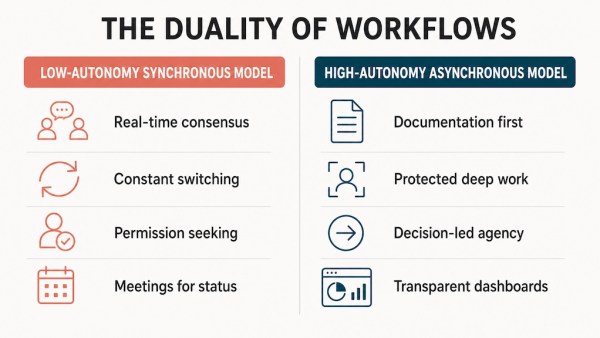
The Async Shift: Building High-Documentation, High-Autonomy Workflows
The route to reclaiming up to ten hours each week is to move from synchronous defaults to high-documentation, asynchronous workflows.
Asynchronous work does not mean working alone or avoiding conversation. It means people do not need to be online at the same moment for work to progress. That creates more autonomy, but only when teams have reliable written context.
Without documentation, autonomy quickly turns into confusion. If someone cannot find project history, strategic objectives or technical specifications, they must wait for a live explanation. Documentation is not bureaucracy; it is the operating system that makes autonomy practical.
High documentation + clear context = high autonomy
To build high-autonomy workflows, focus on three operational pillars.
1. Documented Strategic Intent
Every project should start with a concise written brief covering the background, objectives, constraints and non-negotiables. When people understand the intended outcome, they have the autonomy to choose the best route towards it without asking permission at every turn.
2. Centralised Knowledge Architecture
Protocols, decision logs, product roadmaps and research should sit in an accessible, searchable knowledge base. Centralised information gives people autonomy to self-serve rather than schedule a call to ask where a file lives or what was agreed last week.
3. Asynchronous Decision Logs
Not every decision needs a meeting. Instead, use short written proposals that state the problem, options considered and recommended action. Give stakeholders 24 hours to comment asynchronously. This protects autonomy by allowing people to contribute during their own focus windows while keeping the decision trail visible to everyone.
Real-World Scenarios: How Team Autonomy Removes Bottlenecks
High-documentation, high-autonomy work is easiest to understand in everyday situations.
Scenario A: Resolving Cross-Functional Dependencies
- The low-autonomy approach: A marketing manager needs input from product engineering to finalise launch messaging. They schedule a 30-minute meeting with three senior engineers. The engineers spend 20 minutes getting up to speed and ten minutes giving verbal answers. The business loses 1.5 engineering hours and 30 minutes of marketing time.
- The high-autonomy alternative: The marketing manager posts a concise project summary in the central workspace and tags engineering with two specific questions. The lead engineer answers in writing during a scheduled review block that afternoon. Marketing continues with the rest of the campaign in the meantime.
Result: 1.5 work hours saved across the team, with everyone retaining autonomy over their schedule.
Scenario B: Managing an Unexpected Operational Incident
- The low-autonomy approach: A software bug affects customer checkout. Eight stakeholders join an emergency all-hands call. The meeting lasts an hour, while six people watch two people troubleshoot.
- The high-autonomy alternative: The incident lead opens a dedicated incident document and follows a pre-agreed protocol. Roles are assigned from documented guidelines. The technical lead posts updates to an asynchronous log every 15 minutes, and stakeholders follow progress without interrupting the engineers.
Result: The issue is resolved faster, and six stakeholders retain their focus and autonomy through the afternoon.
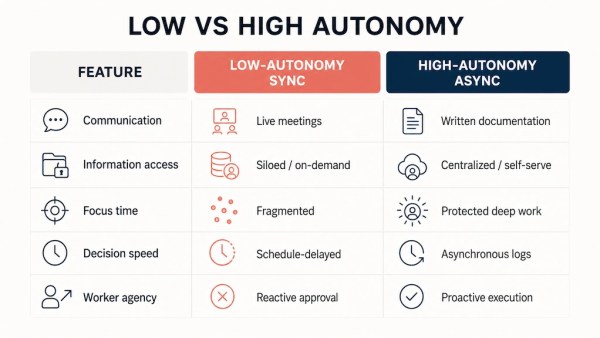
The 10-Hour Reclaim Framework for Team Autonomy
Moving from meeting overload to high-autonomy performance requires a deliberate operating model. This four-step framework helps leaders remove avoidable calendar time without sacrificing collaboration.
Step 1: Run a Calendar Radicalisation Audit
Audit every recurring meeting. Each one must justify its existence.
Ask three questions:
- Is the purpose simply to share information? If so, replace it with an asynchronous update.
- Is the meeting solely for status tracking? If so, replace it with a digital dashboard.
- Could the outcome be achieved by one person spending 15 minutes writing a clear proposal? If so, cancel the meeting and request the proposal.
Removing information-sharing and status meetings can reclaim five to six hours per person each week. More importantly, it restores autonomy over when people focus and how they progress work.
Step 2: Establish Default-Async Communication Rules
Set one clear rule: no meeting can be scheduled without a written brief attached at least 24 hours in advance.
The brief should include:
- The specific purpose of the discussion.
- Background context and links to relevant documentation.
- The exact decision required by the end of the call.
If the organiser does not provide the brief in time, invitees have the autonomy to decline. This creates useful discipline. Writing often clarifies the problem so well that the meeting is no longer needed.
Step 3: Implement Decentralised Decision Rights
Meetings multiply when people lack clear authority. To create genuine autonomy, define where independent decision-making begins and ends.
Use a simple three-level model:
- Level 1: Full autonomy. Low-risk or easily reversible actions. Team members act immediately without approval.
- Level 2: Consultative autonomy. Moderate-impact actions. Team members review relevant documentation, gather asynchronous input, decide and post the outcome in the team log.
- Level 3: Shared decision. High-stakes choices involving major financial commitments, material risk or core strategy. These may justify a focused, time-bound live discussion.
When people know their decision rights, they stop booking check-in meetings simply to gain permission.
Step 4: Replace Status Meetings with Asynchronous Reporting
Status meetings are among the largest drains on corporate productivity. Replace weekly progress calls with a standard written check-in.
Each Friday, every team member posts a three-point update:
- Key achievements: Major outcomes completed this week.
- Upcoming focus: Primary goals for next week.
- Blockers: Specific challenges requiring support.
This approach saves group time, creates an accessible record of progress and gives each person autonomy over when they report their work.

The Meeting Audit Checklist
Use this meeting audit template to assess your team’s current habits. Save it, share it and use it before approving recurring calls.

Score Your Team’s Operational Autonomy
- 8–10 checked items: High-autonomy culture. Your team protects focus time and uses documentation to drive performance.
- 5–7 checked items: Moderate-autonomy culture. Good systems exist, but meetings still creep onto calendars and drain productivity.
- 0–4 checked items: Low-autonomy culture. Your calendar is probably running the workday. Start implementing asynchronous workflows immediately.
Reclaim Time by Building Autonomy
When Julian introduced this framework in his division, meeting hours dropped by 40% within four weeks. He regained 12 hours of strategic thinking each week, while senior staff recovered roughly ten hours of uninterrupted focus time.
The bigger gain was not simply time. People felt trusted to make decisions, access information, and move work forward without waiting for the next available slot.
High performance does not come from permanent real-time coordination. It comes from trust, transparent documentation and meaningful autonomy.
Replace one recurring status meeting this week with a structured asynchronous update. Measure the result, listen to the team and build from there.
If you found this perspective useful, consider subscribing to my blog by sharing your email below. You will receive regular insights on strategy, leadership, and building sustainable systems.
Stay Connected: For short-form thoughts and business storytelling, follow me on X and Facebook for regular updates.
Beyond the Blog: If stories of power, ambition, and passion interest you, explore my books on Amazon. They examine the fine line between success and surrender, and the choices that define both.


Leave a Reply