

There are times in our lives when we are confused, and we ponder if we are in the right job, role, industry or organisation.
This might happen as at times we get stuck in our respective, repetitive roles. We keep doing the same things repeatedly, which stops enriching our knowledge and experience.
It is also possible that we do not find enjoyment in what we are doing, or we do not have enough freedom at our workplace to express ourselves and show our actual calibre.
Due to the above factors, we might be missing various Personal Goals that we may have set for ourselves, thus adding further to our anguish. To know more about setting Personal Goals, please read my blog Success Starts Here: Achieve Your Career Goals with a Clear Plan.
It is also possible that we are actually on the right path, but we may be missing the bigger picture due to being in an overwhelming situation at that moment.
Such a situation demands that we pause for a while and do an objective analysis of our current situation and find out where we may have gone wrong.
One way to assess the situation is by using the ‘Personal Performance Model’ illustrated in ‘The Decision Book’.
Let me explain.
According to the Personal Performance Model, to visualise our situation in a job role, we need to assess various tasks that we perform in our day-to-day work, on the following 3 parameters;
Job Evaluation: Have To
This parameter measures the extent to which various tasks are being imposed on us.
Do we have a say in it, or do we just have to perform them irrespective of our opinion about those?
Job Evaluation: Able To
Are we able to do the various tasks that we are performing?
Do those tasks match our skillset, or are we overqualified/ underqualified to perform those tasks?
Job Evaluation: Want To
Do we want to do various tasks that we have been assigned?
Will they help us in realising our long-term personal goals?
“The only way to do great work is to love what you do. If you haven’t found it yet, keep looking. Don’t settle.”
Steve Jobs
To use ‘The Personal Performance Model’, we need to list all important tasks that we perform in our job and do an overall rating on a scale of 1 to 10 on each of the above three parameters, where 1 means that it is ‘Not Applicable’ while 10 means ‘Fully Applicable’.
Please note that here we are not rating individual tasks but doing an overall rating for the job profile.
Once we have the score for the three parameters, we need to plot these on 3 axes graph. The outcome would look something like below;
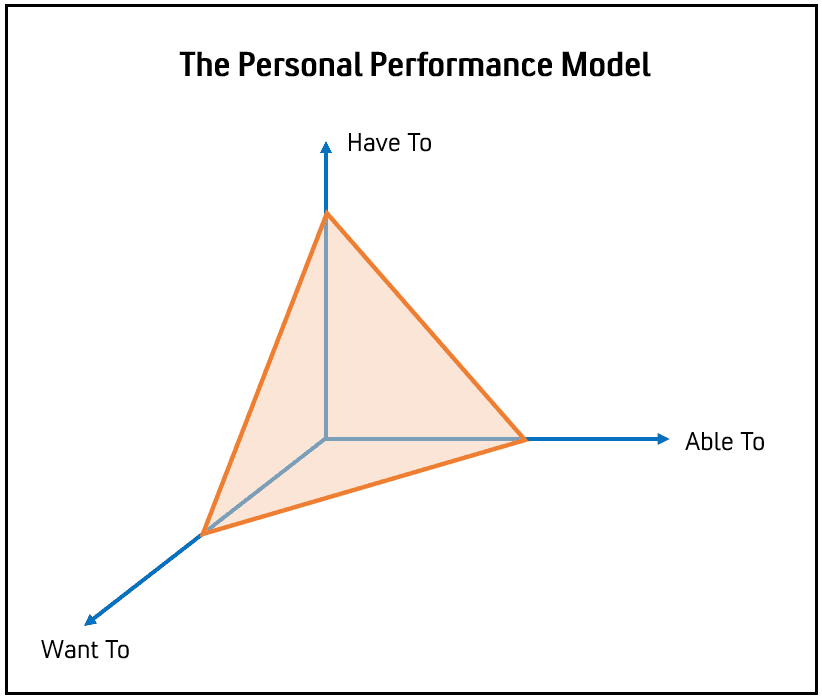
Now we need to analyse our scores on all 3 aspects to understand our situation. A basic interpretation of scores on various parameters could be as below;
Have To
A high score implies that we have very limited freedom at the workplace and have to perform various tasks as directed by our superiors, clients or processes.
This limits the scope for being creative or innovative and may make the overall experience very monotonous. In the long run, it may also result in stress, frustration, disinterest or boredom.
A low score, on the other hand, means freedom and flexibility at the workplace. In some cases, it may also mean that we are being sidelined as no worthwhile work is being assigned to us.
Able To
A low score here may imply a skill gap. In other words, we, on our own, may not be capable of performing most of the tasks assigned to us.
Possibly, we have not equipped ourselves well for performing such tasks, or we might be relying on external support to complete these tasks. This needs to be addressed on priority as it might be affecting our productivity and the quality of our output.
A very high score on this parameter may imply that we are not working on challenging tasks, as the tasks that are being assigned to us are probably much lower than our skill set. This limits the scope for future learning and growth.
Want To
A low score means we don’t like what we are doing, or it is not helping us in meeting our overall life objectives. This is a sure-shot recipe for disaster.
A high score, on the other hand, shows that we might be enjoying what we are doing, and it is in line with our overall Career Progression Plan.
This analysis gives us a decent assessment of our situation; however, please note that there is no right or perfect combination here. We have to assess our scores against our Career Progression Plan and interpret the findings for ourselves.
Doing this analysis once is not sufficient, as the situation at the workplace is often dynamic. The outcome of this analysis, therefore, would change with time. It is, therefore, recommended to do this analysis frequently. At least once a quarter.
We should compare the results of the latest month with the previous months to assess whether the situation is changing or not.
In case the situation is changing, we should also check if it is improving or worsening from our Career Progression Plan’s point of view, and if required, we must make an informed decision at an opportune moment, for a job pivot or a career pivot.
“Choose a job you love, and you will never have to work a day in your life.”
Confucius
I am positive that you found this article informative and useful!
Please subscribe to my blog by filling in your details below:
My blog has countless such articles and stories to guide you and quench your thirst for knowledge.
You can also follow me on X and Facebook to read more such stories and posts.
Leave a Reply