
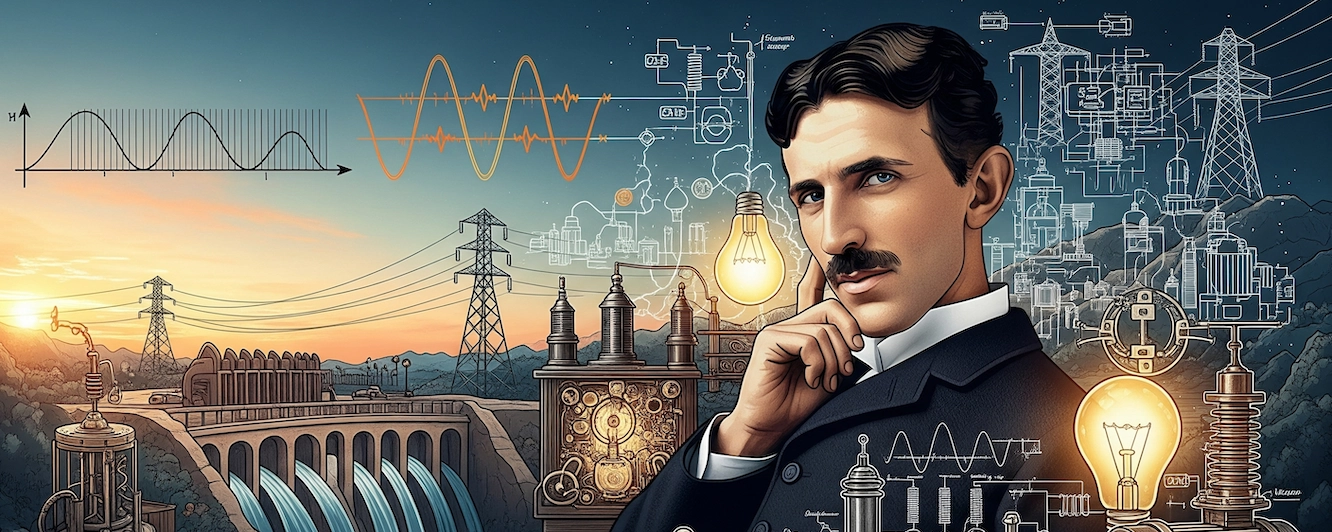
Nikola Tesla, one of the greatest minds in human history, reshaped the world with his imagination, innovation, and unmatched understanding of electrical engineering. Though often overshadowed by contemporaries like Thomas Edison, Tesla’s contributions laid the groundwork for many aspects of modern technology.
From alternating current (AC) systems to radio communication, Tesla’s inventions and ideas stretched far beyond his time. He laid the groundwork for technologies we now consider indispensable. He was a dreamer. A man whose vision often transcended the limits of his era. His legacy continues to influence how we live, connect, and even think about the future.
“A new idea must not be judged by its immediate results.”
Nikola Tesla
Tesla’s life wasn’t just about science and inventions; it was a journey of determination, rivalry, humour, and heartbreak. A tale of brilliance often overshadowed by the complexities of fame and fortune.
Birth and Early Life
Nikola was born during a thunderstorm on the midnight of July 10, 1856, in the small village of Smiljan, located in modern-day Croatia, then part of the Austro-Hungarian Empire.

On his birth, the midwife reportedly exclaimed, “He will be a child of the storm,” to which Tesla’s mother responded, “No, of the light.” This dramatic birth was perhaps a poetic foreshadowing of his future brilliance with electricity.
His father, Milutin, was a Serbian Orthodox priest and a writer. While his mother, Georgina “Djuka” Mandic was uneducated but highly intelligent and an inventor in her own right. She created household tools and had a photographic memory.
Traits Nikola would inherit and refine to a genius level. He showed early signs of brilliance and curiosity, often spending hours constructing elaborate mechanical devices from rudimentary materials.
Education
Tesla’s education began at the Higher Real Gymnasium in Karlovac, where he first developed his fascination for electricity. His professors introduced him to physics and mathematics, and he absorbed knowledge like a sponge.
He could perform complex calculations in his head and often visualised inventions in his mind with perfect clarity. A mental technique he called ‘visual thinking’.
He later enrolled at the Austrian Polytechnic in Graz, where he studied engineering. Here, Tesla first encountered the concept of alternating current, which fascinated him. A concept that would one day become his signature contribution to science.
Despite being a top student initially, he struggled in his later years due to illness and disputes with professors. He eventually left school without graduating. He later attended the Charles-Ferdinand University in Prague briefly. But his father’s death and financial difficulties made him drop out of university before completing his degree.
It was a setback, but for him, failure was never final. It was merely a stepping stone.
Migration To the Land of Opportunities
In 1884, Tesla boarded a ship for the United States with just a suitcase and a letter of recommendation from Charles Batchelor, a former colleague. Batchelor’s letter was addressed to Thomas Edison and famously read, “I know two great men: one is you, and the other is this young man.”
Nikola arrived in New York City eager to make his mark in a land that seemed brimming with promise and innovation. The young inventor was ready to change the world. He quickly found himself in Edison’s orbit, which would prove both inspiring and ultimately contentious.
Early Career
Tesla’s first job was with Edison Machine Works in New York. He was tasked with improving Edison’s direct current (DC) generators. He worked hard and his reputation as a meticulous engineer and inventor began to grow. But his dreams of advancing the field of electricity clashed with Edison’s approach.
Tesla, a firm believer in the potential of alternating current (AC), soon found himself at odds with Edison’s obsession with DC. Despite delivering promising results he eventually had a fallout with Edison. Frustrated and disillusioned, he left Edison’s company after just one year.
Fallout with Edison
The collaboration between Tesla and Edison was short-lived but eventful. While he admired Edison’s grit and practical ingenuity, the two had fundamentally different visions for the future of electricity. Edison was committed to direct current (DC), while Tesla championed the alternating current (AC) system.

Edison once promised Tesla a $50,000 bonus for improving his DC generators. When Tesla delivered, Edison allegedly laughed off the reward, calling it ‘American humour’. Feeling betrayed, Tesla left Edison’s company to pursue his ambitions. Thus began one of the most famous rivalries in scientific history.
AC vs DC: A Battle of Currents
The ‘War of Currents was a battle not only between AC and DC but also between two worldviews. Edison launched a campaign to convince the public that AC was dangerous. He even staged public electrocutions of animals using AC to demonstrate its supposed risks, culminating in the grim spectacle of electrocuting an elephant in 1903.
Tesla, on the other hand, had science and innovation on his side. His AC system was more efficient and practical for large-scale power distribution. With the help of industrialist George Westinghouse, Tesla’s AC technology eventually triumphed.
George Westinghouse
George Westinghouse recognised Tesla’s genius and offered to license his AC patents, including the revolutionary polyphase AC motor. Their partnership was pivotal. Westinghouse provided the financial backing and business acumen, while Tesla brought visionary designs and engineering.

The decisive moment in this partnership came at the 1893 World’s Columbian Exposition in Chicago. The duo powered the entire fair using AC. Two years later, they installed the first major hydroelectric power plant at Niagara Falls. It transmitted power over 26 miles to Buffalo, New York, marking a global turning point in electrical engineering.
George Westinghouse was not just a business partner; he was a believer in Tesla’s vision. This partnership powered cities, bringing electricity to homes, factories, and public spaces. Their collaboration was a testament to how science and business could work hand in hand to transform society.
A Mind Like No Other
Tesla’s mind worked in ways that baffled even his contemporaries. He was not merely an inventor, he was a futurist and a philosopher of science. His thought process was unique. He claimed that every invention came to him fully formed in a flash of inspiration, needing only to be written down or built.
“What one man calls God, another calls the laws of physics.”
Nikola Tesla
He rarely used drawings or schematics to design his inventions. Instead, he visualized every detail in his mind. His lab notebooks were sparse compared to those of his contemporaries, but his mental clarity was astonishing.
He was a perfectionist, often spending years refining his ideas before unveiling them to the world. His career was marked by highs and lows. Brilliant breakthroughs, like the Tesla Coil, and crushing failures, such as the ill-fated ‘Wireless Energy Tower, at Wardenclyffe.
Tesla was often ridiculed for his unconventional ideas, but he remained steadfast in his belief that science could solve humanity’s greatest challenges.
Ideas Ahead of Their Time
Tesla’s inventions weren’t just groundbreaking. They were decades, sometimes even centuries ahead of their time. Among his most ambitious ideas were:
Wireless Energy Transmission
Tesla envisioned a world where energy could be transmitted wirelessly across vast distances. His Wardenclyffe Tower was intended to transmit power wirelessly across the globe. Though never completed, it foreshadowed modern wireless charging and satellite communication.

Remote Control
In 1898, he invented the first remote-controlled boat, laying the groundwork for modern robotics and automation.
Neon Lights
Tesla’s work on high-frequency currents led to the creation of neon and fluorescent lights.
Radio Waves
Tesla demonstrated wireless communication years before Guglielmo Marconi, who is often credited with the invention of the radio. In 1943, the U.S. Supreme Court recognized Tesla’s prior patents.
The Tesla Coil
His iconic invention, the Tesla Coil, remains a staple in electrical experiments and demonstrations.
Contribution and Legacy
Tesla’s work underpins the entire modern electrical infrastructure. Without his inventions, today’s power grids, motors, communication systems, and technologies would not exist in their current forms. His name now graces the SI unit of magnetic flux density: The Tesla.
His visions of wireless communication and energy paved the way for technologies like smartphones, Wi-Fi, and renewable energy systems. Despite dying alone and penniless in 1943, Tesla’s legacy endures.
Today, his name is synonymous with innovation and genius. The Tesla electric car company, named in his honour, serves as a reminder of his enduring impact on science and technology.
The Quirky Side
Despite his serious demeanour, Tesla had a quirky side that produced many amusing stories:
Pigeon Obsession
In his later years, Tesla lived in a New York hotel and became obsessed with feeding pigeons. He reportedly spent thousands caring for an injured white pigeon, claiming he loved her as a man loves a woman.
Fixation on the Number 3
Tesla had an obsessive-compulsive habit of doing things in threes. Walking around a block three times before entering a building, using 18 napkins to clean his utensils, and staying in hotel rooms divisible by three.
“If you only knew the magnificence of the 3, 6 and 9, then you would have the key to the universe.”
Nikola Tesla
Aversion to Pearls
Tesla refused to speak to women wearing pearl earrings, a quirk that could’ve cost him many dates.
A Beacon of Innovation
Nikola Tesla’s life was a symphony of triumphs and tragedies, brilliance and eccentricity. He was a man who saw the world not as it was, but as it could be. His legacy continues to inspire scientists, inventors, and dreamers to push the boundaries of possibility.
As we flick on a light switch or charge our smartphones, we pay tribute to a man who dreamed of lighting the world.
I am positive that you found this story informative and useful!
Please subscribe to my blog by filling in your details below:
My blog has countless such articles and stories to guide you and quench your thirst for knowledge.
You can also follow me on X and Facebook to read more such stories and posts.
YouTube trailer of a movie made on his life:
PS: Copilot and ChatGPT have been used to create parts of this post.
Leave a Reply