
Collaboration is the cornerstone of innovation, problem-solving, and sustainable growth. Successful leaders and organisations understand that true progress is rarely a solo act. When teams collaborate effectively, they transcend individual limitations and create outcomes far greater than the sum of their parts.
Collaboration is not effortless; it demands patience, alignment, empathy, and above all, purpose. It is a discipline as much as it is an art. And perhaps nowhere is this truth captured more profoundly than in the ancient Indian tale of Samudra Manthan, the legendary Churning of the Ocean.
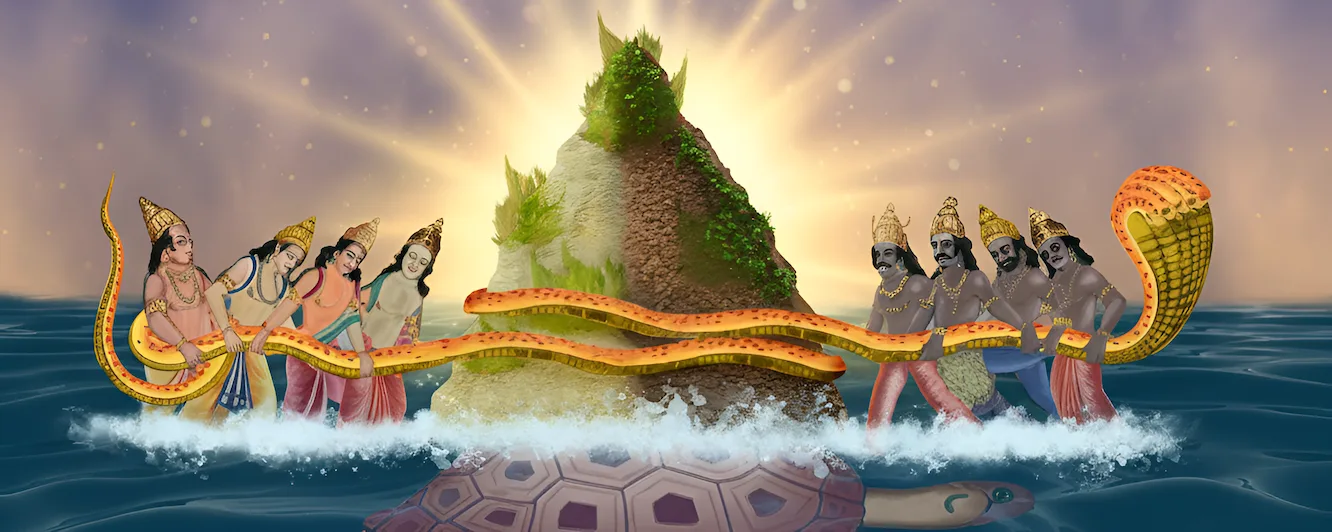
When fierce rivals, the Devas and Asuras, set aside their differences to pursue a shared goal. It’s a tale where unity meets strategy, where perseverance reveals both nectar and poison, and where the journey becomes as meaningful as the reward.
In this article, we explore the Samudra Manthan story and uncover how modern leaders can inspire trust, manage diverse teams, and sustain purposeful collaboration in an increasingly complex and competitive world.
An Epic Tale of Collaboration
A Common Objective
The Samudra Manthan became necessary after the Devas (gods), led by Indra, lost their strength and immortality due to a curse from the sage Durvasa. To regain their vigour and secure the Amrit (the nectar of immortality), they had to undertake the monumental task of churning the ocean. This daunting task required strength far beyond their own, compelling them to seek an unlikely alliance for a bigger objective: to retrieve Amrit and restore their might and attain immortality.
An Unlikely Alliance
In a truly remarkable strategic act, the Devas approached their sworn enemies, the Asuras (demons), for assistance. The Asuras, too, were tempted by the promise of immortality and joined in. Mount Mandara became the churning rod, and the great serpent Vasuki served as the churning rope. Both factions, despite their deep-seated rivalry, committed their resources and physical effort towards the common goal. An ultimate example of stakeholder alignment and resource pooling under extreme pressure.
Good and Bad Outcomes
The churning was a chaotic, prolonged process that yielded numerous treasures. These outcomes included both positive outcomes, like the goddess of wealth, Lakshmi, Kamadhenu (the wish-granting cow), and the celestial horse, Uchchaihshravas, and a terrible negative outcome: the deadly poison, Halahal. The poison threatened to destroy the entire universe, an unexpected crisis that demanded a selfless solution. Finally, the physician of the gods, Dhanvantari, emerged with the Amrit.
An Act of Deception
The distribution of gains became the ultimate test of trust. Lord Vishnu, in the disguise of the enchanting Mohini, stepped in to ensure only the Devas drank the Amrit, maintaining the cosmic balance. One clever Asura, Rahu, however, saw through the ruse and, by cheating, managed to partake in the nectar. This moment of deception highlighted the inherent risks and lack of trust that can shatter an otherwise successful collaborative effort.
A Leader’s Juggle
The story offers a profound insight into a leader’s greatest challenge: mastering the art of collaboration. A true leader is both the chief collaborator and the orchestrator of collaboration, balancing multiple dynamics at once.
On one hand, the leader must look inward, nurturing collaboration within their teams; often a blend of diverse skills, temperaments, and sometimes, clashing personal ambitions. On the other hand, the leader must look outward, engaging in high-stakes collaboration with external stakeholders such as the Board of Directors, investors, key clients, and thought leaders.
In many ways, this dual responsibility mirrors the Samudra Manthan itself. Just as the Devas needed the Asuras to churn the ocean, modern leaders must collaborate beyond their comfort zones, with competitors through strategic alliances, with investors in shaping vision, with customers for meaningful feedback, and with employees to drive innovation.
Collaboration, therefore, is the very axis of leadership. Like Mount Mandara at the centre of the cosmic churning, the leader becomes the stabilising force around which diverse energies revolve, ensuring that friction transforms into progress and unity leads to shared triumph.
The Collaboration Drivers
The story of Samudra Manthan reveals timeless principles that drive collaboration:
- A Common Purpose: The Devas and Asuras came together because they shared a goal: immortality. Similarly, collaboration begins when all parties see clear value in the outcome. Leaders must articulate a vision that transcends personal ambition.
- Resource Pooling: The Asuras brought muscle, the Devas brought strategy. Modern leaders, too, must recognise complementary strengths like Technical skills, creative ideas, and financial resources and integrate them effectively. Collaboration thrives when diversity of talent is respected, not resisted.
- Clearly Defined Roles: In Samudra Manthan, Mount Mandara and Vasuki had specific roles. Chaos was prevented through order. Similarly, successful collaboration requires clarity of roles, accountability, and structured processes.
- Patience and Persistence: The churning took time, effort, and pain. Collaboration, too, is a long game. Leaders must build resilience and maintain motivation even when results are not immediate. It’s a test of endurance and belief in collective effort.
- Handling the Bad Outcomes: Every collaboration brings ego clashes, competing interests, or power struggles. Great leaders, like Lord Shiva, absorb negativity with calmness and prevent it from spreading.
- Ethical Stewardship: When the Amrit appeared, temptation led to deceit. Leaders must remain vigilant about fairness and transparency in collaborative outcomes. Ethics form the boundary that protects collaboration from collapsing under greed or mistrust.
Strategies to Drive Collaboration
1. Establish a High-Stakes Goal
Every successful collaboration begins with a clear and compelling purpose. Ordinary departmental targets will not ignite true collaboration. A leader must define a superordinate goal, so ambitious and mission-critical that it demands cross-functional unity.
In the story of Samudra Manthan, the pursuit of Amrit was the ultimate goal. It was a matter of survival for both the Devas and Asuras, compelling rivals to work together despite deep mistrust.
A high-stakes goal, such as capturing 50% market share in the next quarter or launching a breakthrough product ahead of competition, creates a sense of urgency and shared purpose. When the objective feels existential, collaboration becomes instinctive, individual KPIs fade, and every stakeholder aligns toward a unified mission.
2. Formalise the Collaboration
Collaboration does not happen by chance; it has to be designed, structured, and reinforced. A leader must make collaboration a non-negotiable part of the organisational process, not just an empty statement.
Just as the Devas and Asuras entered into a formal pact during the Samudra Manthan to achieve their shared goal, modern leaders too must institutionalise collaboration. This means integrating it into performance metrics, KPIs, and reviews so that teamwork becomes a measurable expectation.
Leaders can strengthen collaboration by setting up formal MOUs or SLAs between departments to ensure seamless cooperation and accountability. When collaboration is formalised, it shifts from being optional to operational.
3. Facilitate Mutual Respect
The foundation of effective collaboration is mutual respect. When every team and individual feels valued for their contribution, collaboration flourishes naturally.
In the Samudra Manthan, success depended on recognising the role of both Mandara and Vasuki, as well as the sheer strength of the Asuras. Each force, though different, was essential to the process. Likewise, in organisations, acknowledging and celebrating diverse expertise builds trust and interdependence.
Leaders can foster this respect through Knowledge Exchange Workshops, Cross-Training Sessions, or Interdepartmental Showcases that spotlight each team’s strengths. When the engineering team understands the sales team’s market insights, and the sales team values the engineers’ technical brilliance, collaboration transforms from coordination to co-creation.
4. Proactive Risk Identification
Strong collaboration is also about anticipating problems. Great leaders recognise that every collaborative effort carries potential risks, and addressing them early is key to long-term success.
In the Samudra Manthan, the emergence of the Halahal was unexpected. It required swift intervention from Lord Shiva to prevent disaster. Similarly, in modern projects, unforeseen issues, technical failures, personality clashes, data conflicts, or intellectual property disputes can threaten collaboration if not managed proactively.
Leaders should conduct Pre-Mortem sessions, where teams openly discuss everything that could go wrong. This prepares everyone for contingencies. For large or high-impact projects, appointing a dedicated Risk Management Team ensures continuous monitoring and timely intervention.
5. Clear Collaboration Authority
Every successful collaboration needs a clear authority to guide, mediate, and uphold the shared mission. Without it, conflicts of interest and unclear accountability can quickly derail progress.
Leaders must appoint a neutral collaboration authority, such as a Project Manager, Chief Collaboration Officer, or Steering Committee, with the power to resolve disputes, enforce collaboration norms, and make final decisions in the organisation’s best interest.
In the Samudra Manthan, Lord Vishnu played this critical role. When chaos erupted over the distribution of Amrit, he intervened as Mohini, restoring order and ensuring that the collaborative goal was achieved.
Similarly, a collaboration authority serves as the unbiased arbiter, keeping teams aligned, preventing silos, and ensuring focus on the collective purpose.
6. Just Distribution of Triumph
Fairness is the cornerstone of lasting collaboration. When rewards are distributed transparently and proportionately, trust deepens, and collective motivation strengthens.
In the Samudra Manthan, when the Amrit was given only to the Devas, it bred resentment and deceit. Rahu’s attempt to cheat was the clearest consequence. The imbalance in reward distribution turned collaborators into lifelong adversaries.
Modern leaders can avoid this pitfall by clearly defining success metrics and reward structures at the outset. Every participant must understand how outcomes will be measured and gains shared. Recognition systems should celebrate collaborative success through shared bonuses, co-authorship on innovations, joint public acknowledgements, or collective team privileges.
Collaboration Also Produces Poison
Collaboration is a complex and high-friction process. A crucial lesson from the Samudra Manthan is that while searching for Amrit, one must be prepared for the Halahal.
In a modern organisation, the poison can take many forms:
- Strategic Risk: Collaboration may reveal an irreconcilable difference in market strategies, leading to a costly pivot or failure.
- Process Risk: The integration of two systems or teams may reveal technical or cultural incompatibilities.
- Cultural Risk: The forced collaboration between teams with deeply different work ethics may create a toxic work environment and internal conflicts.
A truly effective leader must possess the selfless leadership of Lord Shiva, who consumed the Halahal to save the cosmos. Taking full accountability for the failure, absorbing the public and financial costs, and protecting the teams who put in the effort.
The Dilemma: Who Gets the Amrit?
The final act of the Samudra Manthan reveals one of leadership’s deepest dilemmas: Ensuring fairness in collaboration. Despite equal effort, only the Devas received the Amrit. Was it justified? From a cosmic lens, perhaps yes. But from a leadership perspective, it exposes an enduring truth: not everyone reaps equal rewards from collaboration.
Modern leaders face this ethical paradox. When a project succeeds, who gets the credit: The core team, the leader, the investors, or the unseen contributors behind the scenes? How this question is answered defines a leader’s integrity and the organisation’s culture.
Fair recognition sustains collaboration; unfairness erodes it. A transparent system of credit-sharing, public acknowledgement, and equitable growth opportunities keeps motivation alive. Leaders must also stay vigilant against the “Rahu”, who manipulates systems for unearned gain.
True collaboration thrives when success is shared justly. When recognition is fair, teams trust deeper, contribute more freely, and turn every victory into a collective triumph.
Unity, Strategy, and Shared Triumph
The Samudra Manthan reminds us that greatness is never achieved alone. It is born through collaboration, when diverse minds, united by vision and guided by ethics, churn together through conflict and creation to produce something lasting.
For today’s leaders, collaboration is the modern churning of ideas, egos, skills, and systems. The nectar of success emerges only through patience, purpose, and disciplined strategy.
Unity aligns people under one vision, strategy channels their effort, and shared triumph celebrates the collective spirit that turns good work into great achievements.
Leaders who master collaboration create harmony in motion. They know that the true nectar of success is meant for all who contribute to its making. That is the real power of unity, strategy, and shared triumph.
I am positive that you found this article interesting and useful. Please subscribe to my blog by filling in your details below:
My blog has countless such articles and stories to guide you and quench your thirst for knowledge.
If you enjoy videos, you can watch interesting thoughts and stories on my YouTube channel.
You can also follow me on X and Facebook to read more such stories and posts.
PS: Gemini and/or ChatGPT have been used to create parts of this post.
Leave a Reply