
Power without accountability is dangerous. History has shown time and again that when governments or institutions operate in secrecy, they often bend the very rules they claim to uphold. Accountability is the cornerstone of democracy, the safeguard that ensures no one, no matter how powerful, stands above the law.
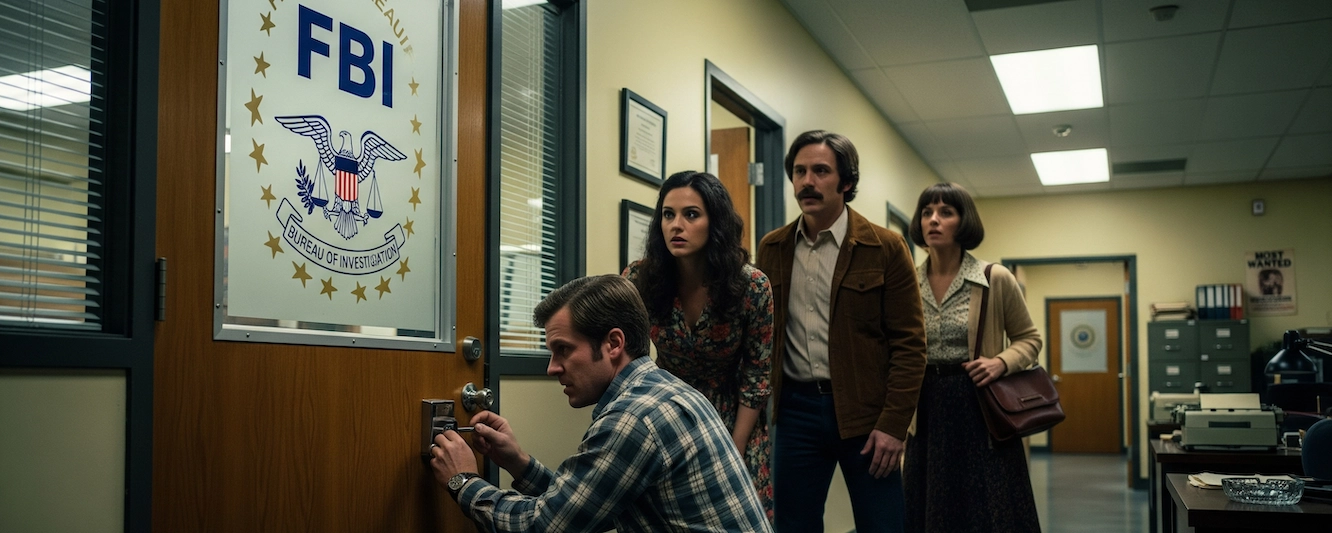
In March 1971, a small group of ordinary citizens put this principle to the ultimate test. In a daring act, they broke into a regional FBI office in Media, Pennsylvania, and uncovered one of the most secretive and abusive surveillance programs in American history. Their bold move rattled America, humiliated the FBI, and forever reshaped the conversation around surveillance.
This is the story of an extraordinary act of defiance. A quiet heist that changed the course of American history. The tale of ordinary people who, through civil disobedience, forced accountability upon one of the most powerful law enforcement agencies in the world.
A Nation on the Brink
To grasp the significance of the Media heist, we must first step back into the turbulent landscape of the United States in the early 1970s.
The nation was in turmoil. The Vietnam War raged on, and the nightly news delivered the grim reality of combat straight into American living rooms, fuelling a massive and ever-growing anti-war movement. The conflict was no longer confined to battlefields abroad; it had become a cultural and generational war at home.
At the same time, the Civil Rights and Black Power movements were shaking the foundations of institutionalised racism. Leaders like Martin Luther King Jr and Malcolm X had forced America to confront centuries of injustice. By the 1970s, newer voices emerged: the Black Panthers, radical student groups, and feminist movements. They all demanded equal rights and deeper social and economic justice.
Government Surveillance
Under J Edgar Hoover, the FBI cast dissent as subversion. Suspicion, polarisation, and fear gripped the nation, creating the perfect backdrop for a dramatic reckoning. A test of accountability that would soon unfold in Media, Pennsylvania.

By the late 1960s, whispers of government surveillance rippled through activist circles. Phones seemed tapped, meetings infiltrated, letters mysteriously delayed or opened. Civil rights leaders spoke of constant harassment. Anti-war organisers noticed strange disruptions at their rallies.
Ordinary Americans began asking dangerous questions. If democracy was truly “by the people and for the people,” why was dissent being criminalised? What limits, if any, bound an agency as powerful as the FBI?
Yet accusations alone were not enough; there was no hard proof. The public had no concrete evidence that their own government was waging a shadow war on its citizens. In that uneasy gap between suspicion and proof, the seed of accountability was planted. One that would soon grow into an unprecedented act of defiance.
Citizens’ Commission to Investigate the FBI
A small band of activists united around a radical idea. They were not hardened criminals or seasoned spies, but ordinary citizens. A mix of teachers, a cab driver, and a social worker. Leading them was William C Davidon, a physics professor at Haverford College who had grown disillusioned with the limits of street protests.

Davidon believed accountability required more than marches and speeches. If the government was illegally targeting dissenters, then proof had to be uncovered, and citizens themselves would have to find it. From this conviction, the Citizens’ Commission to Investigate the FBI was born in late 1970.
The plan was as simple as it was audacious: break into an FBI office, steal its files, and deliver the truth to the press. They reasoned that a smaller, less-guarded location offered the best chance of success. After weeks of reconnaissance, they fixed their sights on the FBI office in Media, Pennsylvania, a quiet suburb of Philadelphia.
For months, they prepared with meticulous care, driven by one unwavering principle: accountability. One member, Bonnie Raines, even posed as a college student eager to work for the FBI, slipping inside to study the office’s layout and security, or the striking lack of it. Her findings confirmed their hopes: no alarm system, only a simple lock on the front door.
Ali vs Frazier: The Perfect Cover
Timing is everything in operations that test the boundaries of power and accountability. The commission knew they needed a distraction. Something that could captivate the nation and divert both law enforcement and public attention. That opportunity came on March 8, 1971, the night of the legendary “Fight of the Century” between Muhammad Ali and Joe Frazier.

The heavyweight title clash was more than just a boxing match; it was the most anticipated sporting event of its era, a cultural spectacle guaranteed to dominate headlines and hold millions in its grip. For the activists, it was the perfect cover for their daring act of civil disobedience.
The plan was simple but profound. While America’s eyes were fixed on two champions battling in the ring, the Citizens’ Commission would slip into a quiet office building in suburban Media, Pennsylvania, and land their own punch for truth and accountability.
Ordinary Citizens, Extraordinary Courage
As the first round of the Ali-Frazier fight thundered through radios and televisions across America, the team was already in motion. They parked their getaway car several blocks away and walked toward the quiet office building in Media, Pennsylvania. Keith Forsyth, the group’s designated lock picker, stepped forward.
With steady hands, Forsyth used a crowbar to pry open the main entrance. Minutes later, he expertly picked the lock to the FBI office itself. Once inside, the group moved swiftly and silently. Their mission was not to cherry-pick files but to take everything. Accountability demanded a full record, not fragments.
Suitcases in hand, they methodically emptied filing cabinets, hauling away more than a thousand documents. In less than an hour, they had pulled off one of the most audacious acts of civil disobedience in American history. This was no heist for money or glory. It was a heist for accountability. That night, eight ordinary citizens humbled the most powerful law enforcement agency in the world.
COINTELPRO Exposed
The stolen files turned out to be a treasure trove of shocking revelations. What emerged from the files was a program so secret and so corrosive that it shook the American establishment to its core: COINTELPRO (COunterINTELligence PROgram).
A sprawling domestic intelligence operation designed to surveil, harass, and disrupt American citizens who dared to dissent. The documents revealed a wide-ranging strategy of manipulation and suppression, including:
- Wiretapping phones and intercepting mail from activists and journalists.
- Infiltrating civil rights groups, planting informants to spread mistrust and division.
- Orchestrating smear campaigns to discredit leaders like Martin Luther King Jr, even attempting to push him toward despair and self-destruction.
- Targeting the Black Panthers, anti-war organisers, and feminist movements with fabricated evidence and intimidation tactics.
The files stripped away the FBI’s veneer of legitimacy. They showed an institution not defending democracy, but undermining it. Under Hoover, the Bureau had become a secretive machine operating without accountability, weaponising its immense power against the very citizens it was sworn to protect.
Going Public
The Citizens’ Commission mailed the stolen files anonymously to newspapers and members of Congress, placing accountability squarely into the hands of those who could no longer look away. Yet at first, hesitation reigned. Publishing classified FBI documents was a dangerous step, one that could provoke legal retaliation and challenge the very boundaries of press freedom.
Then, on March 24, 1971, defying the climate of fear, The Washington Post reporter Betty Medsger, who had been sent the files, broke this story. For the first time, ordinary Americans learned that their government was not merely watching enemies abroad, but secretly spying on its own people. Not for safety, but for control.

The impact was immediate and explosive. Citizens were outraged by the betrayal. Politicians demanded investigations. And the once-untouchable reputation of J Edgar Hoover’s FBI began to crack, as the Bureau faced a reckoning it had long evaded. The pursuit of accountability had begun in earnest.
Demanding Accountability
The FBI assigned more than 200 agents to track down the burglars. Yet despite years of effort, the culprits were never found, and their identities remained hidden for over four decades. When the statute of limitations finally expired, some members chose to reveal themselves in 2014 through journalist Betty Medsger’s groundbreaking book The Heist.
Public outrage grew impossible to ignore, and Congress was forced to confront the abuses of the FBI and the CIA. This culminated in the historic Church Committee hearings of 1975, which pulled back the curtain on even more misconduct and recommended sweeping reforms.
COINTELPRO was officially shut down in 1971. Permanent congressional oversight committees were created to ensure intelligence agencies could no longer operate in unchecked secrecy. And in 1978, the Foreign Intelligence Surveillance Act (FISA) was passed, requiring judicial approval for surveillance activities.
Each of these steps reinforced the principle that accountability is not optional in a democracy. It is essential for its survival.
The Lasting Significance of the Heist
The 1971 Media heist remains one of the most daring acts of civil disobedience in American history. It forced a reckoning, exposing hidden abuses and proving that even the most powerful institutions must answer to the principle of accountability.
The actions of the Citizens’ Commission directly spurred legislative reforms and ushered in greater transparency in government operations. Their message was clear: accountability is not just about having rules on paper, it is about enforcing those rules and ensuring real consequences when they are broken.
The legacy of the Media heist still echoes today, reminding us of the fragility of privacy and the ongoing need for vigilance. Power unchecked is power abused, and accountability is not a choice; it is the very safeguard of liberty.
I am positive that you found this story interesting and useful!
Please subscribe to my blog by filling in your details below:
My blog has countless such articles and stories to guide you and quench your thirst for knowledge.
If you enjoy videos, you can watch interesting thoughts and stories on my YouTube channel.
You can also follow me on X and Facebook to read more such stories and posts.
PS: Gemini and/or ChatGPT have been used to create parts of this post.
Leave a Reply