

50-WORD SUMMARY: Market chaos tests every leader’s judgement, focus and execution. Discover how control, mental immunity and the CLEAR framework help leaders separate signal from noise, manage uncertainty, protect priorities and make better decisions. Learn from Alan Mulally how disciplined responses, adaptive leadership and sound decision-making turn uncertainty into opportunity.
At 8:15 on a Monday morning, a business leader faces three problems. A key supplier has raised prices overnight. A political announcement has unsettled the market. A major customer may cancel an order.
His phone keeps buzzing. His team wants answers. His calendar is packed.
He can spend the day reacting to every disturbance, or he can pause, separate facts from fears and decide what deserves his attention.
Both choices consume time. Only one protects his ability to lead.
Welcome to modern business, where uncertainty is no longer an occasional visitor. It has become a permanent resident.
A leader’s challenge is not to eliminate chaos, but to develop mental immunity so external turbulence doesn’t dictate internal priorities. This begins with understanding what we can control, what we can influence and what we must accept.
Why Has the Marketplace Become So Chaotic?
Today, a conflict thousands of miles away can affect fuel prices and freight costs. A social media post can damage a brand before its communications team has assembled. AI can transform an industry’s competitive landscape before established players have reviewed their annual plans.
The VUCA environment, characterised by volatility, uncertainty, complexity and ambiguity, has become an everyday operating reality.
Three forces intensify the problem.

Information Overload: Leaders receive constant updates, opinions and predictions. Finding information is easy. Identifying what deserves attention is difficult.
Interconnected Decisions: A pricing change affects margins, customer behaviour, inventory and cash flow. One disruption can spread across the organisation, producing consequences that were difficult to anticipate.
Growing Expectations: Customers demand faster responses, investors expect results and employees look to leaders for certainty. Unfortunately, the demand for immediate answers often exceeds the availability of reliable facts.
The problem, however, is not necessarily the market. It is a leader’s inability to distinguish a meaningful threat from temporary noise.
When everything appears urgent, strategic thinking becomes the first casualty.
How Chaos Disrupts a Leader’s Rhythm
Leaders require time to think, decide, execute and learn. Chaos breaks this rhythm by repeatedly pulling attention towards immediate disturbances.
Three consequences follow.

Reactive Decision-making: Under pressure, people favour immediate relief over long-term value. A leader may approve unnecessary discounts to rescue monthly sales when the real problem lies in poor lead conversion or weak follow-up.
Cognitive Overload: Every unresolved issue occupies mental space. Constantly switching between subjects makes sustained concentration difficult and reduces the quality of judgement.
Organisational Anxiety: Teams observe their leader’s behaviour. If priorities change after every new development, employees learn that plans are temporary. They stop committing to execution and wait for the next instruction.
This is how market turbulence becomes internal instability. A supplier delay becomes a production crisis. Poor communication then turns the resulting customer-service problem into a reputational risk.
The leader may not have created the disruption, but the response can amplify it.
The answer is not indifference. It is disciplined control over attention, judgement and response.
Mental Immunity: The New Leadership Advantage
Simply put, mental immunity is a leader’s ability to handle uncertainty, pressure and conflicting information without allowing them to dictate every thought or action.
This does not mean suppressing emotions or pretending everything is fine. It means recognising an emotional response without automatically acting on it.
Imagine receiving an email alleging a serious operational failure. Your immediate reaction might be frustration or a desire to find someone responsible. Mental immunity creates a gap between the message and response.
A leader must use that gap to ask three questions:
- What do I know to be true?
- What am I assuming?
- What action would improve the situation?
A missed target is a fact. The belief that the business is collapsing may be an interpretation. Treating the two as identical can lead to disproportionate action.
The objective is not absolute control over circumstances. That is impossible. It is the ability to direct your attention, evaluate evidence and choose your response.
The CLEAR Framework for Mental Immunity
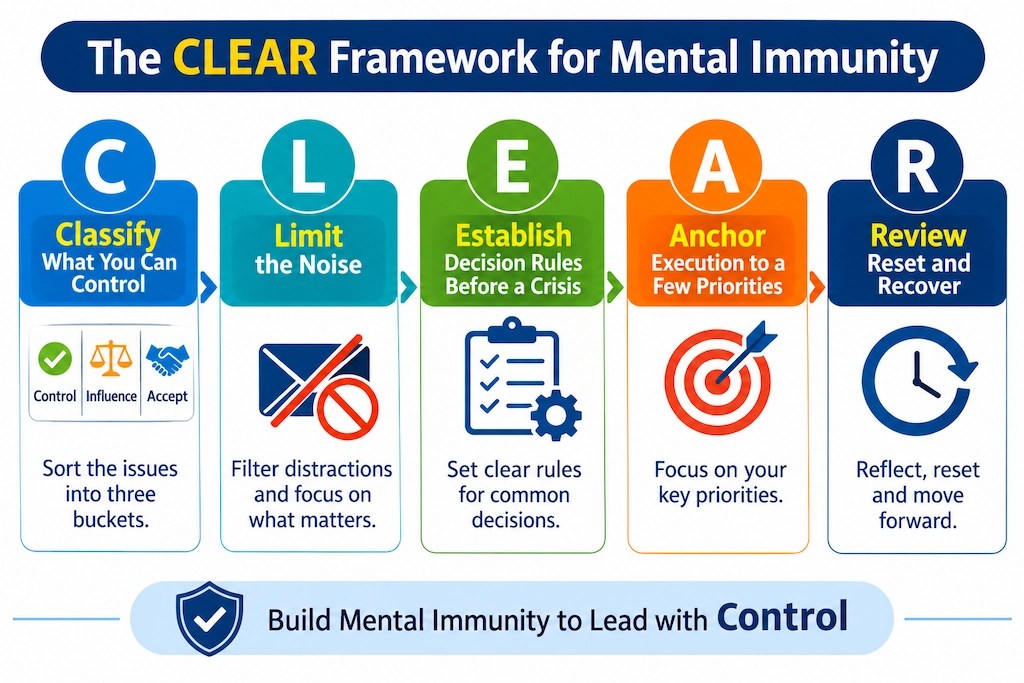
Mental resilience becomes useful when translated into repeatable behaviour. The CLEAR framework offers five practical steps for protecting focus and control during market turbulence.
C: Classify What You Can Control
Divide a problem into three categories.
- Control: Your decisions, preparation, communication, spending approvals and operating discipline.
- Influence: Supplier negotiations, employee engagement, customer confidence and stakeholder expectations.
- Accept: Unexpected political decisions, competitors’ actions and events beyond your reasonable control.
Consider a transportation business facing a sudden increase in fuel prices. Its owner cannot control international crude prices, but they can improve routing efficiency, renegotiate selected contracts, reduce unproductive journeys and revise pricing where commercially justified.
Practical trick: Draw three columns labelled Control, Influence and Accept. Place each aspect of a problem in the appropriate column before deciding what to do.
L: Limit the Noise
Many leaders begin their mornings by opening email, messaging applications and news feeds. Other people’s priorities then determine the first hour of their day.
Instead, establish deliberate controls and information boundaries. Review operational dashboards at fixed times, create a separate channel for genuine emergencies and ask teams to escalate exceptions rather than send routine updates throughout the day.
A regional operations head managing 50 locations does not need a message for every delayed appointment. A dashboard showing overdue cases, customer impact and recurring exceptions can reveal where intervention is necessary.
The leader retains visibility without becoming a bottleneck.
Practical trick: Before consuming an update, ask, “Could this information change a decision I need to make today?” If not, defer it.
E: Establish Decision Rules Before a Crisis
Predefined decision rules reduce that risk.
A retailer might establish a minimum contribution margin below which discounts require approval. A manufacturer might define inventory thresholds that trigger replenishment. A service organisation might specify when customer complaints must be escalated.
These rules preserve judgement for situations that genuinely require it.
Consider a business facing weakening demand. Without financial guardrails, managers may cut prices indiscriminately to protect sales volumes. With agreed margin floors and approval limits, they can test targeted offers without sacrificing profitability unnecessarily.
Practical trick: Identify five recurring decisions that cause confusion. Define decision owners, approval limits and escalation conditions for each.
A: Anchor Execution to a Few Priorities
A leader cannot prevent every disruption but can prevent every disruption from becoming a new priority.
Suppose a business is working to improve customer retention, reduce service turnaround time and strengthen cash collection. A competitor’s new campaign suddenly attracts attention, and the team wants an immediate response.
Before diverting resources, ask whether the campaign threatens an existing priority, what evidence supports that concern and what work would be postponed if a response were necessary.
This protects execution from constant strategic switching.
Practical trick: Identify three important outcomes at the beginning of each week. When an unexpected demand arrives, decide whether it replaces, supports or waits behind any one of them.
R: Review, Reset and Recover
Mental immunity does not mean remaining calm all the time. It means recovering perspective after pressure disrupts it.
A short daily review can help:
- What changed today?
- Which decisions were driven by evidence and which by emotion?
- What deserves attention tomorrow?
- What can I stop worrying about because no useful action is available?
The purpose is not to replay mistakes but to extract lessons.
Review the business as well. Are customer complaints increasing? Is cash collection deteriorating? Are operational exceptions becoming more frequent? Is the same problem repeatedly returning?
Mental discipline must never become an excuse to dismiss inconvenient evidence. Sometimes the right response is to change the plan. The important distinction is whether the change is supported by facts or driven by the loudest voice.
Practical trick: Reserve 15 minutes at the end of each working day to record one important decision, one lesson and one priority for tomorrow.
How Alan Mulally Regained Control at Ford

When Alan Mulally became Ford’s chief executive in 2006, the company faced heavy losses, a fragmented product portfolio and intense competitive pressure. The global financial crisis soon made the situation even more difficult.
Mulally could not control the economic downturn, but he could change how Ford identified problems and executed its strategy.
He introduced a structured business review process in which leaders reported performance consistently. Problems were expected to surface rather than remain hidden until they became crises. Teams reviewed evidence, identified obstacles and coordinated corrective action.
This strengthened accountability and reduced the tendency for departments to protect themselves at the expense of the organisation.
Ford’s recovery involved several strategic and financial factors. Nevertheless, Mulally’s approach illustrates an important lesson:
When the external environment becomes unpredictable, disciplined internal processes become even more valuable.
He did not eliminate uncertainty. He improved the organisation’s ability to respond.
When Mental Immunity Becomes Isolation
It is important to note that mental immunity should make a leader more receptive to evidence, not less. It should reduce emotional overreaction while preserving curiosity, empathy and the willingness to change direction.
A leader who blocks every distraction may also block valuable information. Someone who becomes emotionally detached may mistake silence for stability. A leader who insists on independent judgement may stop listening to people who recognise risks that others have missed.
Consider a manufacturing head who refuses to let a delayed shipment disrupt the production plan. The approach appears disciplined until the warehouse reports that the missing components are essential to a safety-critical assembly.
The right response is to investigate the warning, assess its credibility and adapt the plan.
The objective is to reduce noise without suppressing signals. A leader can achieve this by inviting dissentduring important decisions. They should encourage employees to report bad news early, and separate criticism of an idea from criticism of the person presenting it.
Conclusion: Own Your Response, Not the Chaos
The modern marketplace will continue to surprise us. Political developments will change assumptions, competitors will make unexpected moves, and technology will disrupt established business models.
Waiting for a quieter environment before developing better leadership habits is a losing strategy.
Absolute control over the marketplace is an illusion. Meaningful control over attention, decisions, resources and execution is achievable.
Start small. Classify what you can control. Limit unnecessary noise. Establish decision rules. Protect your priorities. Review your actions and remain open to evidence that challenges your assumptions.
Then extend these habits to your team and operating systems.
The goal is not to become a leader who never feels pressure. It is to become one who can think clearly under pressure, act decisively without rushing and change direction without losing purpose.
The market may create the chaos. Your response determines how much of it enters your business.
Enjoyed this perspective? Drop your email below, subscribe to my blog and receive regular insights on strategy, leadership, and sustainable systems.
Follow along: Catch short-form thoughts and business storytelling on X and Facebook.
Read the books: Find my work on Amazon covering power, ambition, and the choices that shape success.


Leave a Reply